Yongming Yanshou
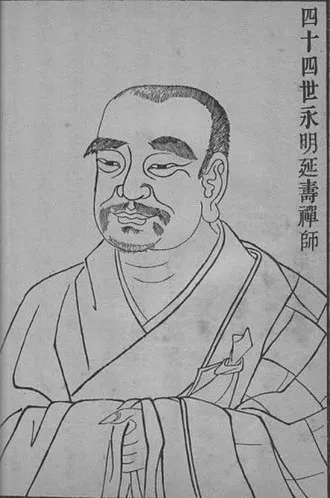
Yongming Yanshou
904 – 975
Yongming Yanshou (永明延壽, 904–975) was a Dharma heir of Tiantai Deshao and abbot of Yongming Temple at West Lake in Hangzhou under the patronage of the last Wuyue king Qian Chu. He is the most consequential synthesising thinker of late-tenth-century Chinese Buddhism: his hundred-fascicle *Zōngjìnglù* (宗鏡錄, "Records of the Mirror of the [One-Mind] Source") draws on Chan, Tiantai, Huayan, Yogācāra, Vinaya and Pure Land sources to argue that all are reducible to the single Mind-only doctrine, and his *Wànshàn Tóngguī Jí* (萬善同歸集, "All Good Practices Returning to the Same Refuge") promotes a deliberate combination of Chan investigation with Pure Land *nianfo* practice[1].
Yanshou's *shuang-xiu* ("dual cultivation") of Chan and Pure Land became, over the next centuries, one of the most influential templates for mainstream Chinese Buddhist practice — the working background of Ming-Qing Chan and one of the patterns later carried into Korea and Japan[2]. The combination of Pure-Land devotion with Chan investigation that defines so much of late-imperial East Asian Buddhism descends in large measure from his synthesis[3].
Names
Teachers and lineage of Yongming Yanshou
Teacher / root master:
Teachings
Yanshou taught: "If you have Chan and Pure Land together, you are like a tiger with horns—in the present life a teacher of men, in the future life a Buddha or patriarch. If you have Chan but no Pure Land, nine out of ten will go astray—if the bardo death comes on you, you will follow your karma wherever it leads. If you have Pure Land but no Chan, ten thousand practice, ten thousand go—if you see Amitabha, why worry about not awakening? But if you have neither Chan nor Pure Land—iron bed, bronze pillars—ten thousand kalpas, a thousand births, there is nothing to rely on."
Yanshou is said to have performed one hundred acts of virtue every day, including reciting the names of Buddhas, practicing meditation, releasing living creatures, copying sutras, worshipping at stupas, giving food to the hungry, and offering incense. He said: "Each act by itself is a drop of water. Only when the sea is filled drop by drop does the ship of liberation sail. Do not ask which drop was final—every drop was necessary."
Chan and Pure Land are not two separate paths. Chan is the mind of the Buddha, and Pure Land is the land of the Buddha—how can these be divided? When you sit in meditation and see your own nature, the Pure Land appears right here and now. When you call the name of Amitabha with a concentrated mind, that is itself Chan practice. Those who practice Chan and dismiss Pure Land have lost half the teaching. Those who practice Pure Land and dismiss Chan have lost the other half. The complete teaching unites both: the direct pointing of Chan and the compassionate gateway of Pure Land.
With Chan and with Pure Land, one is like a tiger with horns—in this life a teacher of humankind, in the next a Buddha or patriarch. With Chan but without Pure Land, nine out of ten will stumble on the road—without a guide at the moment of death, even a master may lose the way. Without Chan but with Pure Land, if ten thousand practice, ten thousand will arrive—when Amitabha appears, one is born in the Western Land. Without Chan and without Pure Land, the iron bed and the copper pillars await—for ten thousand kalpas, no end to suffering.
Other masters in Fayan
Master Record Sources
904-975
Yongming Yanshou
Qingyuan line
- nameZen Editorial Overlay - Originals Curation
Yongming Yanshou
- teachersZen Editorial Overlay - Originals Curation
Tiantai Deshao