Fayan
Chan
Fayan
法眼宗
Branch of Qingyuan line
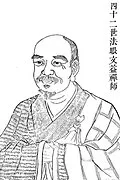
The Fayan school (法眼宗) is one of the Five Houses of Chan, founded by Fayan Wenyi (885–958), a dharma heir of Luohan Guichen in the lineage of Xuefeng Yicun and Shitou Xiqian[1]. The school is named after Fayan's monastery on Mount Qingliang in Jinling (modern Nanjing). During the Five Dynasties and Ten Kingdoms period, the Fayan school became the dominant Chan school in the Southern Tang and Wuyue kingdoms[1]. Fayan Wenyi's teaching emphasized the harmony of the three teachings—Buddhism, Confucianism, and Daoism—and sought to place culture and learning in service of insight rather than rejecting them. His Ten Admonishments for the Lineage (Zongmen shigui lun) critiqued the decline of Chan practice in his era[1]. Key figures include Tiantai Deshao (891–972), who served as national preceptor of Wuyue and revitalized the Tiantai school alongside his Chan teaching[2], and Yongming Yanshou (904–975), regarded as the third Fayan patriarch, who authored the monumental Zongjing lu (Records of the Mirror of the Source) and initiated the Chan-Pure Land synthesis that shaped all subsequent Chinese Buddhism[3]. The Fayan school was the first Chan lineage to gain recognition at the Song court, but it did not survive as an independent institution beyond the early Song dynasty, its methods and insights absorbed into the Linji tradition.
Meditation practice
The Fayan school integrated doctrinal understanding with direct Chan realization, drawing on Huayan philosophy’s vision of the mutual interpenetration of all phenomena[1]. Practice was not reduced to scholasticism, but it refused the anti-intellectual pose of treating study as an obstacle: meditation, scriptural reflection, and dialectical questioning belonged together. Fayan Wenyi’s question ‘the myriad dharmas return to the one; where does the one return?’ exemplifies this training, in which conceptual inquiry is pushed until it opens into contemplative insight[1]. Yongming Yanshou extended the same synthetic method by combining Chan meditation with Pure Land recitation and broader Mahayana study, creating a practice culture in which contemplation, devotion, and doctrine reinforce one another[3].
Key texts
- Ten Admonishments for the Lineage
'Zongmen shigui lun' — Fayan's critique of ten characteristic failings of Chan monks of his era, from shallow imitation of encounter-dialogue style to neglect of scripture. The founder's own manual for preventing the school's decline.
- Records of the Mirror of the Source
A hundred-fascicle synthesis in which the third Fayan patriarch reconciles Chan with Huayan, Tiantai, Yogācāra, and Pure Land thought. Initiated the Chan–Pure Land synthesis that dominated later Chinese Buddhism.
Key concepts
- Interpenetration of dharmas
'Shi-shi wu-ai' — the Huayan doctrine of the mutual non-obstruction of all phenomena, made the contemplative horizon of Fayan practice. Every moment interpenetrates every other; realization is the non-conceptual seeing of this.
- Chan–Pure Land synthesis
'Practicing Chan and Pure Land together' — the dual discipline codified by Yongming Yanshou: seated meditation paired with nianfo recitation, treating them as two entry points into one awakened mind. The inheritance that later shaped Ōbaku Zen.
In the words of the masters
- Six Attributes of One House
Universal and particular, identical and different, integration and disintegration — six attributes of one house. The student who lives in the house need not name them; the rooms work whether or not he has the words.
Masters in this branch
Sibling branches of Qingyuan line
Sources in use
- Chart of the Chan Ancestors
- Zen Editorial Overlay - Originals Curation