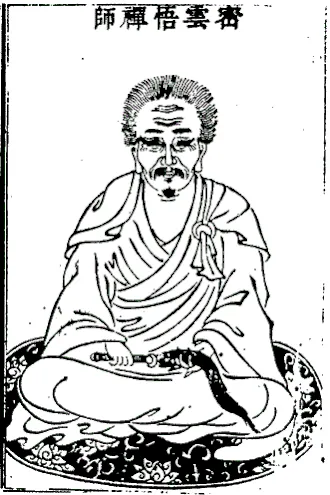
Miyun Yuanwu

Miyun Yuanwu
1566 – 1642
Miyun Yuanwu (1566–1642) was arguably the most influential figure in institutional Chinese Buddhism of the seventeenth century, the fountainhead from whom virtually all subsequent Linji Chan transmission flowed. Born in Changzhou prefecture, Jiangsu Province, from humble peasant stock, he decided to become a monk after reading the Platform Sutra of the Sixth Patriarch. In 1595, at about twenty-eight, he left his wife and children to become a disciple of Huanyou Zhengchuan, receiving full ordination in 1598.
Miyun became famous for his distinctive revival of the "beating and shouting" methods of the original Linji Yixuan — a sharp contrast to the gentle, syncretic Buddhism of the late Ming. His Tiantong lineage insisted on strict orthodoxy, doctrinal purity, and rigorous monastic practice. He received dharma transmission in 1611 and held abbacies at numerous prestigious monasteries, including the great Tiantong monastery. His most notable students included Feiyin Tongrong, Muchen Daomin, and through Feiyin, Yinyuan Longqi, who emigrated to Japan and founded the Ōbaku school. Through Muchen's line, the dharma was transmitted to Vietnam via Nguyên Thiều. He died in 1642 at age seventy-six, just as the Ming dynasty was collapsing. His legacy ensured that the Linji school dominated Chinese Buddhism for centuries.
Master Record Sources
No citations attached yet.