Linji
Chan
Linji
臨濟宗
Branch of Nanyue line
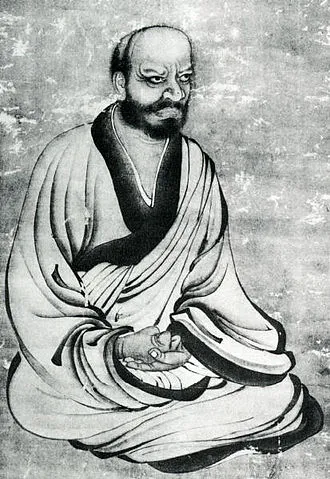
The Linji school (臨済宗) is the most dynamic and influential of the Five Houses of Chan, founded by Linji Yixuan (d. 866) in the lineage of Mazu Daoyi through Baizhang Huaihai and Huangbo Xiyun[1]. Linji's teaching is characterized by fierce directness—he used shouts (katsu), blows, and paradoxical exchanges to shatter students' conceptual thinking and precipitate immediate awakening[1]. His 'True Person of No Rank' teaching and his four-fold classification of shouts became foundational for the school[1]. During the Song dynasty, the Linji school divided into the Yangqi and Huanglong branches, with the Yangqi line eventually becoming dominant[2]. The school produced the two greatest koan collections: the Blue Cliff Record (Yuanwu Keqin's commentary on Xuedou Chongxian's verses)[3] and the Gateless Barrier (Wumen Huikai's forty-eight cases)[4]. Dahui Zonggao championed the huatou (keyword) method of koan practice—concentrating on a single critical phrase until all conceptual thinking is exhausted—which became the standard Linji approach[5]. Through transmission to Japan, Korea, and Vietnam, the Linji school became the most geographically widespread form of Chan/Zen Buddhism[6].
Meditation practice
The Linji school’s primary meditation method is huatou (話頭) practice, championed by Dahui Zonggao, in which the practitioner takes up a single critical phrase—such as ‘Mu’ or ‘What is this?’—and returns to it with gathering intensity until discursive mind is exhausted in great doubt[5]. This is not mere repetition: the phrase becomes a living point of inquiry that absorbs body and mind. Practice is then tested and deepened in rushi (face-to-face encounter), where the master may respond with shouts, paradoxes, blows, or abrupt questions intended to expose whether realization is embodied or merely conceptual[1]. Linji training therefore combines seated investigation with high-pressure personal interview aimed at discovering the ‘True Person of No Rank’ directly[1].
Prominent masters
Key texts
- Record of Linji
The sayings of the school's founder — four shouts, the True Person of No Rank, the four processes of 'guest and host.' The single most-studied yulu in the Chan/Zen corpus; every later Linji/Rinzai teacher pivots off these pages.
- Blue Cliff Record
One hundred cases with Xuedou's verses and Yuanwu's commentary, assembled at a Linji monastery. Dahui famously burned the blocks so students would meet the koans directly rather than through literary polish; the text has shaped Chan and Zen koan study ever since.
- Gateless Barrier
Forty-eight koans — Zhaozhou's Mu, 'The flag is moving,' 'One hand,' and more — each with a pointing verse. Compiled at a Linji monastery and the standard entry curriculum for huatou practice.
- Letters of Dahui
Dahui's correspondence with officials and lay practitioners in which he articulates kanhua chan (huatou practice) as the core Linji method and polemicizes against 'dead' silent illumination. The founding manifesto of koan-as-meditation.
Key concepts
- Huatou
'The head of a saying' — a single critical phrase (Mu, 'What is this?', 'Who drags this corpse?') taken up as the sole object of meditation. The defining Linji method as systematized by Dahui Zonggao.
- Kanhua chan
'Observing-the-phrase Chan' — Dahui's name for the formalized huatou method. Deliberately contrasted with Hongzhi's silent-illumination style, though modern practice increasingly unites them.
- True Person of No Rank
Linji's famous pointing: 'On this lump of red flesh there is a true person of no rank, constantly going in and out of the faces of every one of you.' The invitation to recognize awakened mind as already operative in perception.
- Great Doubt
The intense, body-pervading questioning that the huatou is meant to produce. Later codified (especially by Hakuin) as one of the Three Essentials: great faith, great doubt, great determination.
- Four Shouts
Linji's typology of katsu: sometimes it cuts like a sword, sometimes it crouches like a lion, sometimes it probes like a pole, sometimes it does not function as a shout at all. The prototype for all later pedagogical use of shouts and blows.
In the words of the masters
- When You Meet a Swordsman
When you meet a swordsman, draw your sword. Do not offer a poem to someone who is not a poet.
- Cease to Cherish Opinions
Do not search for the truth. Only cease to cherish opinions.
- Every Season Is a Good Season
In spring, hundreds of flowers. In autumn, the moon. In summer, a cool breeze. In winter, snow. If useless things do not clog your mind, every season is a good season.
- Make Your Mind Bright
Just make your mind bright and clear. One day you will get it, and you will know it was always right there.
- One Mind, Nothing Else
All the Buddhas and all sentient beings are nothing but the One Mind — there is no other dharma. This mind has been there from the beginning. It is not born and does not die.
- The Gateless Barrier
The Great Way has no gate — a thousand paths enter it. Once you pass through the barrier, you walk freely between heaven and earth.
Masters in this branch
- Muzhou Daoming
- Xinghua Cunjiang
- Linji Yixuan
- Nanyuan Huiyong
- Huanglong Huinan
- Wuzu Fayan
- Zhenjing Kewen
- Baofeng Kewen
- Yuanwu Keqin
- Dahui Zonggao
- Mian Xianjie
- Wumen Huikai
- Miyun Yuanwu
- Feiyin Tongrong
- Juefan Huihong
- Langye Huijue
- Baoshou Yanzhao
- Baizhang Niepan
- Taiping Huiqin
- Licun
- Yunan Kewen
- Fenyang Shanzhao
- Baoning Renyong
- Fengxue Yanzhao
- Xiyuan Siming
- Yuean Shanguo
- Kaifu Daoning
- Doushuai Congyue
- Dahong Zuzheng
- Huguo Jingyuan
- Dayu Shouzhi
- Huangbo Xiyun
- Cuiyan Kezhen
- Tongfeng Anzhu
- Sansheng Huiran
- Yuelin Shiguan
- Shishuang Chuyuan
- Xita Guangmu
- Shoushan Xingnian
- Huanglong Huiji
- Xuan Huaichang
- Zifu Rubao
- Huoan Shiti
- Huitang Zuxin
Sibling branches of Nanyue line
Major works of this school
Sources in use
- Chart of the Chan Ancestors
- Zen Editorial Overlay - Originals Curation
- Terebess Asia Online - Zen Encyclopaedia
- Wikipedia - Zen Lineage Charts