Nanquan Puyuan
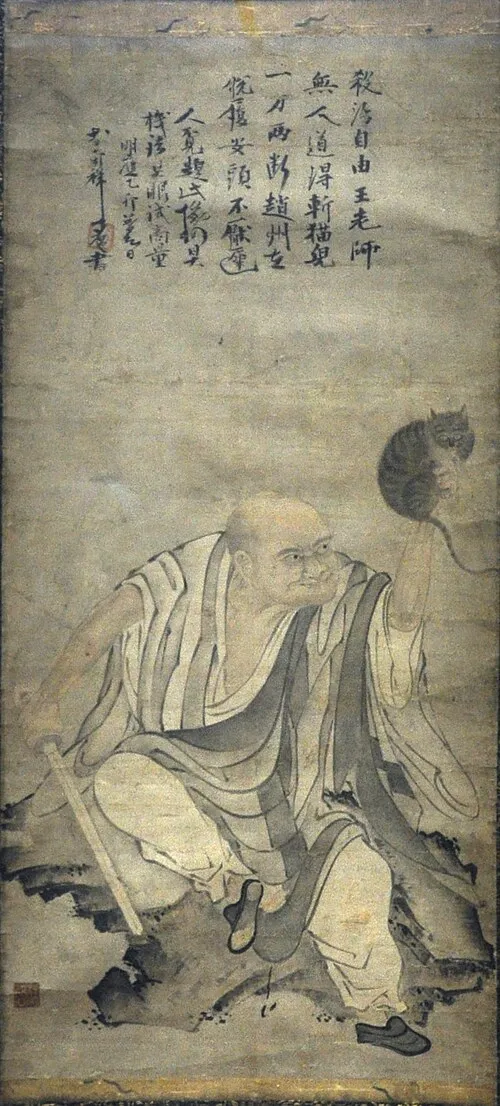
Nanquan Puyuan
748 – 835
Nanquan Puyuan was a disciple of Mazu Daoyi who spent thirty years on Nanquan Mountain without descending to the world below[1]. He is known for his deeply unconventional teaching and for his famous student Zhaozhou Congshen, with whom he engaged in some of the most celebrated exchanges in Chan history[2]. Nanquan's teaching style combined radical directness with apparent paradox, constantly undercutting any fixed view of practice or attainment[1].
The most famous story about Nanquan involves his cutting a cat in two to resolve a dispute among monks about ownership. He afterward asked Zhaozhou what he would have done. Zhaozhou put his sandals on his head and walked out. Nanquan said: "If you had been here, I could have saved the cat." This story, recorded as case 63 in the Blue Cliff Record, points to the impossibility of grasping reality through conceptual categories[3]. Nanquan's life on the mountain and his Dharma encounters with his many students established him as one of the towering figures of the Tang Chan renaissance[1].
Names
Disciples of Nanquan Puyuan
Teachers and lineage of Nanquan Puyuan
Teacher / root master:
Teachings
Nansen saw the monks of the eastern and western halls fighting over a cat. He seized the cat and told the monks: "If any of you say a good word, you can save the cat." No one answered. So Nansen boldly cut the cat in two pieces. That evening Joshu returned and Nansen told him about this. Joshu removed his sandals and, placing them on his head, walked out. Nansen said: "If you had been there, you could have saved the cat." Mumon’s comment: Why did Joshu put his sandals on his head? If anyone answers this question, he will understand exactly how Nansen enforced the edict. If not, he should watch his own head. Had Joshu been there, He would have enforced the edict oppositely. Joshu snatches the sword And Nansen begs for his life.
A monk asked Nansen: "Is there a teaching no master ever preached before?" Nansen said: "Yes, there is." "What is it?" asked the monk. Nansen replied: "It is not mind, it is not Buddha, it is not things." Mumon’s comment: Old Nansen gave away his treasure-words. He must have been greatly upset. Nansen was too kind and lost his treasure. Truly, words have no power. Even though the mountain becomes the sea, Words cannot open another's mind.
Nansen said: "Mind is not Buddha. Learning is not the path." Mumon’s comment: Nansen was getting old and forgot to be ashamed. He spoke out with bad breath and exposed the scandal of his own home. However, there are few who appreciate his kindness. When the sky is clear the sun appears, When the earth is parched rain will fall. He opened his heart fully and spoke out, But it was useless to talk to pigs and fish.
- dialogueOrdinary Mind Is the Way
Zhaozhou asked Nanquan, "What is the Way?" Nanquan said, "Ordinary mind is the Way." Zhaozhou asked, "Should I try to direct myself toward it?" Nanquan said, "If you try to direct yourself toward it, you turn away from it." Zhaozhou asked, "If I do not try, how will I know it is the Way?" Nanquan said, "The Way does not belong to knowing or not-knowing. Knowing is delusion; not-knowing is blankness. If you truly reach the genuine Way, you will find it as vast and boundless as outer space. How can this be discussed at the level of right and wrong?" At these words, Zhaozhou was suddenly awakened.
- dialogueNanquan Kills the Cat
Nanquan saw the monks of the eastern and western halls fighting over a cat. He seized the cat and said, "If any of you can say a word of Zen, you will save the cat. Otherwise I will kill it." No one could answer. Nanquan cut the cat in two. That evening Zhaozhou returned from outside and Nanquan told him what had happened. Zhaozhou removed his sandals, placed them on his head, and walked out. Nanquan said, "If you had been there, you could have saved the cat."
- dialogueA Flower in a Dream
The official Lu Geng said to Nanquan, "The teaching of Sengzhao says, 'Heaven and earth and I share one root; the myriad things and I are of one body.' This is marvelous indeed!" Nanquan pointed to a flower in the garden and said, "People of this age see this flower as if in a dream."
Other masters in Nanyue line
Master Record Sources
748-835
Nanquan Puyuan
Qingyuan line
- koan_refsChart of the Chan Ancestors
28,31,40 9,16,23 14,19 20,23 63,64,69 69,91,93 27,34
- nameZen Editorial Overlay - Originals Curation
Nanquan Puyuan
- teachersZen Editorial Overlay - Originals Curation
Mazu Daoyi