Zhaozhou Congshen
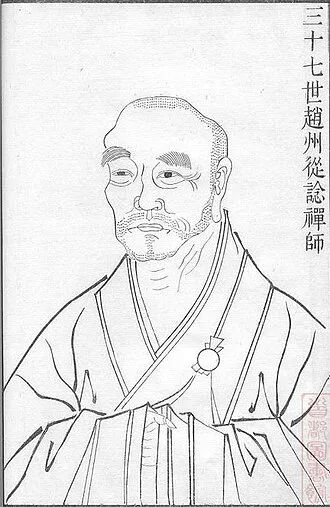
Zhaozhou Congshen
778 – 897
Zhaozhou Congshen was one of the greatest Tang dynasty Chan masters and the subject of more koans than perhaps any other figure in the tradition[1]. He was a student of Nanquan Puyuan and lived to the extraordinary age of one hundred and twenty, practicing and teaching for most of his long life. He is said to have first met Nanquan when he was a young monk and to have experienced his initial awakening in their first encounter[1].
Zhaozhou's most famous teaching is recorded in the first case of the Gateless Barrier (Wumenguan): a monk asked him whether a dog has Buddha nature, and Zhaozhou replied "Mu" (No, or Nothing)[2]. This single syllable became the gateway koan of the Rinzai tradition, the first koan given to most students beginning formal koan practice[3]. His other famous exchanges—"Have you had breakfast? Then go wash your bowl." and "Does the oak tree have Buddha nature?" and his description of Zhaozhou bridge—demonstrate his ability to point to the ordinary as the sacred without making anything mystical or special. His collected sayings show a mind of inexhaustible patience and precision[1].
Names
Disciples of Zhaozhou Congshen
Teachers and lineage of Zhaozhou Congshen
Teacher / root master:
Teachings
- koanJoshu's Dog
A monk asked Joshu, a Chinese Zen master: "Has a dog Buddha-nature or not?" Joshu answered: "Mu." † Mumon's comment: To realize Zen one has to pass through the barrier of the patriarchs. Enlightenment always comes after the road of thinking is blocked. If you do not pass the barrier of the patriarchs or if your thinking road is not blocked, whatever you think, whatever you do, is like a tangling ghost. You may ask: What is a barrier of a patriarch? This one word, Mu, is it. This is the barrier of Zen. If you pass through it you will see Joshu face to face. Then you can work hand in hand with the whole line of patriarchs. Is this not a pleasant thing to do? If you want to pass this barrier, you must work through every bone in your body, through every pore of your skin, filled with this question: What is Mu? and carry it day and night. Do not believe it is the common negative symbol meaning nothing. It is not nothingness, the opposite of existence. If you really want to pass this barrier, you should feel like drinking a hot iron ball that you can neither swallow nor spit out. Then your previous lesser knowledge disappears. As a fruit ripening in season, your subjectivity and objectivity naturally become one. It is like a dumb man who has had a dream. He knows about it but he cannot tell it. When he enters this condition his ego-shell is crushed and he can shake the heaven and move the earth. He is like a great warrior with a sharp sword. If a Buddha stands in his way, he will cut him down; if a patriarch offers him any obstacle, he will kill him; and he will be free in his way of birth and death. He can enter any world as if it were his own playground. I will tell you how to do this with this koan: Just concentrate your whole energy into this Mu, and do not allow any discontinuation. When you enter this Mu and there is no discontinuation, your attainment will be as a candle burning and illuminating the whole universe. Has a dog Buddha-nature? This is the most serious question of all. If you say yes or no, You lose your own Buddha-nature. "Mu" is the negative symbol in Chinese, meaning "No thing" or "Nay." See also: article on Mu at Wikipedia.
A monk told Joshu: "I have just entered the monastery. Please teach me." Joshu asked: "Have you eaten your rice porridge?" The monk replied: "I have eaten." Joshu said: "Then you had better wash your bowl." At that moment the monk was enlightened. Mumon’s comment: Joshu is the man who opens his mouth and shows his heart. I doubt if this monk really saw Joshu's heart. I hope he did not mistake the bell for a pitcher. It is too clear and so it is hard to see. A dunce once searched for a fire with a lighted lantern. Had he known what fire was, He could have cooked his rice much sooner.
Joshu went to a place where a monk had retired to meditate and asked him: "What is, is what?" The monk raised his fist. Joshu replied: "Ships cannot remain where the water is too shallow." And he left. A few days later Joshu went again to visit the monk and asked the same question. The monk answered the same way. Joshu said: "Well given, well taken, well killed, well saved." And he bowed to the monk. Mumon’s comment: The raised fist was the same both times. Why is it Joshu did not admit the first and approved the second one? Where is the fault? Whoever answers this knows that Joshu's tongue has no bone so he can use it freely. Yet perhaps Joshu is wrong. Or, through that monk, he may have discovered his mistake. If anyone thinks that the one's insight exceeds the other's, he has no eyes. The light of the eyes is as a comet, And Zen's activity is as lightning. The sword that kills the man Is the sword that saves the man.
Joshu asked Nansen: "What is the path?" Nansen said: "Everyday life is the path." Joshu asked: "Can it be studied?" Nansen said: "If you try to study, you will be far away from it." Joshu asked: "If I do not study, how can I know it is the path?" Nansen said: "The path does not belong to the perception world, neither does it belong to the nonperception world. Cognition is a delusion and noncognition is senseless. If you want to reach the true path beyond doubt, place yourself in the same freedom as sky. You name it neither good nor not-good." At these words Joshu was enlightened. Mumon’s comment: Nansen could melt Joshu's frozen doubts at once when Joshu asked his questions. I doubt though if Joshu reached the point that Nansen did. He needed thirty more years of study. In spring, hundreds of flowers; in autumn, a harvest moon; In summer, a refreshing breeze; in winter, snow will accompany you. If useless things do not hang in your mind, Any season is a good season for you.
A traveling monk asked an old woman the road to Taizan, a popular temple supposed to give wisdom to the one who worships there. The old woman said: "Go straight ahead." When the monk proceeded a few steps, she said to herself: "He also is a common church-goer." Someone told this incident to Joshu, who said: "Wait until I investigate." The next day he went and asked the same question, and the old woman gave the same answer. Joshu remarked: "I have investigated that old woman." Mumon’s comment: The old woman understood how war is planned, but she did not know how spies sneak in behind her tent. Old Joshu played the spy's work and turned the tables on her, but he was not an able general. Both had their faults. Now I want to ask you: What was the point of Joshu's investigating the old woman? When the question is common The answer is also common. When the question is sand in a bowl of boiled rice The answer is a stick in the soft mud.
Goso said: "When a buffalo goes out of his enclosure to the edge of the abyss, his horns and his head and his hoofs all pass through, but why can't the tail also pass?" Mumon’s comment: If anyone can open one eye at this point and say a word of Zen, he is qualified to repay the four gratifications, and, not only that, he can save all sentient beings under him. But if he cannot say such a word of true Zen, he should turn back to his tail. If the buffalo runs, he will fall into the trench; If he returns, he will be butchered. That little tail Is a very strange thing.
- dialogueWash Your Bowl
A monk told Zhaozhou, "I have just entered the monastery. Please teach me." Zhaozhou asked, "Have you eaten your rice porridge?" The monk replied, "I have eaten." Zhaozhou said, "Then you had better wash your bowl." At that moment the monk was enlightened.
- dialogueThe Oak Tree in the Garden
A monk asked Zhaozhou, "What is the meaning of Bodhidharma's coming from the West?" Zhaozhou said, "The oak tree in the garden."
- dialogueGo Drink Tea
Zhaozhou asked a newly arrived monk, "Have you been here before?" The monk said, "Yes, I have been here." Zhaozhou said, "Go drink tea." He then asked another monk, "Have you been here before?" The monk said, "No, I have never been here." Zhaozhou said, "Go drink tea." The head monk asked, "Why do you say 'Go drink tea' to someone who has been here and also to someone who has not?" Zhaozhou called out, "Head monk!" The head monk answered, "Yes?" Zhaozhou said, "Go drink tea."
- dialogueZhaozhou's Stone Bridge
A monk said to Zhaozhou, "The stone bridge of Zhaozhou is famous far and wide, but coming here I find only a simple log bridge." Zhaozhou said, "You see only the log bridge. You do not see the stone bridge." The monk asked, "What is the stone bridge?" Zhaozhou said, "Horses cross, donkeys cross."
- dialogueDoes a Dog Have Buddha Nature?
A monk asked Zhaozhou, "Does a dog have Buddha nature, or not?" Zhaozhou said, "Wu!" [No!] This single word—Mu—has become the first barrier that countless students of Zen have thrown themselves against. It is not an answer to be understood with the intellect. Zhaozhou's Mu is not the opposite of 'yes.' It cuts through the very question, through the one who asks, through all dualistic thinking. To penetrate Mu is to penetrate the gateless barrier itself.
Zhaozhou went to a hermit's place and asked, "Are you in? Are you in?" The hermit raised his fist. Zhaozhou said, "The water is too shallow for a ship to anchor." He left. He went to another hermit's place and asked, "Are you in? Are you in?" The hermit also raised his fist. Zhaozhou said, "Freely you give, freely you take away. Freely you bestow life, freely you destroy." He bowed deeply. When asked why he approved of one and not the other when both raised their fists, Zhaozhou said, "I have been to the South and the North. I know the lay of the land."
- proverbMu
Does a dog have Buddha-nature? Mu. Three years on this one syllable, and the syllable will pour back through your life and rinse it clean.
A monk said: I have just entered the monastery; please instruct me. Have you eaten breakfast? Yes. Then go and wash your bowl. The monk woke up.
- proverbCypress Tree in the Garden
What is the meaning of the patriarch's coming from the west? The cypress tree in the garden. Do not look elsewhere — there is no elsewhere.
- proverbHave a Cup of Tea
A new monk arrived; I told him to have a cup of tea. An old monk arrived; I told him to have a cup of tea. The temple steward asked: why the same answer? I told him to have a cup of tea.
- proverbThree Pounds, One Mountain
Some teacher said: three pounds of flax. Some teacher said: a dry shit-stick. I say: a stone bridge. Cross all three, and you arrive at the same village.
- proverbEven Now, Not Yet
I am eighty years old, and even now I have not finished my study. The day I finish, I will sit down and rest; until then, the work continues whether or not I am tired.
- proverbThe Stone Bridge
I have heard about the famous stone bridge of Zhaozhou — but I see only a single log. The stone bridge crosses both donkeys and horses; the single log only crosses you.
- proverbOld Buddha, Old Cup
What is Zhaozhou? An old Buddha. What is the old Buddha? An old cup. The cup is not less because it is old; tea fills it as it always did.
Featured in
- Traditional Zen Encounter DialoguesOrdinary Mind Is the Way
- Traditional Zen Encounter DialoguesNanquan Kills the Cat
Other masters in Nanyue line
Master Record Sources
778-897
Zhaozhou Congshen
Nanyue line
- koan_refsChart of the Chan Ancestors
2,9,30,41,45 9,10,18,39 1,7,11 21, 23 52,57,58,59 47,57,63 14,19 44, 50 64,80,96 31,37 93
- nameZen Editorial Overlay - Originals Curation
Zhaozhou Congshen
- teachersZen Editorial Overlay - Originals Curation
Nanquan Puyuan