Mazu Daoyi
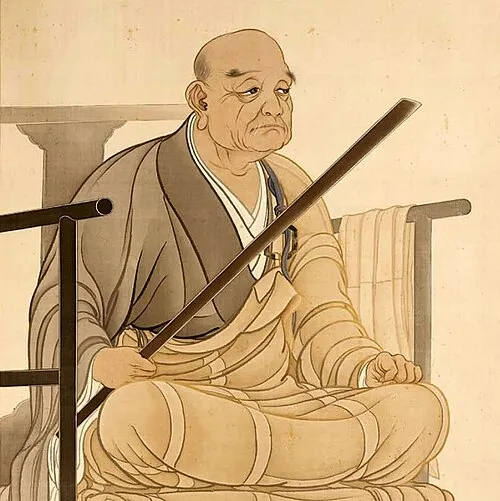
Mazu Daoyi
Dates uncertain
Mazu Daoyi was the other great heir of the post-Huineng generation, descending through Nanyue Huairang, and one of the most dynamic and influential Chan masters in Chinese history[1]. He was the teacher of hundreds of students and was renowned for his startling, unconventional teaching methods. Mazu introduced the "shout" (katsu/he) as a teaching device, sometimes shouting so forcefully that students experienced sudden awakening. He also employed physical gestures—grabbing noses, twisting ears, striking students unexpectedly—as direct interventions in the stream of conceptual thought[2].
Mazu's famous saying that "everyday mind is the Way" became one of the cornerstone teachings of the Chan tradition[3]. By this he meant that awakening is not a special state separate from ordinary experience but is the direct recognition of experience as it actually is, before any overlay of conceptual construction. His students—including Baizhang Huaihai, Nanquan Puyuan, and Zhaozhou's teacher—spread throughout China and established the Hongzhou style of Chan that became the foundation of the Linji/Rinzai tradition[1].
Names
Disciples of Mazu Daoyi
Teachers and lineage of Mazu Daoyi
Teacher / root master:
Teachings
Daibai asked Baso: "What is Buddha?" Baso said: "This mind is Buddha." Mumon’s comment: If anyone wholly understands this, he is wearing Buddha's clothing, he is eating Buddha's food, he is speaking Buddha's words, he is behaving as Buddha, he is Buddha. This anecdote, however, has given many a pupil the sickness of formality. If one truly understands, he will wash out his mouth for three days after saying the word Buddha, and he will close his ears and flee after hearing "This mind is Buddha." Under blue sky, in bright sunlight, One need not search around. Asking what Buddha is Is like hiding loot in one's pocket and declaring oneself innocent.
A monk asked Baso: "What is Buddha?" Baso said: "This mind is not Buddha." Mumon’s comment: If anyone understands this, he is a graduate of Zen. If you meet a fencing-master on the road, you may give him your sword, If you meet a poet, you may offer him your poem. When you meet others, say only a part of what you intend. Never give the whole thing at once.
- dialogueThis Very Mind Is Buddha
Damei asked Mazu, "What is Buddha?" Mazu said, "This very mind is Buddha." At these words, Damei was deeply awakened. Later, Mazu said to the assembly, "No mind, no Buddha." When someone told Damei that Mazu was now saying "No mind, no Buddha," Damei replied, "That old fellow will go on confusing people forever. Let him say 'No mind, no Buddha.' For me, this very mind is Buddha." When Mazu heard this, he said, "The plum is ripe."
Mazu was unwell. The temple director asked him, "Teacher, how has your health been in recent days?" Mazu said, "Sun-face Buddha, Moon-face Buddha."
- dialogueDrink Up the Yangtze River
A monk asked Mazu, "What is the meaning of Bodhidharma's coming from the West?" Mazu said, "I'll tell you after you've drunk up the Yangtze River in one gulp." The monk stood speechless.
- dialogueNot Mind, Not Buddha
A monk asked Mazu, "What is Buddha?" Mazu said, "This mind is Buddha." Later, another monk asked, "What is Buddha?" Mazu said, "Not mind, not Buddha." When asked why he gave two different answers, Mazu said, "'This mind is Buddha' is to stop a baby from crying. Once the crying has stopped, I say 'Not mind, not Buddha.' The first is medicine for the sick; the second takes away the medicine when the sickness is cured."
- proverbThis Very Mind Is Buddha
This very mind is Buddha. When someone asks for the teaching outside this mind, he is like a man riding an ox looking for an ox.
- proverbOrdinary Mind Is the Way
What is the Way? Ordinary mind is the Way. What is ordinary mind? Hungry, eat. Tired, sleep. Foolishness arises only when we add anything else.
- proverbA Shout That Deafens
I shouted at Baizhang, and his ears rang for three days. The shout was not punishment — it was the doorway. Three days of deafness is a small price for the silence that follows.
- proverbNot Mind, Not Buddha
Yesterday I said: this very mind is Buddha. Today I say: not mind, not Buddha. The teaching shifts; the student who clings to either statement misses both.
- proverbTrample the Buddha
When you walk through the gate, leave the Buddha outside. If you carry him in, he becomes a stone in your shoe.
- proverbEighty-Four Students
I had eighty-four enlightened students, and not one of them taught the same thing. The dharma is wide enough to give each of them a different door, and narrow enough that all those doors open onto the same yard.
- proverbWild Fox
If you say a great practitioner does not fall under cause and effect, you become a wild fox for five hundred lives. If you say he is not blind to cause and effect, the wild fox is freed at once. Watch the difference of one syllable.
- proverbThe Tile and the Tile-Maker
Nanyue polished a tile to make a mirror; I polished sitting to make a Buddha. He laughed; I laughed back. From that day, I sat for the sake of sitting, and a Buddha appeared without anyone making one.
Featured in
- Traditional Zen Encounter DialoguesPolishing a Tile
Other masters in Nanyue line
Master Record Sources
Mazu Daoyi
Linji
- koan_refsChart of the Chan Ancestors
3,53,73 6,36 30,33 18
- nameZen Editorial Overlay - Originals Curation
Mazu Daoyi
- teachersZen Editorial Overlay - Originals Curation
Nanyue Huairang