Philip Kapleau
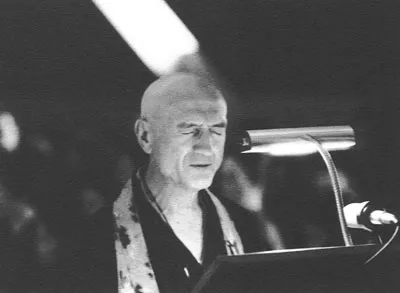
Philip Kapleau
1912 – 2004
Philip Kapleau (1912–2004) was one of the most important early figures in the transmission of Zen Buddhism to the West, whose book "The Three Pillars of Zen" (1965) became the single most influential introduction to Zen practice for English-speaking readers. Before turning to Zen, Kapleau had served as a court reporter at the Nuremberg and Tokyo war crimes trials, experiences that confronted him with the depths of human cruelty and intensified his search for meaning. He traveled to Japan in 1953 and spent thirteen years in rigorous training, primarily under Yasutani Haku'un, with additional study under Nakagawa Soen and Harada Sogaku's lineage.
After receiving authorization to teach from Yasutani, Kapleau returned to the United States in 1966 and founded the Rochester Zen Center in New York, which became one of the most rigorous and well-established Zen practice centers in America. He made the controversial decision to conduct practice in English rather than Japanese, adapting liturgy, chanting, and ritual forms to Western cultural contexts — a choice that led to a break with Yasutani, who felt the Japanese forms should be preserved. Kapleau's insistence on cultural adaptation rather than wholesale importation proved prescient and influenced the entire subsequent development of Western Zen. "The Three Pillars of Zen," with its unprecedented inclusion of firsthand enlightenment accounts, detailed practice instructions, and transcribed private interviews with a Zen master, opened the door to authentic Zen practice for an entire generation.
Master Record Sources
No citations attached yet.