Yasutani Hakuun
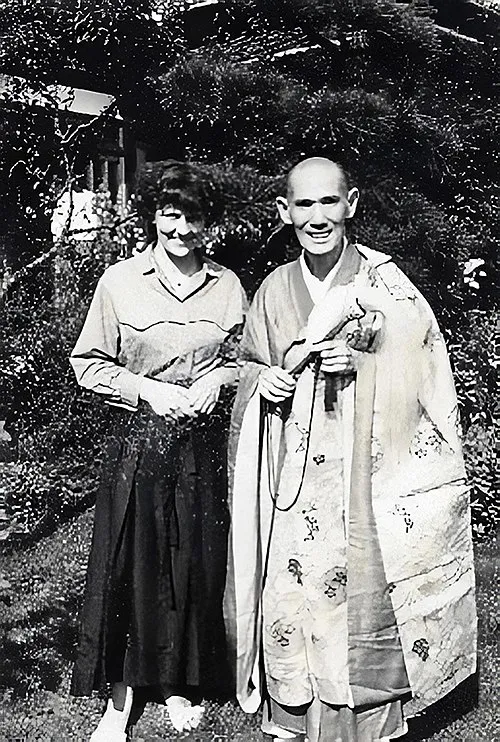
Yasutani Hakuun
1885 – 1973
Hakuun Ryōkō Yasutani (安谷 白雲, 1885–1973) was the dharma heir of Harada Daiun Sogaku who carried the Harada-Yasutani method to Western lay students and, in doing so, became the most direct Japanese root of contemporary American Zen. He was born in 1885 in Shizuoka Prefecture and ordained at age thirteen at the Sōtō temple Teishin-ji, where he received the religious name Hakuun ("white cloud")[1]. After years of conventional Sōtō training and work as a schoolteacher, he married at thirty and had five children, only beginning serious kōan practice under Harada in 1925 at the age of forty; he reported kenshō under Harada in 1927 and received dharma transmission (inka shōmei) from him in 1943[1][2].
In January 1954 Yasutani broke with the institutional Sōtō-shū and registered an independent religious corporation, the Sanbō Kyōdan ("Order of the Three Treasures"), in order to teach the integrated kōan-and-shikantaza curriculum he had inherited from Harada to mixed sanghas of monastics and laypeople, women included[2]. From 1962 onward he made repeated teaching tours of the United States and Europe, leading sesshin in Hawai'i, California, and New York that produced a generation of Western teachers; named dharma heirs include Yamada Kōun (who succeeded him as second patriarch of Sanbō Kyōdan in 1970), Philip Kapleau, Robert Aitken, Taizan Maezumi, and Eido Shimano[1][2].
His written legacy survives in three principal channels. His teisho on the *Shōbōgenzō* "Genjō Kōan" were translated by Paul Jaffe and published as *Flowers Fall: A Commentary on Zen Master Dōgen's Genjō Kōan* (Shambhala, 1996); his earlier work *Zen Master Dōgen and the Shūshōgi* dates to 1943[1]. His sustained commentaries on the three classical kōan collections — the *Mumonkan* (Gateless Gate), *Hekiganroku* (Blue Cliff Record), and *Shōyōroku* (Book of Serenity) — were transcribed by his students and form the basis of the introductory dharma talks Philip Kapleau translated and assembled in *The Three Pillars of Zen* (John Weatherhill, 1965), still the most widely read English-language Zen practice manual[1]. Yasutani's wartime writings, however, included openly militarist and antisemitic statements, documented at length in Brian Daizen Victoria's *Zen at War* (Weatherhill, 1997; 2nd ed. Rowman & Littlefield, 2006); in 2000 the Sanbō Kyōdan issued a formal apology acknowledging Yasutani's "right-winged and antisemitic ideology"[1]. He retired in 1970, was succeeded by Yamada Kōun, and died on March 8, 1973[1].
Names
Disciples of Yasutani Hakuun
Teachers and lineage of Yasutani Hakuun
Teacher / root master:
Teachings
- proverbNo Shortcuts
There are no shortcuts in Zen. If you want to walk, you must take every step yourself. No one can walk for you.
- proverbThrow Yourself Into It
You must throw yourself into practice with your whole body and mind. Half-hearted practice produces half-hearted results.
The aim of zazen is to awaken to your True-nature. What is this True-nature? It is the Buddha-nature inherent in every sentient being. Through zazen you can directly experience and validate the truth that each of you is an embodiment of Buddha. Zazen that leads to Self-realization is neither a technique of meditation nor a means of tranquilizing the mind. It is practice that brings the mind to maturity, and it is the actualization of the supreme Way. To practice zazen with the expectation of a reward, even enlightenment, is to sow a seed of delusion. Simply sit with your whole being, pouring all your energy into this sitting.
Without kensho, your Zen is nothing but the empty shell of a peanut. Kensho is the first opening of the mind's eye, the first glimpse into one's True-nature. It is not yet full enlightenment—it is only the beginning—but without this initial awakening, you are groping in the dark. Even a shallow kensho transforms your understanding completely. After kensho, you know for yourself that the world of emptiness is not separate from the world of form. Then real practice begins.
For the practice of Zen, three things are essential: great faith, great doubt, and great determination. Great faith is the unwavering conviction that all beings are endowed with Buddha-nature and that through zazen one can realize this truth directly. Great doubt is the burning questioning that drives you forward—not intellectual doubt, but the doubt that grips your entire being like a red-hot iron ball stuck in your throat. Great determination is the fierce resolve never to give up, no matter what obstacles arise. Without any one of these three, your practice will be incomplete.
Other masters in Sanbo-Zen
Master Record Sources
1885-1973
Yasutani Hakuun
Sanbo-Zen
Harada Daiun Sogaku