Seosan Hyujeong
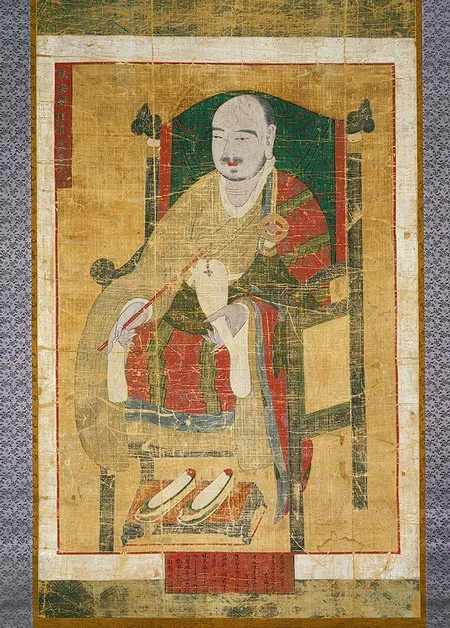
Seosan Hyujeong
1520 – 1604
Seosan Hyujeong (西山休靜, 1520–1604) was the pre-eminent Korean master of the Joseon dynasty, a period during which Neo-Confucian governance had driven Buddhism into the mountains and outlawed its public practice in the capital[1]. When Toyotomi Hideyoshi's forces invaded Korea in 1592, the seventy-two-year-old Seosan left his mountain temple and organized monastic militias (승병 seungbyeong) in the country's defense — a politically consequential gesture that led to the partial rehabilitation of Buddhism at court[1]. His Seongamnok (Mirror of Seon, 선가귀감) became the standard Joseon-dynasty handbook of Korean monastic practice, articulating a synthesis of hwadu meditation, sutra study, and Pure Land recitation that shaped Korean Buddhism into the modern era[2].
Names
Disciples of Seosan Hyujeong
Teachers and lineage of Seosan Hyujeong
Teacher / root master:
Works
- Seonga GwigamSŏn'ga Kwigam (Mirror of Seon)
Seosan Hyujeong's 1564 anthology — short passages drawn from sūtras and Chan masters and stitched together with his own commentary — designed as a complete Seon training manual for monks during the Joseon suppression. It is the most-read Korean Buddhist primer of the early-modern period and shaped the curriculum of the Jogye order down to the present.
Teachings
Some say Seon is the gate of the patriarchs and Pure Land is the gate of the ordinary person. But the original mind that Seon investigates and the mind that calls upon Amitabha are not two minds. When sitting, investigate 'What is this?' When walking, recite the name of Amitabha with the same one-pointedness. Whether the wave of mind rises as a question or as a name, it is the same ocean. Do not set up a boundary between stillness and devotion, between the wordless and the word.
- practice-instructionInvestigating the Live Word
Seosan held that the Seon practitioner takes up a single hwadu — most commonly Zhaozhou's 'Mu' or 'What is this?' (이뭣고, imwŏtgo) — and pursues it with the whole body and breath, not the analytical mind. The 'live word' (活句) is the phrase that cannot be reasoned about; the 'dead word' (死句) is the phrase one explains. 'Whether walking, standing, sitting, or lying down, only investigate the live word. Do not let it drop for an instant.' Doubt that gathers and intensifies until the practitioner is one mass of doubt — that, for Seosan, is the only practice. When that single doubt shatters of its own accord, the original face is seen; until then, sustain it.
Work on the critical phrase as a mosquito works on an iron ox — at a point where it cannot sting, let it bore in with its whole body. In one instant, body and life fall away together.
- proverbThree Bodies, One Sword
Doctrine is the dharma body, meditation is the reward body, conduct is the manifestation body. The Sŏn student wields all three with one sword — and the sword cuts only delusion, never the dharma.
- proverbWarrior-Monk
A monk who takes up the bow does not become a soldier; he becomes a monk in armour. The arrow loosed from the dharma is the first one; the second is the body that loosed it. Both must return to the bow.
- proverbThree Religions, One Mind
Confucius works on the village; Laozi works on the body; the Buddha works on the mind. Where the three meet, no priest is needed — the work is already done.
- proverbAn Empty Temple
An empty temple is not a failed temple. The bell still rings on the empty hour, and the monks on the road carry the temple inside their robes.
After the mosquito has bored into the iron ox, the question becomes: where is the mosquito now? Find that mosquito, and the iron ox stands up and walks.
Other masters in Seon
Master Record Sources
- biographyThe Zen Monastic Experience — Robert E. Buswell
- teachersThe Formation of Ch'an Ideology in China and Korea — Robert E. Buswell