Seung Sahn
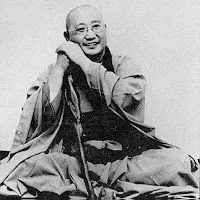
Seung Sahn
1927 – 2004
Seung Sahn Haengwon (숭산행원, 1927–2004) was the Korean Seon master who, more than any other, brought Korean Zen to the Western world and built the largest international Korean Zen sangha of the twentieth century, the Kwan Um School of Zen[1]. He was born Duk-In Lee on 1 August 1927 in Sunchon, South Pyongan Province, in what is now North Korea[1]. As a teenager he joined the Korean independence movement under Japanese occupation and was briefly imprisoned; afterward he studied Western philosophy at Dongguk University in Seoul, where reading the Diamond Sutra prompted him to leave his studies for the mountains. He took monastic precepts in 1948, undertook a hundred-day solitary retreat eating only pine needles, and on 25 January 1949 received dharma transmission from Seon Master Kobong Gyeongook — the only person to whom Kobong ever transmitted, making Seung Sahn at twenty-two the seventy-eighth patriarch in his Korean Imje line[1].
After two decades of monastic and institutional work in Korea, Hong Kong, and Japan — including helping to rebuild the war-damaged Hwagaesa in Seoul — Seung Sahn arrived in Providence, Rhode Island in 1972, taking work in a laundromat and gathering a small group of Brown University students who became the nucleus of the Providence Zen Center[2]. Out of that group grew the Kwan Um School of Zen, which he formally founded in 1983 and which by his death had spread to more than a hundred groups, temples, and monasteries across North America, Europe, Africa, Asia, and Australia[2]. His teaching style was unmistakable: blunt, humorous, often bilingual broken-English exchanges built around what he called the Twelve Gates kong-ans and the central injunction to 'only don't know' and 'only go straight.' He authorized a relatively dense roster of dharma heirs — among them Bo Mun, Su Bong Soeng-Sahn, Soeng Hyang (Barbara Rhodes), Wu Kwang (Richard Shrobe), Dae Gak, and Mu Soeng — who continue to lead the Kwan Um School after his death[2].
His books, mostly co-edited from transcribed talks and letters, became standard introductions to Zen in English[3]. *Dropping Ashes on the Buddha: The Teaching of Zen Master Seung Sahn* was edited by Stephen Mitchell and published by Grove Press in 1976; *Only Don't Know: Selected Teaching Letters of Zen Master Seung Sahn* appeared from Primary Point Press in 1982 (reissued by Shambhala in 1999); *The Whole World Is a Single Flower: 365 Kong-ans for Everyday Life* was published by Charles E. Tuttle in 1992; and *The Compass of Zen*, his most systematic exposition of Hinayana, Mahayana, and Zen, was edited by his American heir Hyon Gak Sunim and published by Shambhala in 1997[3]. Shortly before his death the Jogye Order conferred on him the title Dae Jong Sa, 'Great Lineage Master.' He died at Hwagaesa in Seoul on 30 November 2004 at the age of seventy-seven[1].
Names
Teachers and lineage of Seung Sahn
Teacher / root master:
Teachings
- koanWhat Are You?
A student asked Seung Sahn: 'The dog has Buddha-nature or not? Zhaozhou said Mu. What does Mu mean?' Seung Sahn held up his Zen stick and said: 'You already understand Mu perfectly. What are you?' The student was silent. Seung Sahn said: 'This silence is not enough. Open your mouth.' The student said: 'I don't know.' Seung Sahn said: 'Only don't know! That is Mu. That is Buddha-nature. That is your correct situation. Don't lose it.'
Seung Sahn taught that all the questions of Zen resolve into four, which are themselves one. What am I? Where do I come from? Where am I going? How shall I help others? When the first question is answered completely, not by thinking but by your whole life, the other three answer themselves. This is why practice cannot be only sitting. Every moment of your life — getting on the bus, chopping vegetables, meeting someone who is angry — is asking the first question. The complete answer is a complete human being.
- practice-instructionOnly Don't Know
Seung Sahn taught a single, deliberately simple practice. Sit upright. Breathe naturally. Ask, with the whole body, 'What am I?' — and meet the answer that arises with 'Only don't know.' 'Don't-know mind cuts off all thinking. When you keep don't-know mind one hundred percent, this don't-know mind is your true self. So don't make anything. Don't hold anything. Just keep don't-know mind, moment to moment.' From that don't-know, he said, function appears: when you are hungry, eat; when tired, sleep; when someone is suffering, help. Practice is don't-know in motion.
- proverbOnly Don't Know
Before thinking, what are you? Keep that question. Don't know — that mind is clear like space. In the don't-know, all beings are already saved.
- proverbJust Do It
When you eat, just eat. When you sit, just sit. When you read this, just read it. Do not save anything for later — there is no later.
- proverbVow Before Wisdom
First the great vow, then the great doubt, then the great courage. Wisdom is the smallest of these; without the vow, wisdom is only cleverness.
Open your mouth, already a mistake. So why do I speak? Because the mistake is sometimes the medicine.
- proverbThree Kinds of Students
First-class student: hears one word, gets it, goes to work. Second-class student: hears one word, asks ten more, gets it, goes to work. Third-class student: hears ten words, takes notes, never goes to work. Be the first kind, even on the days you are the third.
- proverbThrow It All Away
Whatever you have, throw it away. Then whatever throws it away, throw that away too. When there is nothing left to throw, you have arrived where you always were.
Master Record Sources
- biographyWikipedia - Zen Lineage Charts