Shinchi Kakushin
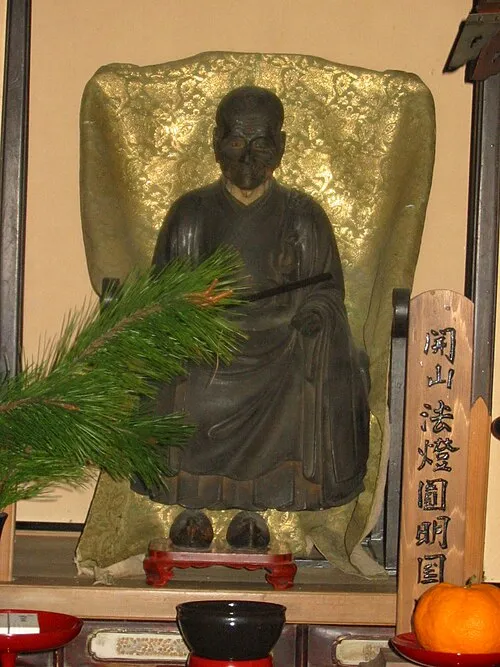
Shinchi Kakushin
1207 – 1298
Shinchi Kakushin (心地覚心, 1207–1298), known posthumously as Hottō Kokushi (法燈国師, "Dharma-Lamp National Teacher"), was a Japanese monk who travelled to Song-dynasty China in 1249 and studied under Wumen Huikai (1183–1260), the compiler of the *Wúménguān* / *Mumonkan*[1]. Although the conventional Japanese historiography classifies him as a Rinzai master, Wumen's own lineage descends from the Yangqi line of Linji Chan, and Kakushin's transmission carries a distinct sub-lineal flavour usually called the Hottō line (法燈派) within the broader Rinzai institution[2].
He returned to Japan in 1254 carrying — most consequentially — a manuscript copy of the *Wúménguān*, which thereafter became one of the two principal koan collections (alongside the *Bìyán Lù*) used in Japanese Rinzai training[3]. He also brought back the Fuke-shū strand of practice associated with the shakuhachi bamboo flute, settled at Saihō-ji in modern Wakayama (the temple later renamed Kōkoku-ji), and through his disciple Kohō Kakumyō and others transmitted his line forward into the late-Kamakura and Muromachi periods[4].
Names
Disciples of Shinchi Kakushin
Teachers and lineage of Shinchi Kakushin
Teacher / root master:
Teachings
- proverbFlute and Zen
I brought the shakuhachi back from China alongside the dharma. The flute and the koan are not different practices — both ask you to stop talking long enough to hear the next note.
- proverbFuke Zen Origins
I traced the line of Fuke back to a wandering Tang monk who rang a small bell through the marketplace. The bell was the only sutra he carried; everyone who heard it was instructed.
Other masters in Rinzai
Master Record Sources
- datesZen Editorial Overlay - Originals Curation
1207-1298
- nameZen Editorial Overlay - Originals Curation
Shinchi Kakushin
- schoolZen Editorial Overlay - Originals Curation
Rinzai
- teachersZen Editorial Overlay - Originals Curation
Wumen Huikai