Baizhang Huaihai
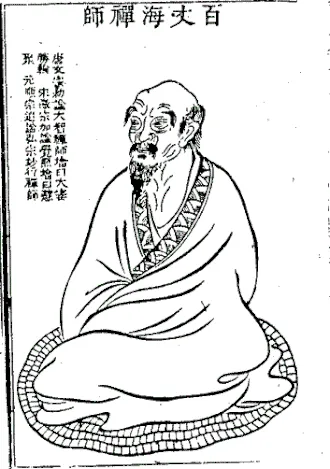
Baizhang Huaihai
Dates uncertain
Baizhang Huaihai was a disciple of Mazu Daoyi and one of the architects of Chan monastic culture[1]. He is famous above all for establishing the first specifically Chan monastic code, the Baizhang Qinggui (Pure Rules of Baizhang)[2]. Before Baizhang, Chan monks lived in Vinaya monasteries designed for a different kind of practice. Baizhang created a distinctly Chan institution in which practice, work, and communal life were fully integrated. His famous dictum—"A day without work is a day without eating"—set the tone for a monasticism in which manual labor was understood as inseparable from spiritual practice[1].
Baizhang also created the formal Dharma hall where the abbot teaches the community publicly, a format that became standard in Chan and Zen monasteries worldwide[2]. His awakening moment under Mazu is legendary: Mazu picked up a whisk and held it vertically. Baizhang asked the meaning. Mazu put it down. Later Mazu asked Baizhang to explain Chan. Baizhang picked up the whisk and held it vertically. Mazu snatched it and asked what he meant by that. Baizhang shouted—and Mazu's roar of laughter could be heard for miles[3]. This encounter appears in several koan collections and illustrates the non-verbal quality of genuine dharma encounter.
Names
Disciples of Baizhang Huaihai
Teachers and lineage of Baizhang Huaihai
Teacher / root master:
Teachings
- koanHyakujo's Fox
Once when Hyakujo delivered some Zen lectures an old man attended them, unseen by the monks. At the end of each talk when the monks left so did he. But one day he remained after they had gone, and Hyakujo asked him: "Who are you?" The old man replied: "I am not a human being, but I was a human being when the Kashapa Buddha preached in this world. I was a Zen master and lived on this mountain. At that time one of my students asked me whether or not the enlightened man is subject to the law of causation. I answered him: 'The enlightened man is not subject to the law of causation.' For this answer evidencing a clinging to absoluteness I became a fox for five hundred rebirths, and I am still a fox. Will you save me from this condition with your Zen words and let me get out of a fox's body? Now may I ask you: Is the enlightened man subject to the law of causation?" Hyakujo said: "The enlightened man is one with the law of causation." At the words of Hyakujo the old man was enlightened. "I am emancipated," he said, paying homage with a deep bow. "I am no more a fox, but I have to leave my body in my dwelling place behind this mountain. Please perform my funeral as a monk." Then he disappeared. The next day Hyakujo gave an order through the chief monk to prepare to attend the funeral of a monk. "No one was sick in the infirmary," wondered the monks. "What does our teacher mean?" After dinner Hyakujo led the monks out and around the mountain. In a cave, with his staff he poked out the corpse of an old fox and then performed the ceremony of cremation. That evening Hyakujo gave a talk to the monks and told them this story about the law of causation. Obaku, upon hearing the story, asked Hyakujo: "I understand that a long time ago because a certain person gave a wrong Zen answer he became a fox for five hundred rebirths. Now I want to ask: If some modern master is asked many questions and he always gives the right answer, what will become of him?" Hyakujo said: "You come here near me and I will tell you." Obaku went near Hyakujo and slapped the teacher's face with his hand, for he knew this was the answer his teacher intended to give him. Hyakujo clapped his hands and laughed at this discernment. "I thought a Persian had a red beard," he said, "and now I know a Persian who has a red beard." Mumon's comment: "The enlightened man is not subject." How can this answer make the monk a fox? "The enlightened man is one with the law of causation." How can this answer make the fox emancipated? To understand this clearly one has to have just one eye. Controlled or not controlled? The same dice shows two faces. Not controlled or controlled, Both are a grievous error.
- dialogueBaizhang's Water Bottle
Baizhang wished to choose an abbot for Mount Gui. He called together the head monk and the assembly, placed a water bottle on the floor, and said, "Without calling this a water bottle, what do you call it?" The head monk said, "You can't call it a wooden peg." Then Baizhang asked Guishan. Guishan kicked over the water bottle and walked away. Baizhang smiled and said, "The head monk has lost the mountain." Guishan was appointed abbot of Mount Gui.
A day without work is a day without eating.
- dialogueThe Wild Fox Koan
Every time Baizhang gave a talk, an old man would attend and listen. One day the old man stayed behind and said, "I am not a human being. In the time of Kashyapa Buddha I was the head monk on this mountain. A student asked me, 'Does a person of great cultivation fall under the law of cause and effect, or not?' I answered, 'Such a person does not fall under cause and effect.' For this I was reborn as a wild fox for five hundred lifetimes. I beg you, Master, give me a turning word so that I may be released." Baizhang said, "Such a person does not evade cause and effect." At these words the old man was greatly enlightened.
- proverbA Day Without Work
A day without work is a day without food. When my disciples hid my tools, I sat at the table and pushed the bowl away. They returned the tools the next morning.
- proverbThe Pure Rule
I wrote down the rules of the monastery so that no master after me could be tempted to make himself a king. Read the rules; they will outlast my voice. The voice was only there to write them.
- proverbHoe and Sutra Together
Bring the sutra to the field, and the field to the sutra. The two were never apart; only our habits make them seem so.
- proverbThree Pounds of Flax
What is Buddha? Three pounds of flax. The student who finds this strange has not yet weighed his own questions.
- proverbFox in the Audience
An old man came to my talks for many years, sitting at the back. He told me he had been a wild fox for five hundred lives because of one wrong word. We buried the fox with monks' rites. The wrong word, properly answered, frees not only the answerer.
- proverbStep Out of the Doorway
Stand in the doorway and the wind cannot enter. Step into the room and the wind cannot enter. Step out, and the room and the wind both pass through you.
- proverbWhat Is Extraordinary
What is extraordinary? Sitting alone on the great peak. The peak does not feel extraordinary about itself; that is its secret.
- proverbWash Your Bowl
After breakfast, what should I do? Wash your bowl. After washing the bowl, what should I do? Set it down. After setting it down, what should I do? You are already doing it.
Other masters in Nanyue line
Master Record Sources
Baizhang Huaihai
Linji
- koan_refsChart of the Chan Ancestors
26,53,70 6, 8 2,40 78 71,72,73
- nameZen Editorial Overlay - Originals Curation
Baizhang Huaihai
- teachersZen Editorial Overlay - Originals Curation
Mazu Daoyi