Bassui Tokusho
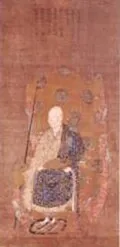
Bassui Tokusho
1327 – 1387
Bassui Tokushō (拔隊得勝, 1327–1387) was a fourteenth-century Japanese Zen master in the Hottō line of Rinzai whose surviving Dharma talks, the *Wadeigassui* (和泥合水, "Mud and Water"), make him one of the most accessible voices in medieval Japanese Zen[1]. Born in Sagami Province, he was preoccupied from childhood with the question of what becomes of consciousness after death; he refused at first to wear monks' robes or live in temples and travelled for years as an unaffiliated practitioner, studying in turn under both Sōtō and Rinzai teachers before settling on the question "Who is the master that hears, sees, and knows?" as the heart of his practice[2].
At thirty-two his awakening was confirmed by Kōhō Kakumyō, the Hottō-line master who had himself trained both with Shinchi Kakushin and with Zhongfeng Mingben in China[3]. Bassui eventually founded the hermitage Kōgaku-an in Kai Province (modern Yamanashi), where his teaching drew large audiences without his ever taking on institutional office; his deathbed words to his community, *Mite, mite — kore wa nan zo* ("Look! Look! — what is this?"), are quoted in the *Wadeigassui* as the summary of his entire teaching method of direct self-investigation[4].
Names
Teachers and lineage of Bassui Tokusho
Teacher / root master:
Teachings
- proverbLook Directly
Look directly! What is this? Look in this manner and you won't be fooled.
- proverbWho Is Hearing?
Who is hearing that sound?
- sayingWho Is the Master?
Who is hearing that sound? Who is it that right now sees colors, hears voices, raises the hands, moves the feet? We know these are functions of the mind, but no one knows precisely where this mind is. All that can be said is that the mind is here. But when you try to see into it, there is nothing that can be called the mind. Yet when you are called, something answers. Who is the master? Pursue this question with single-minded devotion. Ask yourself ceaselessly: who is hearing?
- sermonMud and Water
If you cling to emptiness and deny the reality of things, you are like someone who drowns in water to avoid being burned by fire. If you cling to form and deny emptiness, you are like someone who walks into fire to escape drowning. Neither emptiness nor form can be grasped. When you stop trying to grasp them, the truth reveals itself of its own accord. Do not attach to the idea that mind is void, and do not attach to the idea that mind is something. The one who does not attach to either side—that one walks freely between heaven and earth.
- proverbWho Is the One Who Hears?
Who is hearing this voice? Sit with that question through every cough, every footfall, every bell. The one who hears does not have a name — and yet you have been answering for him all your life.
- proverbMind Without Form
Mind has no form, no color, no weight. Yet it is heavier than the mountain when burdened, lighter than the cloud when free. Find the place where it is neither, and the mountain bows.
- proverbLetter to a Dying Layman
I wrote to a dying layman: do not seek the Buddha outside this body. The body that is dying is the body that has been studying its whole life. Trust it, and the breath that leaves it last carries the answer.
- proverbMud and Water
Mud and water are not enemies; mix them, and the field grows rice. The mind and its troubles are likewise — separated, both starve; together, they feed.
- proverbNothing to Find Outside
If you search for Buddha outside, you will find a stranger. If you search inside, you will find no one. Stop searching, and the meeting is unavoidable.
- proverbDo Not Fear Doubt
Doubt is the lamp; certainty is the candlestick. Without the lamp, the candlestick is decorative. Without the candlestick, the lamp burns the floor. Carry both.
Other masters in Rinzai
Master Record Sources
- datesZen Editorial Overlay - Originals Curation
1327-1387
- nameZen Editorial Overlay - Originals Curation
Bassui Tokusho
- schoolZen Editorial Overlay - Originals Curation
Rinzai
- teachersZen Editorial Overlay - Originals Curation
Koho Kakumyo