Ikkyu Sojun
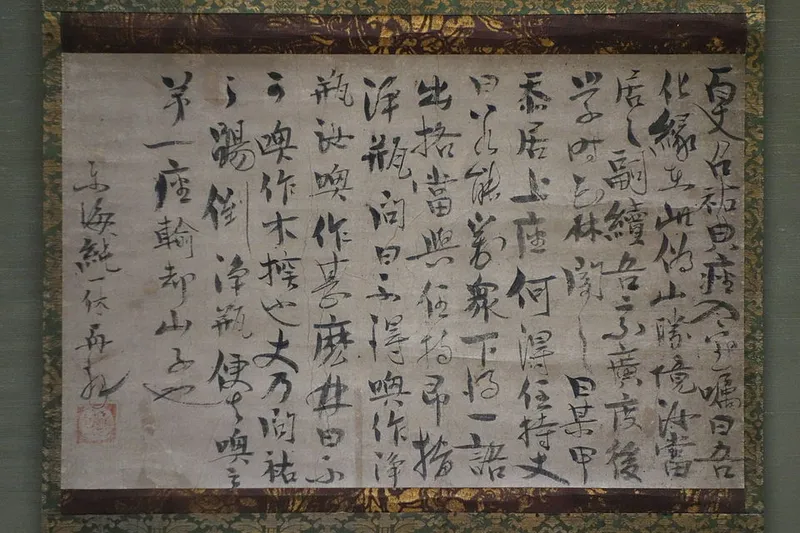
Ikkyu Sojun
1394 – 1481
Ikkyū Sōjun (一休宗純, 1394–1481) is the most famous iconoclast in Japanese Zen history and one of the major figures of fifteenth-century Japanese literature. He is generally believed by his biographers — and was understood by his contemporaries — to have been the illegitimate son of Emperor Go-Komatsu by a court lady of southern-line sympathies; he was sent into temple service in Kyoto at the age of five and was educated in Chinese poetry, philosophy and Sino-Japanese kanbun from an early age[1]. Dissatisfied with what he regarded as the courtly worldliness of the Gozan establishment, he eventually sought out Kasō Sōdon, an austere Daitoku-ji-line hermit living on the shore of Lake Biwa, and under Kasō's regime his decisive awakening came one night in a small boat on the lake at the sudden cry of a crow; he refused, as is famously recorded, to accept the certificate of transmission Kasō offered[2].
For the next several decades Ikkyū lived as a wandering monk who deliberately broke the monastic conventions of his order: he drank, wrote frankly erotic poetry, visited the pleasure quarters of Sakai, and in later life lived openly with the blind singer Mori. His Chinese-style poetry collection, the *Kyōunshū* (狂雲集, "Crazy Cloud"), modulates between metaphysical intensity and a sometimes shocking earthiness, and his prose polemics against the contemporary Daitoku-ji and Myōshin-ji establishment accuse the prominent abbots of selling Dharma certificates and reducing Zen to ritual[3].
Despite this lifelong opposition to institutional Zen, Ikkyū accepted appointment as abbot of Daitoku-ji in 1474, at the age of eighty-one, to oversee its reconstruction after the devastation of the Ōnin War (1467–1477), and held the office until his death in 1481[4]. Through his lay disciple Murata Jukō he shaped the wabi aesthetic of the early *chanoyu* (tea ceremony), and through his poetry and persona he became one of the most enduringly recognised figures of Japanese cultural history, eventually surviving even into modern children's-television iconography as "Ikkyū-san"[5].
Names
Teachers and lineage of Ikkyu Sojun
Teacher / root master:
Teachings
- proverbHaving No Destination
Having no destination, I am never lost.
Every day, priests minutely examine the Dharma and endlessly chant sutras. Before doing that, they should learn how to read the love letters sent by the wind and rain, the snow and moon.
- verseCrazy Cloud
Look at the monks in their grand temples, chanting sutras they do not understand, counting beads while their minds wander to gold, to silk, to the next meal. Crazy Cloud has no temple, no robes of state. He drinks when thirsty, sleeps when tired. The wind blows through the bamboo— that is the only sutra he needs. Who is the true monk: the one who keeps the precepts with a dead heart, or the one who breaks them all and finds the living Buddha in a cup of wine?
- dialogueThe Sound of One Hand
A monk asked Ikkyu: "Master, what is the sound of one hand clapping?" Ikkyu slapped him across the face. The monk stood stunned, his cheek burning. Ikkyu said: "Now you have heard it. Why do you stand there like a dead man? The sound of one hand is not a riddle to solve with your thinking mind. It is the thing itself, striking you awake. Did you need two hands for that?"
- proverbAttention. Attention.
A pilgrim asked me to write a single phrase of the highest wisdom. I wrote: Attention. He said: that is all? I wrote: Attention, Attention. He said: but they look the same. I wrote: Attention, Attention, Attention.
- proverbSkull on a Stick
On New Year's Day I walked through the city with a skull on a stick, calling: beware! beware! The crowd said I was insane. The crowd had not noticed they too had a skull beneath the face.
- proverbBrothel and Temple
I drank in the brothel and meditated in the temple — and the brothel did not lower the meditation, and the meditation did not raise the brothel. Both belong to the dharma; only my embarrassment did not.
- proverbPoems of Rage
I have written poems angry at corrupt monks; I have written poems tender to small children; I have written poems on the bellies of women. The dharma was in all three brushstrokes; it does not care about my reputation.
- proverbCloud-Water Monk
I am a cloud-water monk. The cloud has nowhere to live; the water has nowhere to stay. Whoever calls me his teacher must be willing to walk after the wind.
- proverbBow to a Cherry Blossom
Bow to a cherry blossom and the blossom does not return the bow; yet some part of the bow is returned, in the body, days later. Practice in this way.
Other masters in Rinzai
Master Record Sources
- datesZen Editorial Overlay - Originals Curation
1394-1481
- nameZen Editorial Overlay - Originals Curation
Ikkyu Sojun
- schoolZen Editorial Overlay - Originals Curation
Rinzai
- teachersZen Editorial Overlay - Originals Curation
Kaso Sodon