Bojo Jinul
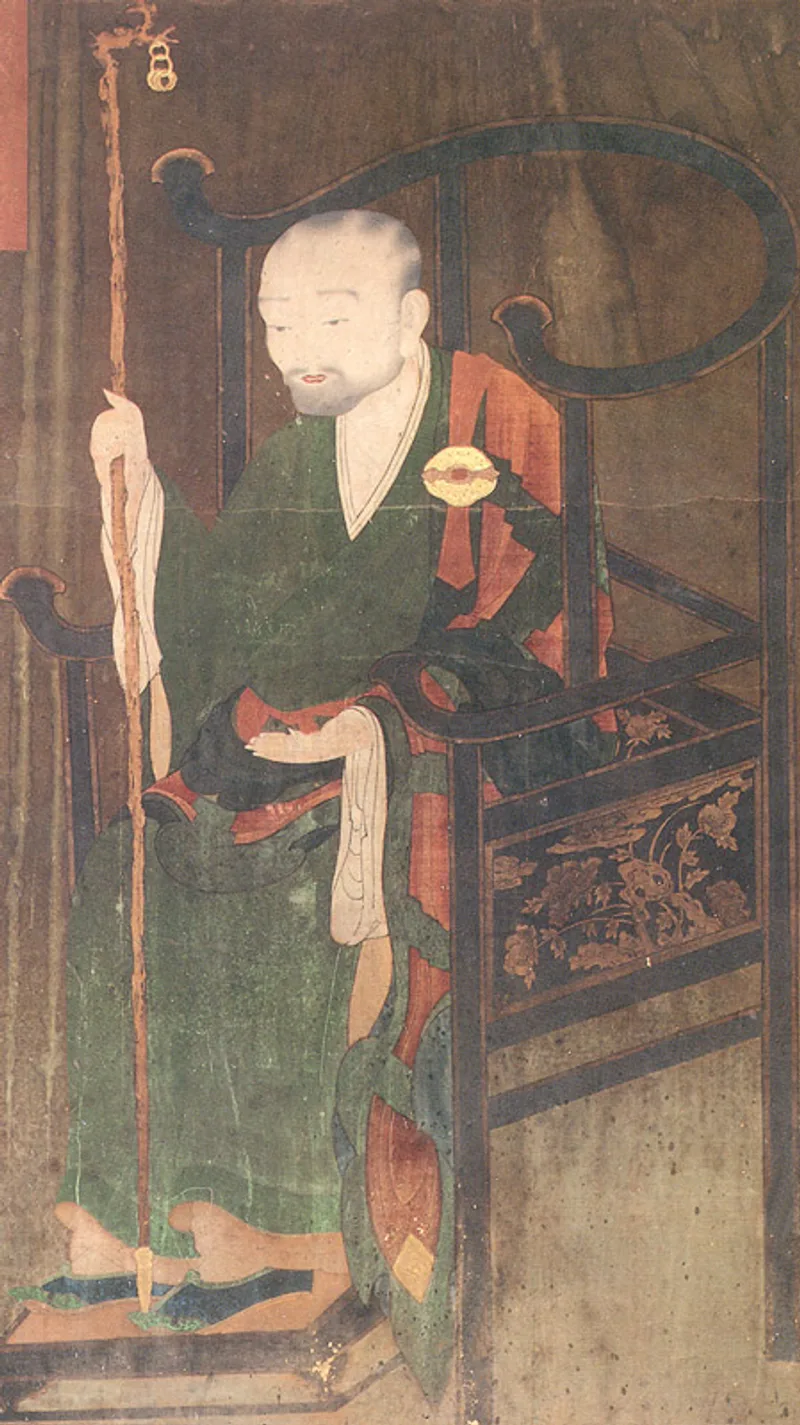
Bojo Jinul
1158 – 1210
Bojo Jinul (普照知訥, 1158–1210) is the central figure of Korean Seon and the master whose synthesis of meditation and doctrinal study shaped all subsequent Korean Buddhism[1]. Denied access to a formal Seon teacher in the sectarian strife of late-Goryeo Korea, he awakened through reading the Platform Sutra, Li Tongxuan's Huayan commentary, and the Records of Dahui Zonggao — an intellectual lineage rather than a transmitted one[1]. Against the Chinese controversy between sudden and gradual awakening he taught sudden awakening followed by gradual cultivation (돈오점수 dono jeomsu), and against the sectarian split between Seon and Hwaeom he argued that meditation and doctrinal study illuminate one another[2]. His Samādhi-Prajñā Society retreat on Mount Jogye (ending 1200) was the seed from which the later Jogye Order grew, and his writings — especially Secrets on Cultivating the Mind and Excerpts from the Dharma Collection — remain the foundational curriculum of Korean monastic training[3].
Names
Disciples of Bojo Jinul
Teachers and lineage of Bojo Jinul
Teacher / root master:
Works
A short tract by Pojo Chinul (1158–1210) framed as a question-and-answer manual for the new practitioner. It introduces the formula "sudden awakening followed by gradual cultivation" (頓悟漸修) that became the doctrinal signature of the Korean Jogye order. Read today as the first text any Korean Seon student studies.
- Beopjip Byeorhaengnok JeoryoExcerpts from the Dharma Collection and Special Practice Record
Chinul's substantial commentary on Zongmi's Chan-doctrinal compendium, the longest of his works. It systematises the relationship between Hwaŏm philosophy and Seon practice, defending kanhwa (kōan) practice in the lineage of Dahui while preserving the Korean integration of doctrinal study with meditative cultivation.
Teachings
- sayingThis Very Mind Is Buddha
If you want to know the Buddha, know that there is nothing apart from this mind. This very mind is the Buddha. This very mind is the dharma. The mind is not somewhere far away, to be sought through practice. It is closer than your own breath. Searching elsewhere, you miss what is already here. Returning, you find it has never been lost.
Those who awaken to their original mind all at once still carry old habits that cannot be shed in a day. Like a sick man who suddenly knows himself cured but whose body has not yet regained full strength, you must go on eating and taking medicine. Do not sit idle thinking the work is done. Awakening is the gate; cultivation is the road. Step through the gate — and then walk.
- practice-instructionSudden Awakening, Gradual Cultivation
Jinul taught that the mind which is to be cultivated and the mind which awakens are not two. Practice, in his framing, begins with sudden awakening (頓悟): the direct recognition that one's own nature is already Buddha-nature, complete and unborn. From this single recognition flows gradual cultivation (漸修): the patient work of dissolving habit-energies that continue to arise even after recognition. In practice this means investigating the hwadu — the live phrase — until intellectual grasping is exhausted, and then sustaining that clarity through every activity of body and speech. 'Even after one has awakened to one's original mind, one's habits are deeply rooted and cannot be removed in one stroke.' The Seon practitioner therefore sits, walks, eats, and works as continuous cultivation of what was already realized.
- proverbThe Mind Is Buddha
Outside of this mind there is no Buddha. Outside of this nature there is no dharma. Look for Buddha apart from your own mind, and you will not find him in a thousand kalpas.
Though one has awakened all at once to the same nature as the Buddhas, beginningless habit-energies remain; and so practice must still gradually purify what awakening has already seen.
- proverbTracing Back the Radiance
Trace back the radiance of your own mind. Do not chase after it outside — there is nothing outside to find.
- proverbThe Three Mysterious Gates
The first gate is the word; the second gate is the meaning; the third gate is the body and life. The student who passes the first stops at the word; the second stops at the meaning. Only the third sets down both word and meaning together.
- proverbAn Ox on the Mountain
Practitioners are like an ox on the mountain: from a distance the ox seems to walk along the path of clouds, yet at every moment its hooves are on the dirt. Awakening does not lift you off the ground — it sets you firmly on it.
- proverbNo Doctrine Outside the Mind
If you take the scriptures as the highest, the mind is buried under words. If you take the mind as the highest and abandon the scriptures, you cut yourself off from the past masters. Practice with both, and neither becomes a cage.
The mountain monk who congratulates himself on having left the world has not yet left himself. The householder who is empty in the marketplace is already in the mountains.
When awakening comes, do not grasp it. When it goes, do not chase it. Both grasping and chasing arise from the same restless habit. Sit until even the joy of seeing becomes another thing to release.
Samādhi without prajñā becomes dullness; prajñā without samādhi becomes scattering. Hold them as two wings of one bird, and the bird neither falls into stupor nor blows away in the wind.
Other masters in Jogye
Master Record Sources
- biographyTracing Back the Radiance: Chinul's Korean Way of Zen — Robert E. Buswell
- datesThe Formation of Ch'an Ideology in China and Korea — Robert E. Buswell
- nameTracing Back the Radiance: Chinul's Korean Way of Zen — Robert E. Buswell