Dajian Huineng
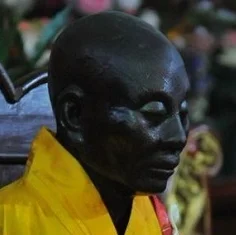
Dajian Huineng
638 – 713
Dajian Huineng, the sixth and final patriarch of undivided Chinese Chan, was an illiterate wood-seller from Guangdong province who became the most influential figure in the entire Chan tradition[1]. His story of recognition by Hongren and subsequent flight southward with the robe and bowl, pursued by monks who sought to reclaim the symbol of patriarchal authority, became one of the founding narratives of Chan[2]. His teaching was eventually recorded in the Platform Sutra, the only Chinese Buddhist text accorded the status of a sutra[3].
Huineng's central teaching was the direct, sudden recognition of original mind, which he called the "no-thought" or "no-mind" approach[4]. He insisted that awakening is not something achieved through gradual accumulation but is the immediate recognition of what one already fundamentally is. His famous exchanges, recorded in the Platform Sutra, demonstrate this direct pointing with extraordinary economy and power. Through his students—particularly Nanyue Huairang and Qingyuan Xingsi—virtually all subsequent Chinese Chan schools trace their lineage[5]. The Rinzai and Soto schools of Japan, the Korean Seon tradition, and the Vietnamese Thien tradition all descend from Huineng through these two streams.
Names
Disciples of Dajian Huineng
Teachers and lineage of Dajian Huineng
Teacher / root master:
Works
- Platform SūtraPlatform Sutra of the Sixth Patriarch (Liùzǔ Tánjīng)
The only Chinese text outside the imported Indian canon to be called a sūtra. Framed as Huineng's autobiography and sermons at Dafan-si, surviving in a Dunhuang manuscript (~780 CE) and a longer Yuan-dynasty redaction. It establishes the Southern School's signature teachings — sudden awakening, the inseparability of meditation and wisdom, and the seeing of one's own nature — and is the single most influential Chan text after the canonical sūtras.
Teachings
Wakuan complained when he saw a picture of bearded Bodhidharma: "Why hasn't that fellow a beard?" Mumon’s comment: If you want to study Zen, you must study it with your heart. When you attain realization, it must be true realization. You yourself must have the face of the great Bodhidharma to see him. Just one such glimpse will be enough. But if you say you met him, you never saw him at all. One should not discuss a dream In front of a simpleton. Why has Bodhidharma no beard? What an absurd question!
When he became emancipated the sixth patriarch received from the fifth patriarch the bowl and robe given from the Buddha to his successors, generation after generation. A monk named E-myo out of envy pursued the patriarch to take this great treasure away from him. The sixth patriarch placed the bowl and robe on a stone in the road and told E-myo: "These objects just symbolize the faith. There is no use fighting over them. If you desire to take them, take them now." When E-myo went to move the bowl and robe they were as heavy as mountains. He could not budge them. Trembling for shame he said: "I came wanting the teaching, not the material treasures. Please teach me." The sixth patriarch said: "When you do not think good and when you do not think not-good, what is your true self?" At these words E-myo was illumined. Perspiration broke out all over his body. He cried and bowed, saying: "You have given me the secret words and meanings. Is there yet a deeper part of the teaching?" The sixth patriarch replied: "What I have told you is no secret at all. When you realize your own true self the secret belongs to you." E-myo said: "I was under the fifth patriarch many years but could not realize my true self until now. Through your teaching I find the source. A person drinks water and knows himself whether it is cold or warm. May I call you my teacher?" The sixth patriarch replied: "We studied together under the fifth patriarch. Call him your teacher, but just treasure what you have attained." Mumon’s comment: The sixth patriarch certainly was kind in such an emergency. It was as if he removed the skin and seeds from the fruit and then, opening the pupil's mouth, let him eat. You cannot describe it, you cannot picture it, You cannot admire it, you cannot sense it. It is your true self, it has nowhere to hide. When the world is destroyed, it will not be destroyed.
Two monks were arguing about a flag. One said: "The flag is moving." The other said: "The wind is moving." The sixth patriarch happened to be passing by. He told them: "Not the wind, not the flag; mind is moving." Mumon’s comment: The sixth patriarch said: "The wind is not moving, the flag is not moving. Mind is moving." What did he mean? If you understand this intimately, you will see the two monks there trying to buy iron and gaining gold. The sixth patriarch could not bear to see those two dull heads, so he made such a bargain. Wind, flag, mind moves, The same understanding. When the mouth opens All are wrong.
- proverbYour Original Face
What was your original face before your parents were born?
- proverbIt Is Your Mind That Moves
It is not the wind that moves. It is not the flag that moves. It is your mind that moves.
Good friends, the wisdom of bodhi and prajna is originally possessed by worldly people themselves. It is only because their minds are deluded that they cannot attain enlightenment by themselves and must seek the help of a good and learned friend to show them how to see their own nature. Good friends, if you meet enlightenment, wisdom is realized. Good friends, my teaching of the Dharma takes meditation and wisdom as its basis. Never under any circumstances say mistakenly that meditation and wisdom are different; they are a unity, not two things. Meditation itself is the substance of wisdom; wisdom itself is the function of meditation.
Good friends, in this teaching of mine, from ancient times up to the present, all have set up no-thought as the main doctrine, no-form as the substance, and no-abiding as the basis. No-form is to be separated from form even when associated with form. No-thought is not to think even when involved in thought. No-abiding is the original nature of humankind. Successive thoughts do not stop; prior thoughts, present thoughts, and future thoughts follow one after the other without cessation. If one instant of thought is cut off, the Dharma body separates from the physical body. In the midst of all thoughts, do not abide in any thought. If you abide in thought, it is bondage. If in regard to all things you do not abide, that is freedom.
- dialogueThink Neither Good Nor Evil
The monk Huiming pursued the Sixth Patriarch to seize the robe and bowl. When he caught up, Huineng placed the robe and bowl on a rock and said, "This robe represents the dharma. It should not be fought over by force. Take it if you wish." Huiming tried to lift them but could not. Trembling, he said, "I came for the dharma, not for the robe." Huineng said, "Think neither good nor evil. At this very moment, what is your original face—the face you had before your mother and father were born?" At these words, Huiming was greatly enlightened.
- proverbThere Is No Mirror Stand
Originally there is not a single thing — where could dust alight? Polish a mirror that is not there, and you make new dust by polishing.
- proverbSelf-Nature Suffices
How marvelous: self-nature is originally pure. How marvelous: self-nature is originally unborn. How marvelous: self-nature is originally complete. How marvelous: self-nature is originally unmoving. How marvelous: from self-nature, the ten thousand things arise.
Without thinking good or evil, what is your original face — the face you had before your father and mother were born?
- proverbAn Illiterate Patriarch
I cannot read the sutra you hold; please read it aloud. The sutra is not in the words on the paper. It rises only in the place where listening is empty enough to receive.
- proverbNot the Flag, Not the Wind
Two monks argued: one said the flag moves, the other said the wind moves. I said: it is not the flag and not the wind — it is your minds that move.
Featured in
- Platform SūtraThe Robe and Bowl Transmission to Huineng
Other masters in Early Chan
Master Record Sources
638-713
Dajian Huineng
Early Chan
- koan_refsChart of the Chan Ancestors
23,29 1
- nameZen Editorial Overlay - Originals Curation
Dajian Huineng
- teachersZen Editorial Overlay - Originals Curation
Daman Hongren