Dahui Zonggao
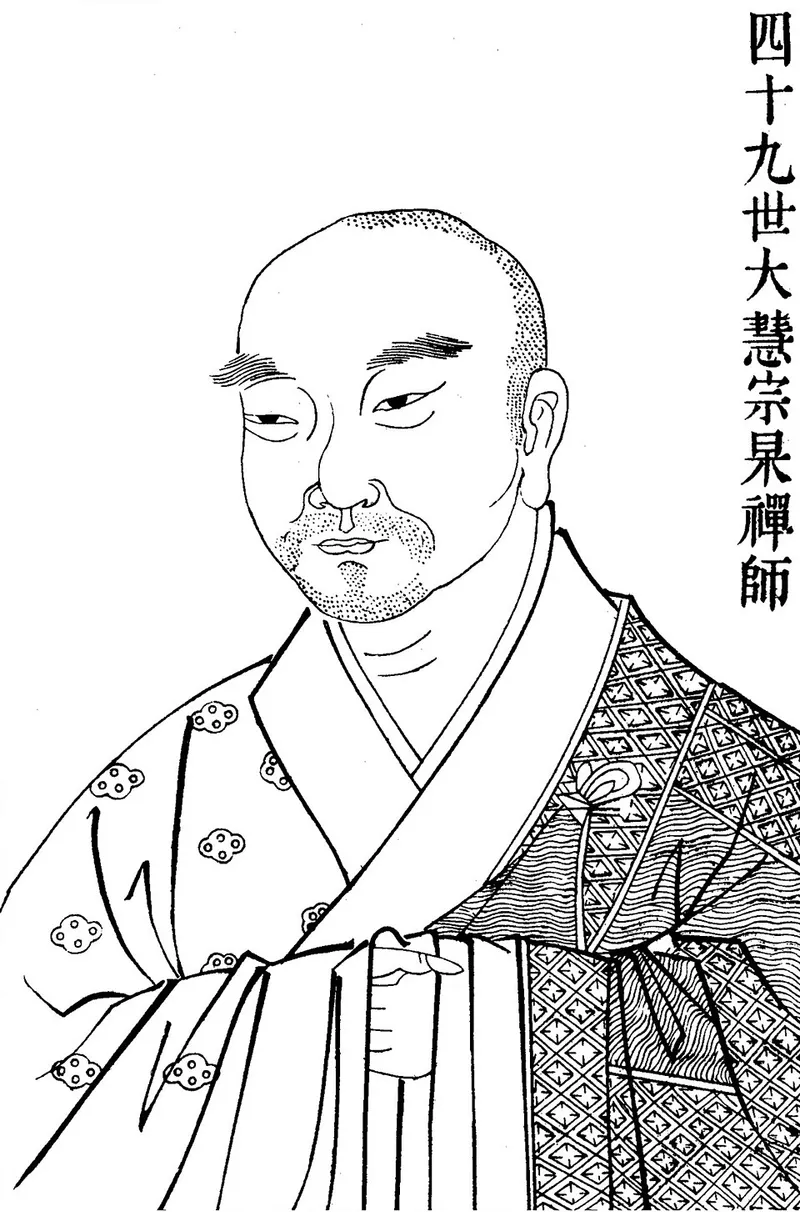
Dahui Zonggao
1089 – 1163
Dahui Zonggao (大慧宗杲, 1089–1163) was the principal Dharma heir of Yuanwu Keqin and the master most responsible for the development of the *kānhuà chán* (看話禪, "investigating-the-phrase Chan") method that has dominated Linji-house and Rinzai practice ever since[1]. His teaching method concentrated the student on a single critical phrase from a koan — most paradigmatically Zhaozhou's "wu" 無 — held to the point of "great doubt" (*dàyí*) until conceptual thinking exhausts itself and gives way to direct insight[2].
Dahui is also remembered for two unusually polemical campaigns: the public attack on the *mòzhào chán* ("silent illumination") of his Caodong contemporaries Hongzhi Zhengjue and Changlu Qingliao, which he characterised as a "withered-tree" quietism, and the burning of the printing blocks of his own teacher's *Bìyán Lù* in 1140 — an act preserved in his correspondence and explained as a refusal to allow the literary appreciation of the text to substitute for the labour of investigation it was meant to provoke[3]. Morten Schlütter's *How Zen Became Zen* is the standard modern monograph on the Dahui–Hongzhi controversy and its institutional context[4].
Names
Teachers and lineage of Dahui Zonggao
Teacher / root master:
Teachings
- proverbMake Your Mind Bright
Just make your mind bright and clear. One day you will get it, and you will know it was always right there.
At the place where you cannot get a grip or a foothold, where you are totally helpless—that is where you must exert your full strength. At the place where there is no flavor at all—that is where you must taste deeply. When you reach the point where you feel like a ball of hot iron stuck in your throat that you can neither swallow nor spit out—that is the time to let go of your former knowledge, your clever understanding, your learned interpretations. Great doubt—great awakening. Small doubt—small awakening. No doubt—no awakening.
I burned the wood-blocks of my master's record because students were memorizing the cases instead of meeting them. The fire that destroyed the book preserved the dharma.
Some teachers tell you to sit until the mind is bright like a clear pond. I tell you: bring up the hwadu and let it cut through the pond. A pond untouched by a stone does not yet show its bottom.
- proverbLetters to Lay Students
I write to officials and merchants the same way I speak to monks. The dharma is not embarrassed by the marketplace; the marketplace is the place where it is most needed.
- proverbGreat Mass of Doubt
Stir up a great mass of doubt about the hwadu. Stir until the doubt becomes the only thing in your day. The day the doubt cracks, the day cracks too.
The householder's practice is the hardest. Children cry, debts arrive, work waits. Nobody rings a bell to begin or end. Whoever practices well in this is already an old master.
- proverbQuietude Is Not the Goal
If quietude were the goal, every stone would be a Buddha. Quietude is the chair the practice sits in; it is not the practice itself.
Other masters in Linji
Master Record Sources
1089-1163
Dahui Zonggao
Linji
- datesZen Editorial Overlay - Originals Curation
1089-1163
- nameZen Editorial Overlay - Originals Curation
Dahui Zonggao
- teachersZen Editorial Overlay - Originals Curation
Yuanwu Keqin