Thích Thanh Từ
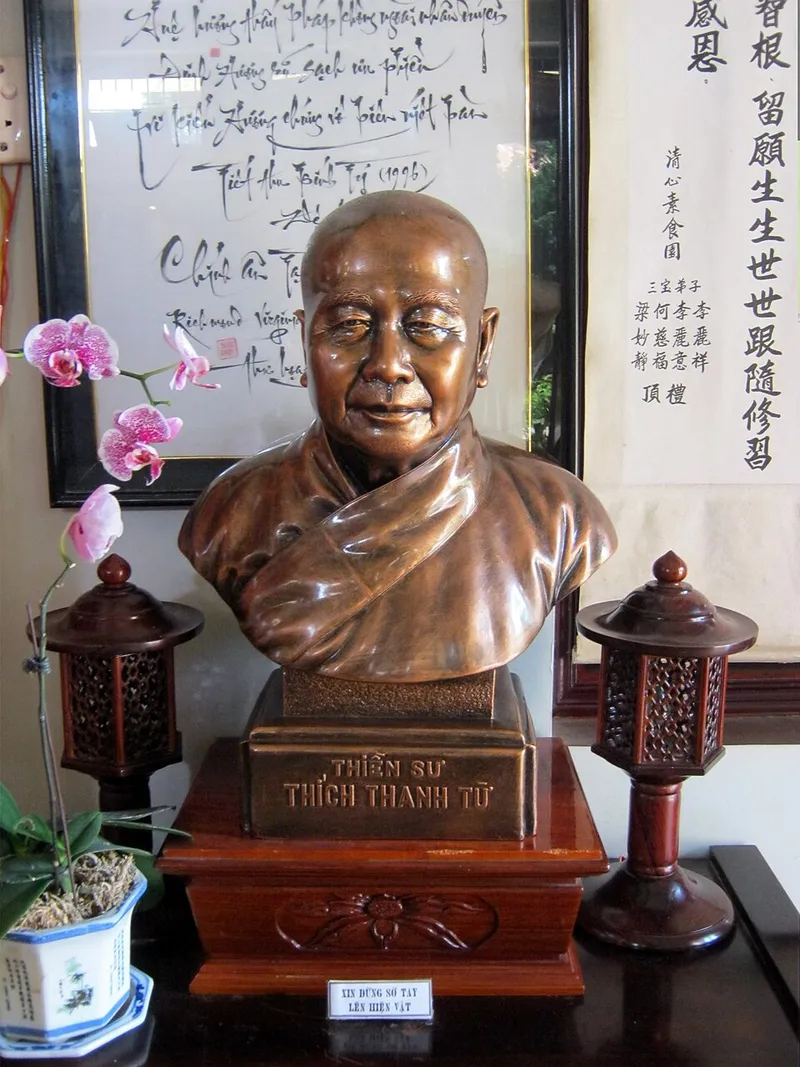
Thích Thanh Từ
1924 – Unknown
Thích Thanh Từ (1924–2022) was the principal architect of the modern revival of Trúc Lâm Zen, the indigenous Vietnamese Thiền school founded by Emperor Trần Nhân Tông in the thirteenth century and largely dormant for some six hundred years[1]. He was born Trần Hữu Phước on 24 July 1924 in Tích Khánh hamlet, Thiện Mỹ commune, Trà Ôn district, Vĩnh Long province in the Mekong Delta[1]. Drawn to monastic life from his youth, he was ordained at Chùa Phật Quang on 15 July 1949 under the great southern reformer Thích Thiện Hoa as his root teacher (bổn sư), and received the full bhikṣu precepts in 1952 from Tổ Khánh Anh. He was first formed in the Pure Land tradition that dominated southern Vietnamese Buddhism, and only in 1966 — after building a small meditation hut and entering an extended solitary retreat — did he turn decisively toward Thiền, an inner reorientation he later described as a recovery of the lost Vietnamese Zen of Trúc Lâm rather than a borrowing from China or Japan[1].
In December 1971 he opened Thiền viện Chân Không on Mount Tương Kỳ near Vũng Tàu with ten students, and in 1974 founded Thiền viện Thường Chiếu in Long Thành, Đồng Nai — alongside the satellite hermitages Linh Quang, Chân Không, and Bát Nhã — which from 1986 became the organizational headquarters of the entire Trúc Lâm revival[1]. From the early 1990s he undertook a deliberate programme of re-rooting the school in its historical homeland: Thiền viện Trúc Lâm Đà Lạt opened on Phụng Hoàng mountain above Tuyền Lâm Lake in 1993; Thiền viện Trúc Lâm Yên Tử was consecrated in 2002 on the very mountain where Trần Nhân Tông had established the original school; and Thiền viện Trúc Lâm Tây Thiên was opened in 2005 in Vĩnh Phúc[1]. By his later years more than sixty Trúc Lâm monasteries in Vietnam and overseas — including houses in California, Australia, Canada, and France — traced their lineage back to him[1].
His pedagogical method, which he called 'the practising method of Vietnamese Zen' (Thiền tông Việt Nam), centres on recognising thoughts as empty as they arise — biết vọng không theo, 'knowing the false thoughts and not following them' — and on a curriculum built from the recorded sayings of the Trúc Lâm patriarchs Trần Thái Tông, Tuệ Trung Thượng Sĩ, Trần Nhân Tông, Pháp Loa, and Huyền Quang, alongside the Heart and Diamond sutras and the Chinese Chan classics[2]. He began writing in 1961 and produced more than fifty original works and translations over the next four and a half decades, gathered in the forty-three-volume *Thích Thanh Từ Toàn Tập*, including *Thiền Tông Việt Nam Cuối Thế Kỷ 20* ('Vietnamese Zen at the End of the Twentieth Century'), annotated editions of the Trúc Lâm records, the popular primer *Phật Giáo Trong Mạch Sống Dân Tộc*, and Vietnamese commentaries on the Heart Sutra, Diamond Sutra, and Sutra of Hui-neng[2]. Among his closest dharma heirs and senior disciples — many of whom now lead the major Trúc Lâm centres — are Thích Nhật Quang at Thường Chiếu, Thích Thông Phương at Trúc Lâm Đà Lạt, Thích Kiến Nguyệt at Trúc Lâm Tây Thiên, and Thích Tâm Hạnh, who together have carried the revival into a second institutional generation[1].
Names
Teachers and lineage of Thích Thanh Từ
Teacher / root master:
Other masters in Trúc Lâm
Master Record Sources
- biographyWikipedia - Zen Lineage Charts