Plum Village
Thiền
Plum Village
Làng Mai · 梅村
Branch of Lâm Tế
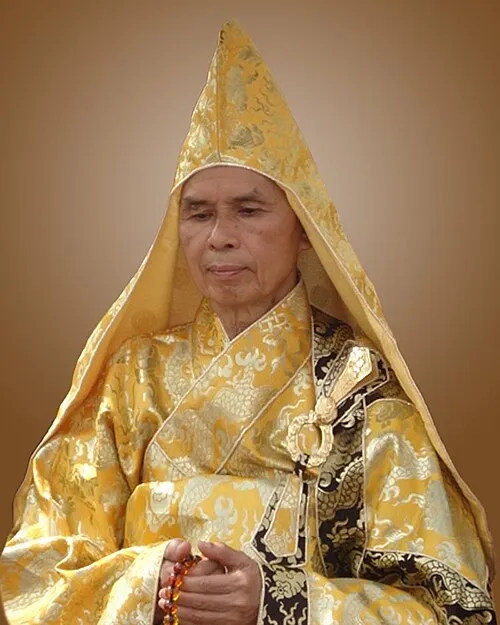
The Plum Village tradition is a modern school of engaged Buddhism founded by Thích Nhất Hạnh (1926–2022) in the Lâm Tế (Vietnamese Linji) lineage[1]. Named after Plum Village, the practice center established in the Dordogne region of France in 1982, the tradition emphasizes mindfulness in daily life, engaged social action, and the integration of meditation practice with ethical living[2]. Thích Nhất Hạnh developed the practice of the Fourteen Mindfulness Trainings as the foundation of the Order of Interbeing (Tiếp Hiện), established in 1966 during the Vietnam War[3]. The tradition's teaching methods—walking meditation, mindful eating, dharma sharing circles, and the practice of Beginning Anew—have made Zen practice accessible to millions worldwide[2]. With monasteries and practice centers on five continents and hundreds of local sanghas, Plum Village is one of the largest Buddhist communities in the Western world[2].
Meditation practice
Plum Village practice integrates mindfulness into every activity—walking meditation, mindful eating, conscious breathing, deep listening, and careful speech—so that formal sitting becomes one part of a whole ecology of awareness[2]. The tradition is highly structured but not monastically severe in the classical Zen sense: bells of mindfulness, guided meditations, communal chanting, and dharma sharing circles repeatedly return practitioners to embodied presence. The Fourteen Mindfulness Trainings of the Order of Interbeing function as both ethical commitments and contemplative exercises, linking inner transformation to nonviolence, right consumption, and compassionate social action[3]. Beginning Anew, total relaxation, and ‘lazy days’ further mark Plum Village as a school in which healing, community, and engagement are integral to practice rather than secondary to it.
Prominent masters
Key texts
- The Miracle of Mindfulness
Originally a long letter of instruction to a young monk during the Vietnam War. Introduced 'mindfulness' as a practicable discipline to Western readers and remains the canonical short introduction to Plum Village practice.
- The Heart of the Buddha's Teaching
Plum Village's definitive presentation of the Four Noble Truths, Noble Eightfold Path, and the Three Dharma Seals — the tradition's own claim that its mindfulness practice is classical Buddhism, not a secular derivative.
- Interbeing: Fourteen Guidelines for Engaged Buddhism
The charter of the Order of Interbeing — the Fourteen Mindfulness Trainings with extended commentary. Functions as both ethical code and contemplative manual for engaged practitioners.
- Old Path White Clouds
Thích Nhất Hạnh's life of the Buddha, drawn from the Pali canon and classical Mahayana texts. The narrative core of Plum Village's self-understanding as a Buddha-centered tradition.
Key concepts
- Interbeing
Thích Nhất Hạnh's English neologism for the Avataṃsaka / Huayan doctrine that nothing exists by itself — every phenomenon 'inter-is' with every other. The philosophical heart of Plum Village practice and ethics.
- Fourteen Mindfulness Trainings
The ethical and contemplative commitments of the Order of Interbeing, founded in 1966 — openness, non-attachment to views, freedom of thought, awareness of suffering, simple and healthy living, and so on. Both vows and practice instructions.
- Walking meditation
'Kinh hành' in Vietnamese, kinhin in Japanese — at Plum Village, walking is a central and distinct practice, not a mere break between sittings. Each step is coordinated with breath and the recognition that arrival is here.
- Bell of mindfulness
The recurring sound-anchor of Plum Village life. Phone rings, clocks, and temple bells are all treated as invitations to return to the breath; the practice trains attention through environmental cues rather than willpower.
- Beginning Anew
A four-part reconciliation practice (flower watering, expressing regret, expressing hurt, asking for support) central to sangha life. The community dimension of individual mindfulness: clearing interpersonal sediment so that practice can continue.
In the words of the masters
- The Present Moment
The present moment is the only moment available to us, and it is the door to all moments. When you touch the present deeply, you touch the past and the future at the same place.
- Interbeing
If you are a poet, you will see clearly that there is a cloud floating in this sheet of paper. Without a cloud, there will be no rain; without rain, the trees cannot grow; and without trees, we cannot make paper. The cloud and the paper inter-are.
- Washing Dishes to Wash Dishes
There are two ways to wash the dishes: to wash them in order to have clean dishes, and to wash them in order to wash them. The second is the practice. The first is only a chore.
- No Mud, No Lotus
There is no lotus without mud. The wise gardener does not wash the mud away — she invites it close enough to feed the flower.
- Anger Like a Baby
When anger arises, do not push it away. Hold it like a baby crying in your arms. The baby does not know why it cries; it only knows that it must be held until it does not.
- Walking as If Kissing the Earth
Walk as if you are kissing the earth with your feet. The earth has been waiting for that kiss for a very long time, and most of us pass over it without ever noticing.
Masters in this branch
Plum Village practice centres
France
United Kingdom
Netherlands
- Welcoming Joy Sangha (Plum Village Amsterdam Centrum)
- Sangha Leven in Aandacht Amsterdam
- Sangha Amsterdam Oost - Diemen (Plum Village)
- Open Hart Sangha Alkmaar/Bergen (Plum Village)
- Sangha Amersfoort (Plum Village)
- Metta Sangha Arnhem (Plum Village)
- Sangha Baarn-Soest (Plum Village)
- Sangha Breda (Plum Village)