Thích Nhất Hạnh
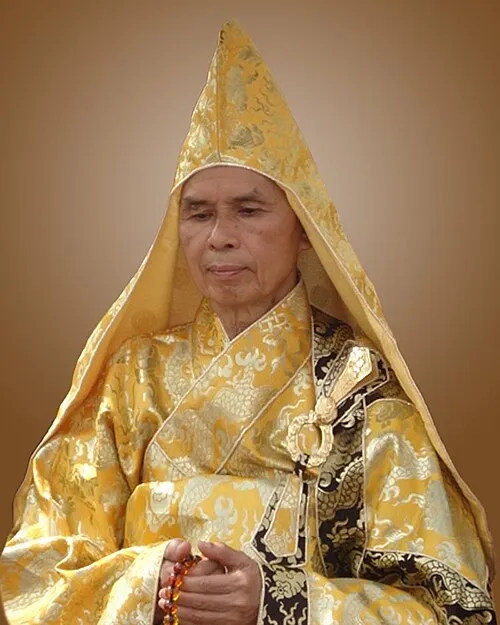
Thích Nhất Hạnh
1926 – 2022
Thích Nhất Hạnh (一行, 1926–2022) was the Vietnamese Thiền master, poet, peace activist, and author who, more than any other modern teacher, shaped the global understanding of mindfulness and gave the world the term 'engaged Buddhism.'[1] He was born Nguyễn Xuân Bảo on 11 October 1926 in Huế, central Vietnam, and at sixteen entered Từ Hiếu Temple as a novice under Zen Master Thanh Quý Chân Thật, of the forty-third generation of the Lâm Tế (Linji) school and the ninth generation of its Liễu Quán branch; he was fully ordained as a bhikṣu at Ấn Quang Pagoda in Saigon in 1951[1]. He studied at the Báo Quốc Buddhist Academy and took degrees in French and Vietnamese literature at Saigon University before going to the United States in 1960–1962 to study comparative religion at Princeton and to lecture at Columbia and Cornell; he eventually read and taught in Vietnamese, French, Classical Chinese, Sanskrit, Pali, and English[1]. On 1 May 1966 his teacher transmitted 'the lamp' to him, formally making him a dharmacharya and spiritual head of the Từ Hiếu line[2].
Out of the Vietnam War he built two of the most influential institutions of modern Buddhism[1]. In 1964 he co-founded the School of Youth for Social Service (SYSS), a 'neutral' corps that trained some ten thousand young Buddhists to rebuild bombed villages, run schools and clinics, and care for refugees on both sides of the war. Between 1964 and 1966 he and a small group of monastics founded the Order of Interbeing (Tiếp Hiện), a mixed monastic and lay order whose Fourteen Mindfulness Trainings reframed the bodhisattva precepts for engaged practice[2]. During his 1966 American tour he met Martin Luther King Jr. and persuaded him to speak publicly against the war; in 1967 King nominated Nhất Hạnh for the Nobel Peace Prize, writing that 'I do not personally know of anyone more worthy of the Nobel Peace Prize than this gentle monk from Vietnam.'[1] Refusing to support either side of the war cost him his country: both Saigon and Hanoi denied him re-entry, and he lived in exile in France for thirty-nine years. In 1982 he and Sister Chân Không founded Plum Village (Làng Mai) in the Dordogne, which by 2019 had grown into nine affiliated monasteries on three continents and the largest Buddhist monastic community in Europe and North America, with more than 750 resident monastics[2].
He published more than one hundred books in English[3]. The most influential include *Vietnam: Lotus in a Sea of Fire* (Hill and Wang, 1967), in which he coined the term 'engaged Buddhism'; *The Miracle of Mindfulness* (Beacon Press, 1975), originally a long letter of encouragement to SYSS workers and later credited as a foundational text for mindfulness-based clinical interventions; *Being Peace* (Parallax Press, 1987); *Old Path White Clouds: Walking in the Footsteps of the Buddha* (Parallax Press, 1991); *Peace Is Every Step* (Bantam, 1992); *Living Buddha, Living Christ* (Riverhead, 1995); and *The Heart of the Buddha's Teaching* (Broadway, 1998)[3]. After a severe brain hemorrhage in November 2014 he gradually returned to Vietnam, settling permanently at the root temple of Từ Hiếu in 2018, where he died on 22 January 2022 at the age of ninety-five[1]. His teaching survives through a dense lineage of dharma heirs — Sister Chân Không, Thầy Pháp Ấn, Thầy Pháp Dung, Sister Annabel Laity (Chân Đức), Thầy Pháp Linh, and many others — together with the lay membership of the Order of Interbeing[2].
Names
Teachers and lineage of Thích Nhất Hạnh
Teacher / root master:
Works
Originally a long letter (1974) from Thích Nhất Hạnh to Brother Quang of the School of Youth for Social Service in Saigon, written during the Vietnam War. Translated by Mobi Ho and published by Beacon Press in 1975, it became the seminal English-language introduction to mindfulness practice — its descriptions of washing dishes, drinking tea, and walking shaped the secular mindfulness movement that followed.
Thích Nhất Hạnh's 1973 introduction to Vietnamese Thiền, originally published in French as Clés pour le Zen. Distinct from his later mindfulness writings, it situates his teaching in the lineage of Linji and the Trúc Lâm tradition, and remains his clearest book-length account of kōan practice as a Mahāyāna inheritance.
Teachings
I am the mayfly metamorphosing on the surface of the river, and I am the bird that swoops down to swallow the mayfly. I am the frog swimming happily in the clear water of a pond, and I am the grass snake that silently feeds itself on the frog. I am the child in Uganda, all skin and bones, my legs as thin as bamboo sticks. And I am the arms merchant, selling deadly weapons to Uganda. Please call me by my true names, so I can hear all my cries and my laughter at once, so I can see that my joy and pain are one.
The present moment is the only moment available to us, and it is the door to all moments. Each breath, each step, each bite of food — these are not preparations for life. These are life. When we walk, we touch the earth with each step, and if we can touch it in full awareness, the earth becomes real, we become real, and the connection between us and all things becomes real. Mindfulness is the miracle by which we can call back our dispersed mind and restore it to wholeness.
- practice-instructionBreathing In, I Know I Am Breathing In
Thích Nhất Hạnh framed practice as the conscious unification of body and mind through the breath. The first instruction is the simplest: 'Breathing in, I know I am breathing in. Breathing out, I know I am breathing out.' Awareness rides on the breath; the breath, when noticed, slows and deepens of itself. From that base he taught the gathas — short verses spoken silently with each breath ('Breathing in, I calm my body; breathing out, I smile') — and walking meditation, in which each step is taken in full awareness of contact with the earth. 'The miracle is not to walk on water; the miracle is to walk on the green earth.' Sitting, walking, eating, washing dishes: any of these is the whole of Plum Village practice when done with one undivided breath.
- proverbThe Present Moment
The present moment is the only moment available to us, and it is the door to all moments. When you touch the present deeply, you touch the past and the future at the same place.
- proverbInterbeing
If you are a poet, you will see clearly that there is a cloud floating in this sheet of paper. Without a cloud, there will be no rain; without rain, the trees cannot grow; and without trees, we cannot make paper. The cloud and the paper inter-are.
There are two ways to wash the dishes: to wash them in order to have clean dishes, and to wash them in order to wash them. The second is the practice. The first is only a chore.
- proverbNo Mud, No Lotus
There is no lotus without mud. The wise gardener does not wash the mud away — she invites it close enough to feed the flower.
- proverbAnger Like a Baby
When anger arises, do not push it away. Hold it like a baby crying in your arms. The baby does not know why it cries; it only knows that it must be held until it does not.
Walk as if you are kissing the earth with your feet. The earth has been waiting for that kiss for a very long time, and most of us pass over it without ever noticing.
- proverbDeep Listening
Listen with the ear of the heart. The other person is speaking from a wound you cannot see; if you hear only the words, you will quarrel with the bandage.
- proverbEngaged Buddhism
When the village is on fire, do not stay in the meditation hall. Go out, carry water, comfort the children. The hall will be there when you return — and you will sit better in it for having gone.
- proverbA Cloud Never Dies
A cloud cannot die. It can only become rain, become river, become sea. So with you. The form is borrowed; the water is what you are.
- proverbSmile at the Source
Breathe in, calm body. Breathe out, smile. The smile is not for show; it is the body's way of telling itself that the storm has passed and it is safe to come outside.
- proverbWalking with the Buddha
When you walk, walk as though the Buddha walks with you. After many walks, you will notice that the Buddha walks because you do — and that he never had any other legs.
- proverbDrinking Tea
Drink your tea slowly and reverently, as if it is the axis on which the world turns — slowly, evenly, without rushing toward the future. Live the actual moment; only this moment is life.
Master Record Sources
- biographyWikipedia - Zen Lineage Charts