Baotang Wuzhu
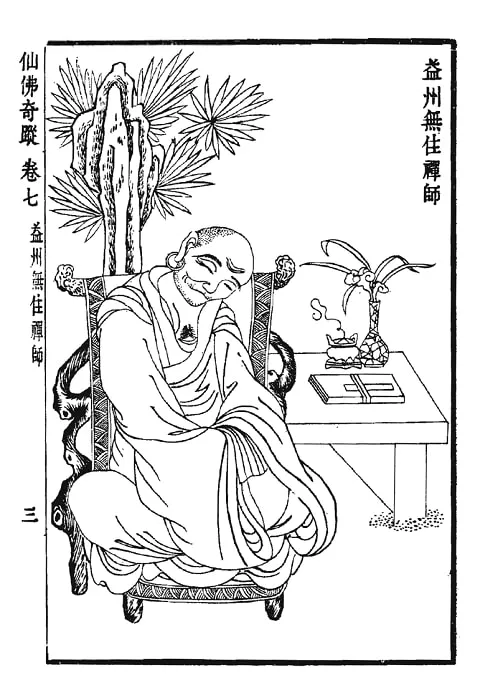
Baotang Wuzhu
714 – 774
Wuzhu (無住, 714–774) was the founder of the Bao-Tang school of Chan in Sichuan and one of the most radical figures of the eighth-century proto-Chan movement[1]. Initially trained in the Northern-School lineage and then in the Sichuanese Jingzhong tradition of Wuxiang, he eventually established his own community at Bao-Tang temple (保唐寺) near Chengdu and propagated an aggressively iconoclastic teaching that rejected external practice — bowing, chanting, formal sūtra recitation, and even seated meditation — as forms of attachment[2].
The Bao-Tang school is best known through the *Lìdài Fǎbǎo Jì* (歷代法寶記), a late-eighth-century Dunhuang text recovered in the early twentieth century and now central to the modern scholarly reconstruction of pre-Linji Chan. The school did not survive long as an independent institution, but its insistence that no method can substitute for the immediate recognition of Buddha-nature anticipates and is sometimes read alongside the iconoclastic flavour of later Hongzhou-line Chan; Wendi Adamek's *The Mystique of Transmission* is the standard modern monograph[3].
Names
Teachers and lineage of Baotang Wuzhu
Teacher / root master:
Other masters in Early Chan
Master Record Sources
- datesZen Editorial Overlay - Originals Curation
714-774
- nameZen Editorial Overlay - Originals Curation
Baotang Wuzhu
- teachersZen Editorial Overlay - Originals Curation
Jingzhong Wuxiang