Daman Hongren
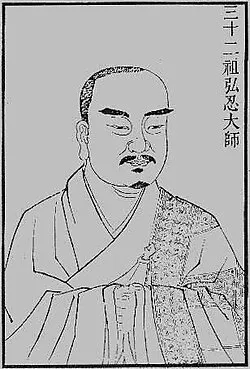
Daman Hongren
602 – 675
Daman Hongren, the fifth Chinese Chan patriarch, continued and expanded the communal model of practice established by his teacher Dayi Daoxin on East Mountain[1]. Under Hongren's leadership, the East Mountain community became the preeminent center of Chan practice in Tang dynasty China, drawing students from throughout the country. His teaching emphasized the direct recognition of original mind as the ground of all practice and all merit[2].
Hongren is particularly significant because among his many students he recognized the extraordinary capacity of Huineng, a young illiterate wood-seller from the south[3]. The story of their encounter is pivotal in Chan history. Hongren tested all his students by asking them to demonstrate their understanding in verse. The head monk Shenxiu wrote: "The body is the Bodhi tree; the mind is like a bright mirror's stand. At all times we must strive to polish it and must not let the dust collect." Huineng had someone read this to him and then composed his own verse: "Bodhi originally has no tree; the bright mirror has no stand. Originally there is not a single thing; where could dust alight?" Hongren recognized Huineng's verse as the expression of a deeper understanding and secretly transmitted to him the patriarchal robe and bowl[3].
Names
Disciples of Daman Hongren
Teachers and lineage of Daman Hongren
Teacher / root master:
Teachings
The essence of cultivating the Way lies in maintaining awareness of the fundamental mind. This fundamental mind is the pure mind that has existed since before the beginning. It is bright and shining, never obscured, luminous and aware, knowing all things. It is also called the Buddha-nature, or the Tathagata-garbha. The sutras speak of it in a thousand ways, but all point to this one thing. If you can maintain continuous awareness of this mind without wavering, you will naturally arrive at the shore of awakening. There is no other method.
The Fifth Patriarch came to the threshing room at midnight. He found Huineng hulling rice. He asked, 'Is the rice ready?' Huineng said, 'The rice has long been ready—it only needs to be sifted.' The Fifth Patriarch struck the mortar three times with his staff and left. Huineng understood the meaning and went to the patriarch's room at the third watch. The Fifth Patriarch used his robe to shield them from view and expounded the Diamond Sutra. When he reached the phrase 'produce a mind that abides nowhere,' Huineng was greatly awakened and exclaimed, 'Who would have thought that self-nature is originally pure! Who would have thought that self-nature is originally complete!' The Fifth Patriarch then transmitted the robe and bowl to him, saying, 'You are now the Sixth Patriarch. Guard this teaching well.'
- proverbGuard the One Mind
Guard the one mind through all twelve hours of the day. The chickens scatter, the visitors come and go; if the one mind is guarded, none of them disturb the household.
- proverbTrue Pearl in Muddy Water
Stir the muddy water and the pearl is hidden. Sit still, and the mud settles, and the pearl appears — not because you have created it but because you have stopped disturbing it.
- proverbTwo Verses, One Field
Shenxiu wrote of polishing the mirror. Huineng wrote that there is no mirror. The robe went south; the polishing did not stop. Both verses were correct, in different rooms of the same house.
Other masters in Early Chan
Master Record Sources
602-675
Daman Hongren
Early Chan
- nameZen Editorial Overlay - Originals Curation
Daman Hongren
- teachersZen Editorial Overlay - Originals Curation
Dayi Daoxin
601–674
Daman Hongren
Chan
- teachersWikipedia - Zen Lineage Charts
Dayi Daoxin