Mahasattva Fu
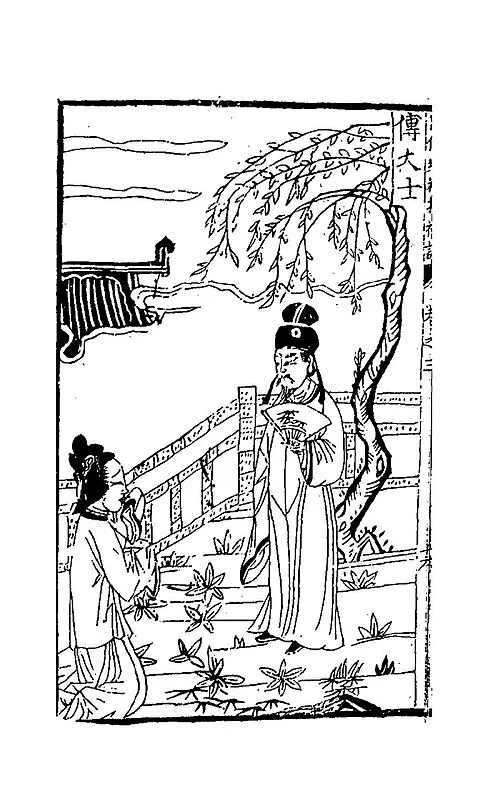
Mahasattva Fu
497 – 569
Fu Dashi (傅大士, "Great Master Fu"), also called Fu Xi or Shanhui Dashi, was a Liang-dynasty lay practitioner whom later Chan tradition retrospectively claimed as one of its precursors. Born in 497 in Yiwu (modern Zhejiang), he combined Buddhist devotion with Daoist and folk elements; the Liang emperor Wu (r. 502–549), a major Buddhist patron, is reported in the lamp records to have invited him repeatedly to the capital and treated him as a living bodhisattva[1]. Tradition credits him with the invention of the *zhuanlunzang* (轉輪藏), the revolving sūtra repository whose rotation was held to confer the merit of reading its scriptures, and the device became standard furniture in later East Asian temple libraries[2].
The Chan transmission-of-the-lamp literature preserves a celebrated anecdote in which Emperor Wu invited Fu Dashi to lecture on the *Diamond Sūtra*: he ascended the high seat, struck the lecture-table once with his ruler, and descended without speaking, whereupon the court monk Baozhi (寶誌) declared that "the Mahāsattva has finished expounding the sūtra"[3]. The episode — already in circulation by the Tang and prominent in the *Jǐngdé Chuándēng Lù* — became one of the earliest models for the "transmission outside the scriptures" trope that Chan writers retrojected onto pre-Chan figures, regardless of how historical its core may be[4].
Names
Teachers and lineage of Mahasattva Fu
Teacher / root master:
Other masters in Early Chan
Master Record Sources
Mahasattva Fu
497-569
Mahasattva Fu
Early Chan
Bodhidharma
- nameZen Editorial Overlay - Originals Curation
Mahasattva Fu