D.T. Suzuki
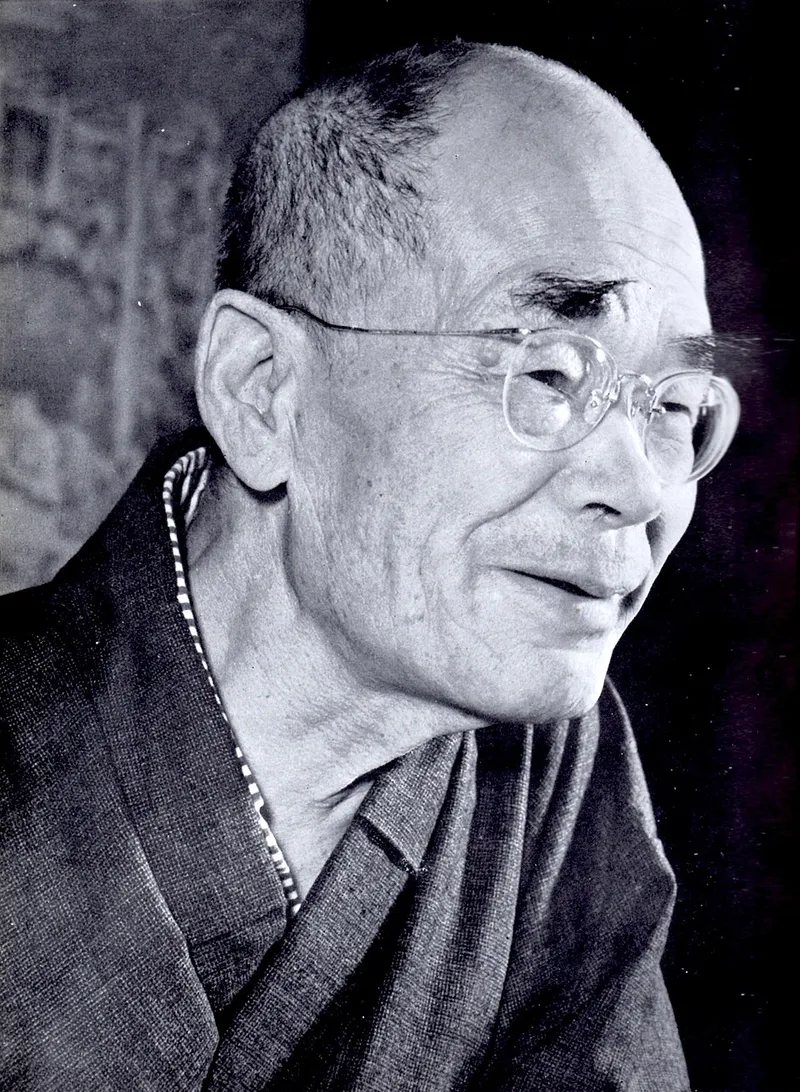
D.T. Suzuki
1870 – 1966
Daisetsu Teitarō Suzuki (鈴木 大拙 貞太郎) was born on 18 October 1870 in Honda-machi, Kanazawa, in Japan's Ishikawa Prefecture, into a family of physicians of samurai descent that had been impoverished by the Meiji Restoration. He studied at Waseda University and the Imperial University of Tokyo, where he acquired the unusual command of Chinese, Sanskrit, Pāli, English, French, and German that would later define his career as a translator and interpreter of the Zen tradition for Western readers[1].
During his Tokyo years Suzuki began zazen at Engaku-ji in Kamakura under Imakita Kōsen, and after Kōsen's death in 1892 he continued under Kōsen's heir Soyen Shaku, undergoing what he later described as "four years of mental, physical, moral, and intellectual struggle" before receiving the lay name Daisetsu — "Great Simplicity" — from his teacher. Suzuki never took monastic ordination; his entire career was as a lay (koji) Zen practitioner and scholar, a status that was decisive in shaping how Zen would later be presented to the West[1][2].
In 1897, on Soyen's recommendation, Suzuki travelled to LaSalle, Illinois, to assist the German-American philosopher Paul Carus at Open Court Publishing. Over the next eleven years he translated the *Tao Te Ching*, Aśvaghoṣa's *Awakening of Faith in the Mahayana* (Open Court, 1900), and produced *Outlines of Mahāyāna Buddhism* (Luzac, 1907) — the first systematic English presentation of the tradition. After returning to Japan he married the American Theosophist Beatrice Erskine Lane in 1911 and took up a chair in Buddhist philosophy at Ōtani University in Kyoto in 1921, where the couple founded the journal *The Eastern Buddhist*[1].
The works that made Suzuki the single most influential interpreter of Zen for the twentieth-century West appeared in a sustained burst from London publisher Luzac and later Rider: *Essays in Zen Buddhism, First Series* (1927), *Second Series* (1933) and *Third Series* (1934); *An Introduction to Zen Buddhism* (1934), for which C. G. Jung wrote his celebrated foreword; *The Training of the Zen Buddhist Monk* (1934); and *Manual of Zen Buddhism* (1935). After the war he produced *Zen and Japanese Culture* (Princeton/Bollingen, 1959, an expansion of his 1938 *Zen Buddhism and Its Influence on Japanese Culture*), *Mysticism: Christian and Buddhist* (Harper, 1957), and the late *Shin Buddhism* lectures[1].
From 1952 to 1957 Suzuki taught at Columbia University, where his open seminars drew John Cage, Erich Fromm, Karen Horney, the psychoanalyst Richard DeMartino, Thomas Merton and a circle of Beat writers including Allen Ginsberg and Jack Kerouac. The 1957 conference in Cuernavaca that produced *Zen Buddhism and Psychoanalysis* (Harper, 1960, with Fromm and DeMartino), together with his earlier exchanges with Jung at the Eranos meetings, fixed his idiosyncratic reading of Zen — emphasising satori, "pure experience" in the manner of his Kyoto School friend Nishida Kitarō, and the irrational over the institutional — as the West's default image of the tradition. Nominated for the Nobel Peace Prize in 1963, he died in Kamakura on 12 July 1966; his pupils Masao Abe and Mihoko Okamura carried his interpretive project forward through *The Eastern Buddhist* and the thirty-two-volume *Suzuki Daisetsu Zenshū*[1][3].
Names
Teachers and lineage of D.T. Suzuki
Additional teachers:
Teachings
- proverbBefore and After Zen
Before studying Zen, men are men and mountains are mountains. After a first glimpse into the truth of Zen, mountains are no longer mountains. After enlightenment, mountains are once again mountains.
- proverbGod of Zen
The God of Zen lives in the kitchen, in the garden, in the workshop—wherever work is done with the whole heart.
Unless it grows out of yourself, no knowledge is really yours. It is only borrowed plumage.
- sayingOn the Essence of Zen
Zen in its essence is the art of seeing into the nature of one's own being, and it points the way from bondage to freedom. We can say that Zen liberates all the energies properly and naturally stored in each of us, which are in ordinary circumstances cramped and distorted so that they find no adequate channel for activity. It is the object of Zen, therefore, to save us from going crazy or being crippled. This is what I mean by freedom, giving free play to all the creative and benevolent impulses inherently lying in our hearts.
Satori is the raison d'être of Zen, without which Zen is not Zen. All the intellectual content of Zen, if there is any, comes from satori. Without satori there is no Zen, for the life of Zen begins with the opening of satori. It is the sudden flashing into consciousness of a new truth hitherto undreamed of. It is a sort of mental catastrophe taking place all at once, after much piling up of matters intellectual and demonstrative. The piling has reached a limit and the whole edifice has come tumbling to the ground, when behold, a new heaven is open to your full survey.
Other masters in Rinzai
Master Record Sources
- datesZen Editorial Overlay - Originals Curation
1870-1966
- nameZen Editorial Overlay - Originals Curation
D.T. Suzuki
- schoolZen Editorial Overlay - Originals Curation
Rinzai
- teachersZen Editorial Overlay - Originals Curation
Soyen Shaku