Soyen Shaku
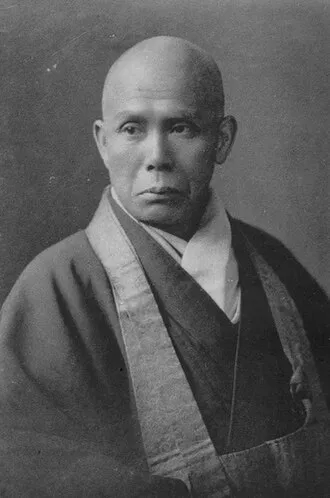
Soyen Shaku
1860 – 1919
Shaku Sōen (釈宗演), often romanised in his lifetime as Soyen Shaku, was born on 10 January 1860 in Takahama, Fukui Prefecture, into the dying years of the Tokugawa shogunate. He entered monastic life as a boy at the Rinzai temple Myōshin-ji and trained under Ekkei Shuken before becoming the disciple of Imakita Kōsen at Engaku-ji in Kamakura. He received Dharma transmission (inka) from Kōsen at the unusually young age of twenty-five, an early recognition that marked him as one of the most promising Rinzai teachers of the Meiji era[1].
Restless within the closed world of the Japanese monastery, Soyen broke with custom by spending three years from 1887 in Ceylon as a wandering Theravāda monk, learning Pāli and the southern Vinaya — an experience that gave him an unprecedented grasp of pan-Asian Buddhism and the conviction that the Dharma had to engage the wider modern world. He also studied for three years at Keio University under Fukuzawa Yukichi, an extraordinary step for a Zen abbot of his generation. In 1892, on Kōsen's death, he succeeded him as kanchō of Engaku-ji; he later also served as abbot of Kenchō-ji and, from 1914 to 1917, as president of Rinzaishū Daigaku, the precursor of today's Hanazono University[1][2].
The decisive moment of his life came in September 1893, when he travelled to Chicago as the head of the Japanese Rinzai delegation to the World's Parliament of Religions, becoming the first Zen master to teach Buddhism in the United States. His paper, "The Law of Cause and Effect, as Taught by Buddha" — translated on the spot by his young lay disciple D. T. Suzuki — placed Buddhist causality in dialogue with Western science and theology, and his correspondence with Paul Carus that grew out of the Parliament led directly to Suzuki's eleven-year stay at Open Court Publishing in LaSalle, Illinois[1].
In 1905–1906 Soyen returned to America for a nine-month sojourn at the home of Alexander and Ida Russell on the Pacific coast south of San Francisco, where Ida Russell became "the first American to study koans" under a Japanese roshi. He travelled with the young monk Nyogen Senzaki, whom he left behind in California with the famously austere instruction to "just face the great city and see whether it conquers you or you conquer it." Senzaki would become the first generation of resident Zen teachers in America; another disciple, Shaku Sōkatsu, sent his own student Sōkei-an Sasaki to New York, where Sōkei-an founded what became the First Zen Institute of America[1][3].
His American lectures were collected as *Sermons of a Buddhist Abbot* (Open Court, 1906), translated and edited by D. T. Suzuki — the first book in English by a Zen master. He also published *Zen for Americans* (in later reprints) and a Japanese edition of his diaries from Ceylon. His named Dharma heirs Tetsuō Sōkatsu and Furukawa Gyōdō continued the Engaku-ji line; through Suzuki, Senzaki, Sōkatsu and Sōkei-an, virtually every twentieth-century American Rinzai lineage traces back to him. Soyen died at Engaku-ji on 29 October 1919, having reshaped the geography of Zen from a single Japanese sect into a transpacific tradition[1][2].
Names
Disciples of Soyen Shaku
Teachers and lineage of Soyen Shaku
Teacher / root master:
Teachings
- proverbA Cup of Tea Is a Cup of Tea
A cup of tea is a cup of tea. But if you drink it with full attention, it becomes the whole universe in a cup.
We Buddhists believe in a universal law of causation, which governs the rise and fall of all things. This law is the foundation of the moral order. No God made it; no God can unmake it. It operates in the heavens and on the earth, in the realm of mind and the realm of matter, alike and without exception. Through understanding this law, we attain freedom. Through ignorance of it, we remain in bondage. The purpose of the Buddha's teaching is to awaken human beings to this law so that they may live in harmony with the truth and attain the highest peace.
The law of cause and effect is the universal law. It governs the physical world and the moral world equally. A stone thrown in the air must come down. A deed done in darkness must come to light. This is not punishment; it is the nature of reality. When you understand that every thought, every word, every action plants a seed, you will be careful what you plant. The one who understands causation is free, because he no longer plants the seeds of suffering.
Other masters in Rinzai
Master Record Sources
- datesZen Editorial Overlay - Originals Curation
1860-1919
- nameZen Editorial Overlay - Originals Curation
Soyen Shaku
- schoolZen Editorial Overlay - Originals Curation
Rinzai
- teachersZen Editorial Overlay - Originals Curation
Kosen Imakita