Bodhidharma
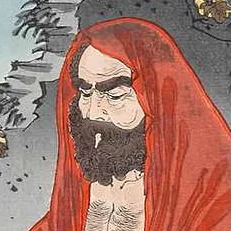
Bodhidharma
Unknown – c. 536
Bodhidharma was the twenty-eighth Indian patriarch and the first Chinese patriarch of Chan, a figure who stands at the hinge between the Indian and East Asian traditions[1]. He arrived in China around the late fifth or early sixth century, having crossed the seas from India[2]. His encounter with Emperor Wu of Liang is one of the most celebrated exchanges in Chan history. The Emperor, who had built many temples and supported thousands of monks, asked what merit he had accumulated. Bodhidharma replied: "No merit whatsoever." When the Emperor asked about the highest sacred truth, Bodhidharma said: "Vast emptiness, nothing sacred." Asked who stood before him, Bodhidharma said: "I don't know."[3]
After this exchange, Bodhidharma traveled north and spent nine years in seated meditation facing a wall at Shaolin Monastery[1]. This period of wall-gazing became one of the defining images of the Chan tradition. He eventually accepted Dazu Huike as his disciple after Huike demonstrated his sincerity by standing in the snow and cutting off his own arm. Bodhidharma transmitted the Lankavatara Sutra along with the wordless transmission of mind[2]. His teaching emphasized direct awakening through meditation practice rather than doctrinal study, and this emphasis became the defining characteristic of the Chan school he founded in China[4].
Names
Disciples of Bodhidharma
Teachers and lineage of Bodhidharma
Teacher / root master:
Teachings
Bodhidharma sits facing the wall. His future successor stands in the snow and presents his severed arm to Bodhidharma. He cries: "My mind is not pacified. Master, pacify my mind." Bodhidharma says: "If you bring me that mind, I will pacify it for you." The successor says: "When I search my mind I cannot hold it." Bodhidharma says: "Then your mind is pacified already." Mumon’s comment: That broken-toothed old Hindu, Bodhidharma, came thousands of miles over the sea from India to China as if he had something wonderful. He is like raising waves without wind. After he remained years in China he had only one disciple and that one lost his arm and was deformed. Alas, ever since he has had brainless disciples. Why did Bodhidharma come to China? For years monks have discussed this. All the troubles that have followed since Came from that teacher and disciple.
- dialogueVast Emptiness, Nothing Holy
Emperor Wu of Liang asked Bodhidharma, "I have built temples and ordained monks. What merit have I gained?" Bodhidharma said, "No merit at all." The emperor asked, "What is the first principle of the holy teaching?" Bodhidharma said, "Vast emptiness, nothing holy." The emperor asked, "Who is this standing before me?" Bodhidharma said, "I don't know." The emperor did not understand. Bodhidharma crossed the Yangtze River and went on to the kingdom of Wei.
A special transmission outside the scriptures; No dependence on words and letters; Directly pointing to the human mind; Seeing one's nature and becoming Buddha.
- proverbChop Wood, Carry Water
Before enlightenment, chop wood, carry water. After enlightenment, chop wood, carry water.
- proverbNo Merit
Emperor Wu asked: how much merit have I gained from building temples? I said: no merit. Real virtue does not count itself; the moment you keep score, you have walked out of it.
- proverbVast Emptiness, Nothing Holy
He asked: what is the highest meaning of the holy truth? I answered: vast emptiness, nothing holy. He could not understand. I crossed the river and went north.
- proverbBring Me Your Mind
Huike said: my mind is not at peace. I said: bring me your mind, and I will pacify it. He searched and could not find it. I said: there — I have pacified it for you.
- proverbSkin, Flesh, Bone, Marrow
I told my four students each to speak the Way. Daofu received my skin. Zongchi received my flesh. Daoyu received my bone. Huike received my marrow. The four divisions were one body; the dharma is whole even when described in pieces.
Featured in
- Traditional Zen Encounter DialoguesMy Mind Is Not at Peace
Other masters in Early Chan
Master Record Sources
d. 536? C.E.
Puti Damo
Early Chan
- koan_refsChart of the Chan Ancestors
1 2 41
d. 536?
Bodhidharma
Chan
d. 536?
Bodhidharma
Chan
- teachersWikipedia - Zen Lineage Charts
Prajñātāra