Nyogen Senzaki
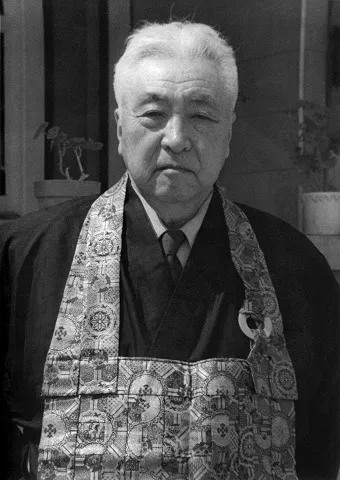
Nyogen Senzaki
1876 – 1958
Nyogen Senzaki (千崎 如幻) was born on 5 October 1876 — by the most reliable accounts in Fukaura, Aomori Prefecture, although Senzaki himself preferred a more elliptical story in which he was found as an abandoned infant on the snow of the Sakhalin coast and raised by a Japanese fisherman. Orphaned again as a young man, he was adopted into a Sōtō priest's household and ordained, but read his way out of his adoptive sect and presented himself in 1896 at Engaku-ji in Kamakura as a disciple of Soyen Shaku, where he met the slightly younger lay student D. T. Suzuki[1].
Senzaki's monastic career was brief and unconventional. After a tubercular collapse in his early twenties he left the monastery and in 1901 founded the Mentorgarten, a Buddhist kindergarten in Hokkaido modelled on Friedrich Fröbel — an experiment that prefigured the lay, educational, anti-clerical cast of the rest of his life. In 1905 he accompanied Soyen to America as his attendant during the Russells' nine-month residency south of San Francisco. When Soyen returned to Japan he left Senzaki behind on the dock with the now-famous instruction: "Just face the great city and see whether it conquers you or you conquer it" — and an order not to teach Zen until he had been silent for seventeen years[1][2].
Senzaki kept that vow. He worked as a houseboy, hotel manager, cook and porter through the 1910s, reading and translating quietly, and only in 1922 did he rent a hall in San Francisco for his first public talk. From that point until his death he taught from what he called "floating zendos" — rented rooms in San Francisco and, from 1928, in Los Angeles — refusing temple property, salaries and titles, and signing himself the "homeless mushroom monk." His Mentorgarten Sangha became the first sustained lay Zen community on American soil. During the Second World War he and his students were forcibly removed to the Heart Mountain internment camp in Wyoming, where he continued to hold zazen and write poetry until 1945[1][2].
His most enduring books were produced in collaboration with Paul Reps. In 1934 they published *The Gateless Gate* — the first complete English translation of Wumen's Mumonkan — together with Senzaki's earlier *101 Zen Stories* (1919/1939); these were combined and reissued by Charles E. Tuttle in 1957 as *Zen Flesh, Zen Bones*, which has remained continuously in print and has shaped the Anglophone imagination of koan literature more than any other single book. His own writings were gathered posthumously by his student Soen Nakagawa and Eido Shimano as *Like a Dream, Like a Fantasy: The Zen Writings and Translations of Nyogen Senzaki* (Wisdom Publications, 2005); earlier collections include *Buddhism and Zen* (1953, with Ruth Strout McCandless) and *Namu Dai Bosa* (1976), the trilogy of Senzaki, Soen and Eido[1][3].
Senzaki never gave formal Dharma transmission in the standard Rinzai sense — consistent with his refusal of institution — but he is the recognised root teacher of Robert Baker Aitken, who began sitting with him at Heart Mountain and went on to found the Diamond Sangha; through Aitken, Senzaki's anti-clerical, lay, koan-centred lineage shaped most of late-twentieth-century American Zen. Other students included Samuel L. Lewis, Mary Farkas and the painter Mihoko Okamura. He died in his small zendo on Bunker Hill, Los Angeles, on 7 May 1958[1][4].
Names
Teachers and lineage of Nyogen Senzaki
Teacher / root master:
Teachings
- proverbNo Temple Needed
I have no temple. The city street is my temple. The taxi horn is my evening bell.
- proverbNo Followers
I have no followers. I do not want followers. I want people who walk on their own two feet.
- sayingThe Mentorgarten
I have no monastery, no zendo with golden Buddhas and incense. I call my meeting place a 'mentorgarten,' a floating zendo. Like Bodhidharma who carried nothing but the robe and bowl, I carry only the Dharma. A rented hall, a few chairs, some sincere students—that is enough. Zen does not need a grand temple. It needs only a mind willing to inquire and a heart willing to let go. In America, we must plant Zen like a seed in new soil, without forcing it into old forms. Let it grow as it will.
For many years I have practiced without a temple, without a sangha of robed monks, without any of the traditional supports. Some say this is not real Zen. But I ask: did the Buddha have a temple when he sat under the Bodhi tree? The sky was his roof, the earth was his cushion. Wherever you sit with sincerity, that place becomes a temple. Wherever two or three gather to investigate the great matter of birth and death, that is a sangha. Do not wait for perfect conditions. Sit now, just as you are.
Other masters in Rinzai
Master Record Sources
- datesZen Editorial Overlay - Originals Curation
1876-1958
- nameZen Editorial Overlay - Originals Curation
Nyogen Senzaki
- schoolZen Editorial Overlay - Originals Curation
Rinzai
- teachersZen Editorial Overlay - Originals Curation
Soyen Shaku