Omori Sogen
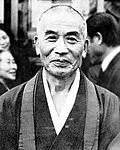
Omori Sogen
1904 – 1994
Ōmori Sōgen (大森曹玄, 1904–1994) was a twentieth-century Rinzai master in the Tenryū-ji line whose work brought together Zen realisation, swordsmanship, and calligraphy as a single integrated practice[1]. Born in Nihonmatsu in Fukushima Prefecture, he became a master of Jikishinkage-ryū kenjutsu and a devoted practitioner of *bokuseki* calligraphy in the Yamaoka Tesshū tradition; he received Dharma transmission in the Tenryū-ji line as a successor of Bokuō Sōun[1].
He served as president of Hanazono University in Kyoto, the Myōshin-ji-affiliated Rinzai institution, and is widely cited for his vision that Zen, swordsmanship, and the brush were three expressions of a single awakened activity rather than parallel disciplines[2]. His textbook *Sanzen Nyūmon* (translated into English as *An Introduction to Zen Training*) became one of the standard modern guides to Rinzai practice[1].
In 1979 Ōmori founded Daihonzan Chōzen-ji in Honolulu — registered with the Rinzai-shū as the first *honzan* (headquarters temple) of a Rinzai branch established outside Japan — where his vision of Zen integrated with the martial and fine arts was given institutional form, offering kendō, kyūdō, and calligraphy training alongside zazen and koan study[3].
Names
Teachers and lineage of Omori Sogen
Teacher / root master:
Teachings
- proverbOne Breath at a Time
Zen practice is one breath at a time. If you can be truly present for one breath, you can be present for your whole life.
Ken Zen Ichi Nyo—the sword and Zen are one. This does not mean that Zen is violent or that the sword is holy. It means that in the way of the sword, as in zazen, there is no room for the thinking mind. When you face an opponent with a sword, if you think for even an instant, you are cut down. You must act from the place before thought arises—the place of mushin, no-mind. This is the same place you reach in deep zazen. The sword cuts away the ego just as the koan does. Both demand that you die to yourself completely and act from the source.
Whether you practice calligraphy, the tea ceremony, archery, or the sword, zazen is the foundation. Without zazen, these arts become mere technique—skillful, perhaps, but without depth. With zazen, even the simplest act becomes a manifestation of awakened mind. You do not sit zazen in order to become good at calligraphy. You sit zazen in order to find the source from which all true action flows. Once you have found that source, everything you do—writing, pouring tea, drawing the bow—flows from it naturally, without contrivance.
Other masters in Rinzai
Master Record Sources
- datesZen Editorial Overlay - Originals Curation
1904-1994
- nameZen Editorial Overlay - Originals Curation
Omori Sogen
- schoolZen Editorial Overlay - Originals Curation
Rinzai
- teachersZen Editorial Overlay - Originals Curation
Bokuo Soun