Prajnatara
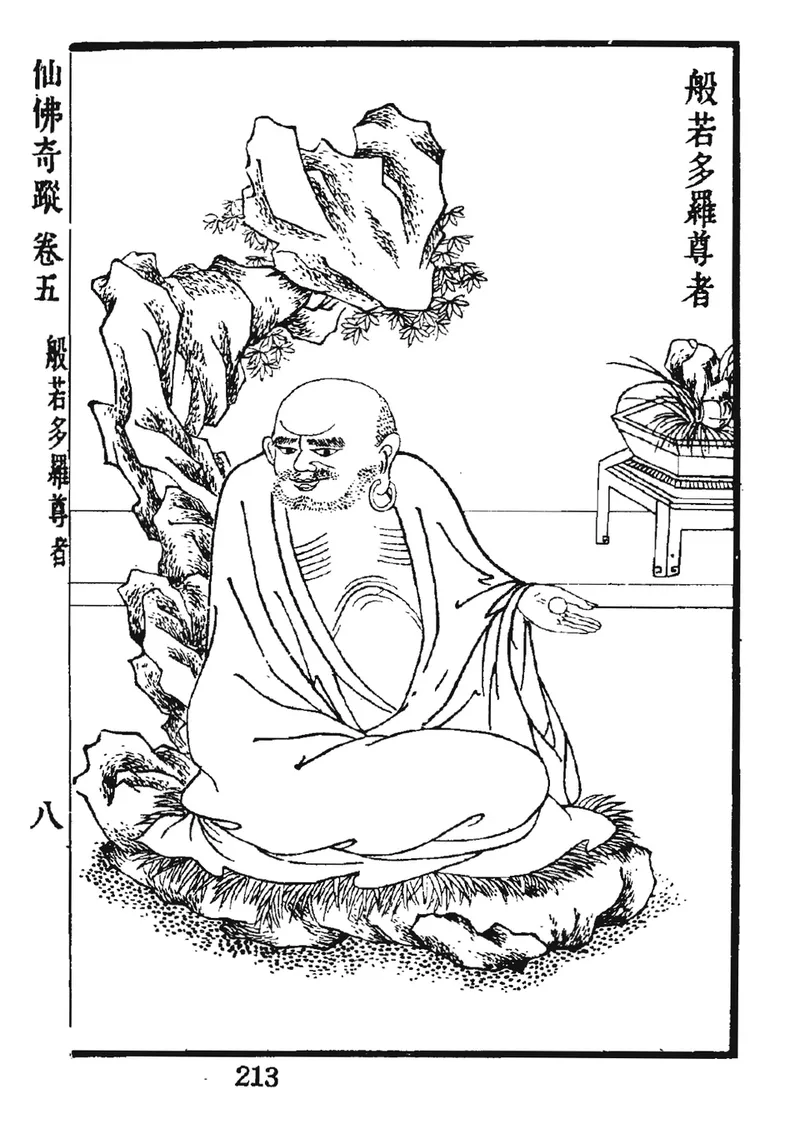
Prajnatara
5th c. – Unknown
Prajñātāra is the twenty-seventh and final Indian patriarch in the Chan list before the transmission passes to China through Bodhidharma[1]. The earliest extended account of him appears in the *Lìdài Fǎbǎo Jì* (Record of the Dharma-Jewel through the Ages, c. 774) and is repeated and elaborated in the *Bǎolín Zhuàn* (Record of the Bao-lin Monastery, 801) and the *Jǐngdé Chuándēng Lù* (1004)[2]. He is described as a master from eastern India who received transmission from Puṇyamitra, traveled and taught widely, and recognized in the third son of a south Indian king the capacity that would carry the Dharma to China.
The narrative of Prajñātāra's encounter with the young Bodhidharma is highly stylized. The boy is depicted displaying a precocious understanding of the *Diamond Sūtra*; Prajñātāra tested him with a series of questions and found him already deeply realized; ordination, training, and transmission followed[3]. Prajñātāra is then said to have foretold that, sixty-seven years after his own death, his disciple would carry the lamp east to a land "beyond the sea." Bodhidharma's eventual departure for Liang-dynasty China is presented as the fulfillment of this charge.
The historicity of Prajñātāra is doubtful. John McRae argues that the figure is best understood as a literary construction designed to give Bodhidharma's mission a properly Indian commission and to tie the Chinese lineage to the southern, Mahāyāna-aligned regions of India where the *Prajñāpāramitā* texts had emerged[4]. Within the Chan self-understanding, Prajñātāra represents the moment at which the Indian transmission, having passed through twenty-eight generations, releases its impulse eastward[5].
Names
Disciples of Prajnatara
Teachers and lineage of Prajnatara
Teacher / root master:
Teachings
Prajñātāra tested the young prince Bodhidharma by placing a jewel before him and asking: 'Of all things, what is most luminous?' The other princes named the jewel. Bodhidharma said: 'The Dharma is most luminous.' Prajñātāra asked: 'Of all things, what is most vast?' The others named the sky. Bodhidharma said: 'The nature of mind is most vast, for it contains the sky.' Prajñātāra said: 'This one alone has turned the jewel's light back on itself.' Keizan's verse: The gem shines outward— / but what shines inside the gem? / Ask the prince with the quiet eyes. / He knows where the light was born.
Before Prajñātāra died, he spoke to Bodhidharma: 'You have completely understood the Dharma. Do not stay in India—the conditions here are fulfilled. Travel east, beyond the great sea, to the land of Han. There the Way will flourish in ways I have not seen in this land. Do not go quickly; wait sixty-seven years after I am gone. The time will be ready then.' Bodhidharma kept this instruction in his heart for the remainder of his life in India.
- proverbNo Need to Recite
Other monks recited the sutras at the donor's house; I sat. The donor asked: why do you not recite? I answered: when I breathe in, I do not consort with the world of beings; when I breathe out, I do not consort with the world of senses. So am I always reciting the sutra of all the buddhas.
- proverbSend Bodhidharma North
Sixty years after I am gone, you will go to a country to the north. Do not stay in our temple; the dharma in this place is well kept and needs no more keeping. The country to the north needs you more than we do.
- proverbNo Pride of Lineage
I am the twenty-seventh patriarch only because someone wrote it down. The number does not bow when I bow; it does not eat when I eat; it has nothing to do with the sitting.
Other masters in Indian Patriarchs
Master Record Sources
- datesZen Editorial Overlay - Originals Curation
trad. 5th c. CE
- nameZen Editorial Overlay - Originals Curation
Prajnatara
- schoolZen Editorial Overlay - Originals Curation
Indian Patriarchs
- teachersZen Editorial Overlay - Originals Curation
Punyamitra
Prajñātāra is counted the twenty-seventh Indian patriarch and the teacher of Bodhidharma in Chan/Zen tradition; the Tibetan Buddhist Encyclopedia preserves the traditional account of this pivotal transmission.