Shibayama Zenkei
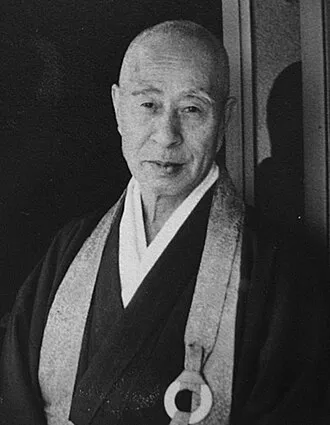
Shibayama Zenkei
1894 – 1974
Zenkei Shibayama (柴山全慶, 1894–1974) was one of the senior Rinzai abbots of mid-twentieth-century Japan and, through a remarkable series of American lecture tours and English-language books, one of the principal voices that introduced classical kōan Zen to postwar Western audiences. He was born on November 30, 1894, trained in the Rinzai monastic system, and pursued an unusually scholarly career alongside monastic practice, eventually teaching at Otani University in Kyoto while continuing his formal Zen training[1].
Shibayama rose to the highest institutional position in his school: he became abbot of Nanzen-ji in Kyoto and "head abbot of the entire Nanzenji Organization, overseeing the administration of over five hundred temples"[1]. Nanzen-ji, founded in the thirteenth century as an imperial Zen monastery, sits at the apex of the Nanzenji-ha branch of Rinzai, and Shibayama's tenure there gave his teaching the full institutional weight of mainstream Japanese Rinzai. Among his dharma heirs was Keido Fukushima, who later became abbot of Tōfuku-ji and a long-running teacher of American university students[1].
From the early 1960s onward Shibayama undertook a series of lecture tours in the United States, traveling to American universities and Zen centers and delivering teishō through interpretation; these tours, together with his English publications, made him one of the few first-generation Japanese roshis whose voice reached general Western readers in print[1]. His Kyoto-published volume *A Flower Does Not Talk* appeared in 1966 (Charles E. Tuttle reprint, 1970) as a collection of teishō and essays; in 1967 he published *On Zazen Wasan: Hakuin's Song of Zazen* (Kyoto, 1967) and, with the painter Gyokusei Jikihara, *Zen Oxherding Pictures* (Tokyo, 1967)[1]. His most enduring work, however, is *Zen Comments on the Mumonkan*, published in English by Harper & Row in 1974 — a complete teishō-style commentary on Wumen's forty-eight kōan collection that has remained one of the standard English Mumonkan commentaries alongside those of Yamada Kōun and Aitken Roshi[1]. Shibayama died on August 29, 1974, the same year his Mumonkan commentary appeared in English[1]. His distinctive contribution to Western Zen lay in modeling, for an English-reading audience, what an institutional Rinzai abbot's relationship to the classical kōan literature actually sounds like — neither the academic detachment of D.T. Suzuki nor the iconoclasm of the American counterculture, but the patient, line-by-line teishō of a working Nanzen-ji abbot[2].
Names
Teachers and lineage of Shibayama Zenkei
Teacher / root master:
Teachings
- proverbOpen Your Zen Eye
Open your Zen eye and you will see that there is nothing in the world that is not a flower, nothing that is not a spring wind.
A monk asked Joshu: 'Has a dog the Buddha-nature or not?' Joshu answered: 'Mu!' This Mu is not the Mu of 'has not.' It is not the opposite of 'has.' Cast aside all your learning, all your logic, all your clever understanding. Become Mu from the top of your head to the soles of your feet. Become one solid mass of questioning. When you have truly become Mu, the gate that has no gate swings open of itself, and you walk freely through. But so long as you stand outside trying to understand Mu with your intellect, you will stand there for ten thousand years.
- sayingOn the Gateless Gate
The gate is called 'gateless' because there is nothing to pass through. A gate implies a barrier, something that divides inside from outside. But in Zen there is no inside or outside. The barrier is your own making—your concepts, your discriminations, your clinging to self. When these fall away, you realize there never was a gate. You have been standing in the open field all along, imagining a wall. Mumon's great compassion is to shout at you: 'There is no gate! Walk through!'
Other masters in Rinzai
Master Record Sources
- datesZen Editorial Overlay - Originals Curation
1894-1974
- nameZen Editorial Overlay - Originals Curation
Shibayama Zenkei
- schoolZen Editorial Overlay - Originals Curation
Rinzai
- teachersZen Editorial Overlay - Originals Curation
Kono Bukai