Xuansha Shibei
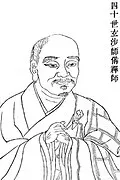
Xuansha Shibei
835 – 908
Xuansha Shibei (玄沙師備, 835–908) is recorded in the *Sòng Gāosēng Zhuàn* and the *Jǐngdé Chuándēng Lù* as a former fisherman from Fuzhou who became one of the closest disciples of Xuefeng Yicun and inherited Xuefeng's community after a period of solitary practice on Mount Xuansha[1]. The lamp records preserve his awakening as a sudden moment of insight on the road down the mountain — recounted in the *Wúménguān* as the "Xuansha stubs his toe" episode — and the formula he is said to have spoken at that moment, "Bodhidharma never came to China; the Second Patriarch never went to India," became a *locus classicus* for the Chan claim that no Dharma is added from outside[2].
Xuansha is best known for the teaching of the "three invalids" (三種病人) — the blind, the deaf, and the mute — used as a diagnostic of the partial understandings into which practitioners settle; the formula is preserved in the *Línjì Lù* commentaries and recycled in koan collections from the *Bìyán Lù* onward[3]. His Dharma was carried forward through Luohan Guichen to Fayan Wenyi, the founder of the Fayan house, making Xuansha the immediate predecessor of one of the canonical Five Houses[4].
Names
Disciples of Xuansha Shibei
Teachers and lineage of Xuansha Shibei
Teacher / root master:
Teachings
- dialogueThe Three Barriers
Xuansha said to his assembly: "The teachers in all directions say they are going to help living beings. Now suppose a blind person comes to you—how will you teach him with form? Suppose a deaf person comes—how will you teach him with sound? Suppose a mute person comes—how will you have him express himself? If you cannot help these three kinds of people, what is the use of your teaching?" The assembly had no reply. Xuansha said: "If you cannot pass through the door of the blind, the deaf, and the mute, your understanding has not yet reached the gate."
Xuansha said: "The whole world in all ten directions is one bright pearl." A monk said, "I heard you once said, 'The whole world in all ten directions is one bright pearl.' How am I to understand that?" Xuansha said, "The whole world in all ten directions is one bright pearl—what is there to understand?" The next day Xuansha asked the monk, "The whole world in all ten directions is one bright pearl—how do you understand that?" The monk said, "The whole world in all ten directions is one bright pearl—what is there to understand?" Xuansha said, "I see you are making your living in a demon's cave."
- dialogueBodhidharma Never Came to China
Xuansha was leaving the mountain when he stubbed his toe on a rock. Blood flowed and he cried out in pain. Then he said to himself, "This body does not exist—where does the pain come from?" At this he was deeply awakened and exclaimed, "Bodhidharma never came to China. The Second Patriarch never went to India."
Other masters in Qingyuan line
Master Record Sources
835-908
Xuansha Shibei
Qingyuan line
- koan_refsChart of the Chan Ancestors
22,88 24, 81 43
- nameZen Editorial Overlay - Originals Curation
Xuansha Shibei
- teachersZen Editorial Overlay - Originals Curation
Xuefeng Yicun