Shitou Xiqian
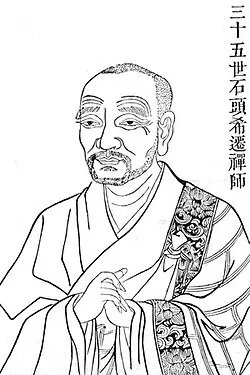
Shitou Xiqian
700 – 790
Shitou Xiqian was one of the two great heirs of Huineng's dharma-grandson lineage—through Qingyuan Xingsi—and the founder of one of the two main streams from which all surviving Chan/Zen schools descend[1]. He was born in Guangdong and was so precocious that as a child he reportedly disrupted local sacrificial rituals by releasing the animals. He became a student of Huineng and then, after Huineng's death, studied with Qingyuan Xingsi. Shitou's approach to Chan was quiet, vast, and deeply grounded in the Huayan teaching of the interpenetration of all phenomena[2].
His most famous text, the Sandokai (Merging of Difference and Unity), is one of the foundational liturgical texts of the Soto school of Zen, chanted daily in temples around the world[3]. The poem articulates the relationship between the absolute and the relative, between emptiness and form, with extraordinary poetic precision. Shitou built a meditation platform on a flat rock on Nanyue Mountain—the name Shitou means "stone head"—and taught from there for decades[1]. From his lineage descended Dongshan Liangjie and the Caodong/Soto tradition[2].
Names
Disciples of Shitou Xiqian
Teachers and lineage of Shitou Xiqian
Teacher / root master:
Works
Shitou Xiqian's short Tang-dynasty verse on the interpenetration of the relative and the absolute — "the spiritual source shines clear in the light; the branching streams flow on in the dark." Forty-four lines, chanted daily in Sōtō zendos along with Dongshan's Jewel Mirror Samādhi, and one of the doctrinal seeds of the Caodong/Sōtō "five ranks."
A Tang-dynasty hermit-song attributed to Shitou: thirty-two lines that describe a grass-thatched hut as both a literal dwelling and the unhoused Mind. Re-introduced into the modern Sōtō repertoire largely through Daniel Leighton's translation work; quietly influential on the contemporary American "hermit" practice imaginary.
Teachings
The mind of the great sage of India is intimately transmitted from west to east. While human faculties are sharp or dull, the Way has no northern or southern ancestors. The spiritual source shines clear in the light; the branching streams flow on in the dark.
- proverbSong of the Grass Hut
I have built a grass hut in which there is nothing of value. After eating, I'm ready for a nap. When the world looks for me, I'm not here — though I never went anywhere.
Brightness and darkness are like the front and back foot in walking. The light is not above the dark; both are needed for the next step.
- proverbStone Head
They call me Stone Head. A stone has no opinion of itself, no preference for sun or rain, no plan for tomorrow. If only my students were as steady.
- proverbDo Not Think About the Roof
When sitting in your hut, do not think about whether the roof will leak. If it leaks, you will know. The thought beforehand only takes the place of the seat.
- proverbTrickle and River
A trickle and a great river — the trickle does not envy the river, the river does not despise the trickle. Both flow downhill toward the same sea.
Other masters in Qingyuan line
Master Record Sources
700-790
Shitou Xiqian
Qingyuan line
- koan_refsChart of the Chan Ancestors
2
- nameZen Editorial Overlay - Originals Curation
Shitou Xiqian
- teachersZen Editorial Overlay - Originals Curation
Qingyuan Xingsi