Qingyuan line
Chan
Qingyuan line
Branch of Chan
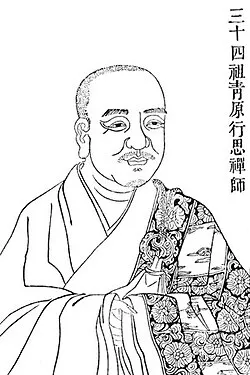
The Qingyuan line descends from Qingyuan Xingsi, a student of the Sixth Patriarch Huineng, and constitutes one of the two great branches of Chan[1]. Through Qingyuan's student Shitou Xiqian—author of the Sandokai (Harmony of Difference and Equality)—this line gave rise to three of the Five Houses: the Caodong school (through Dongshan Liangjie), the Yunmen school (through Yunmen Wenyan), and the Fayan school (through Fayan Wenyi)[2]. The Qingyuan branch is broadly characterized by a more contemplative and subtle approach compared to the Nanyue line's dramatic directness, though individual masters varied widely. Key figures in the early Qingyuan line include Yaoshan Weiyan, who bridged the Shitou and Mazu traditions[3]; Tianhuang Daowu and Longtan Chongxin, through whom the Deshan-Xuefeng lineage developed; and Chuanzi Decheng, the beloved Boat Monk. The line's emphasis on the interpenetration of the absolute and relative, expressed through Shitou's Sandokai and Dongshan's Five Ranks, became a defining contribution to Chan philosophy[4].
Meditation practice
Practice in the Qingyuan line flows from Shitou Xiqian’s Sandokai, which describes the interpenetration of the absolute and relative as the ground of meditation and daily conduct[2]. This branch tends toward subtle contemplative inquiry rather than dramatic confrontation: seated meditation, poetic and philosophical reflection, and close attention to how difference and equality appear together in ordinary experience. That orientation later flowered in the silent illumination of Caodong, the linguistic precision of Yunmen, and the more synthetic contemplative style of Fayan.
Prominent masters
Key texts
- Sandokai
'Harmony of Difference and Equality' — Shitou's 44-line verse on the non-duality of the one and the many. The root poem of the whole Qingyuan branch, chanted daily in Caodong/Sōtō monasteries.
- Song of the Grass-Roof Hermitage
Shitou's long poem on the eremitic life — built a grass hut on Mount Nanyue, watched the world pass through. The template for generations of hermit Chan masters in this line.
Key concepts
- Absolute and relative
Shitou's diagnostic pair — li (absolute/principle) and shi (relative/phenomena). The Qingyuan line studies how these interpenetrate; Dongshan's Five Ranks and Hongzhi's silent illumination are direct developments.
In the words of the masters
- Truth Outside Yourself
If you look for the truth outside yourself, it gets farther and farther away.
- Host Within Host
When the host sees the guest, that is still a division. When the host sees the host, the whole household falls silent.
- Mountains Are Mountains Again
Before I studied Chan, mountains were mountains and rivers were rivers. After studying Chan, mountains were no longer mountains and rivers no longer rivers. Now, after thirty years, mountains are again mountains and rivers again rivers — but with fewer feet of mine in the way.
- Cutting an Axe-Handle
To cut an axe-handle, the model is in your hand. To pass on the dharma, the model is in your life. Look closely at the model; if it has a chip in it, the new handle will too.
- No Marvels at the Hermitage
There are no marvels at this hermitage. We sweep, we cook, we sit. If you wanted marvels, you should have gone to the city — they sell them cheap there, and they break before you reach home.
- Sound of Grass
If you cannot hear the sound of grass growing, you are not yet quiet enough. Sit until you hear it, and you will not be tempted to mistake your speech for teaching.
Masters in this branch
- Nanyue Daoxuan
- Shitou Xiqian
- Danxia Tianran
- Qingyuan Xingsi
- Tianhuang Daowu
- Yaoshan Weiyan
- Daowu Yuanzhi
- Yunyan Tansheng
- Deshan Xuanjian
- Jiashan Shanhui
- Dongshan Liangjie
- Shishuang Qingzhu
- Touzi Datong
- Xuefeng Yicun
- Luopu Yuanan
- Xuansha Shibei
- Daguang Juhui
- Changqing Huileng
- Luohan Guichen
- Baofu Congzhan
- Guizong Cezhen
- Cuiwei Wuxue
- Qingxi Hongjin
- Chongshou Qichou
- Longji Shaoxiu
- Wang Yanbin
- Ruiyan Shiyan
- Shanglan Lingchao
- Changfu Zhi
- Yungai Zhiyuan
- Dingzhou Shizang
- Danyuan Yingzhen
- Shushan Kuangren
- Mingzhao Deqian
- Luoshan Daoxian
- Shaoshan Huanpu
- Longtan Chongxin
- Tianping Congyi
- Yantou Quanhuo
- Taiyuan Fu
- Chuanzi Decheng
- Jiufeng Daoqian
- Baoci Xingyan
Sibling branches of Chan
Major works of this school
Sources in use
- Chart of the Chan Ancestors
- Zen's Chinese Heritage: The Masters and Their Teachings
- Zen Editorial Overlay - Originals Curation
- Terebess Asia Online - Zen Encyclopaedia
- Tibetan Buddhist Encyclopedia - Zen Lineage Charts
- Wikipedia - Zen Lineage Charts