Yamada Koun
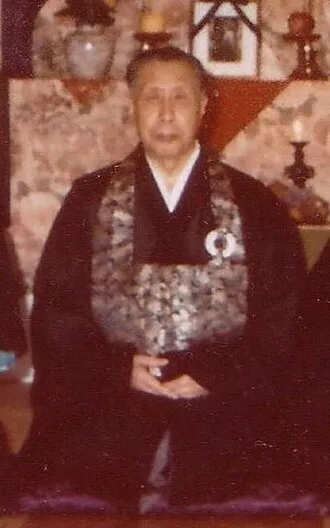
Yamada Koun
1907 – 1989
Yamada Kōun (born Yamada Kiozo, 1907–1989) was the Japanese lay Zen master who shaped Sanbō Kyōdan (now Sanbō Zen) into an internationally accessible lineage and trained the first generation of Western teachers. Born in Nihonmatsu, Fukushima Prefecture, he attended Tokyo's elite Dai-Ichi High School together with the future Rinzai master Soen Nakagawa, then pursued a business career, working from 1941 as a labor supervisor for the Manchurian Mining Company and rising to deputy director of General Affairs by 1945[1]. He began Zen practice at age 38 in Manchuria and, after returning to Kamakura with his wife and three children, sat twice-daily dokusan with Asahina Sōgen Rōshi while serving as a managing director of a major Tokyo firm[1].
Yamada's decisive awakening came on a Tokyo train on 26 November 1953, when reading the line "Mind is no other than mountains and rivers and the great wide earth, the sun and the moon and the stars" provoked a kenshō that Hakuun Yasutani Rōshi confirmed the next day[1]. After completing roughly six hundred kōans he received Yasutani's dharma transmission in 1961 and assumed leadership of Sanbō Kyōdan in the early 1970s, teaching from the San-un Zendo in Kamakura[1]. He emphasized lay practice and deliberately collapsed the gap between ordained and householder students, an orientation that drew an unusually international clientele — by the end of his career roughly a quarter of sesshin participants were Christians[1][2].
His dharma heirs are central to Western Zen: Robert Baker Aitken of the Honolulu Diamond Sangha, Taizan Maezumi of the Zen Center of Los Angeles, the Filipino Jesuit Ruben Habito, the German Benedictine Willigis Jäger, the Swiss Jesuit Niklaus Brantschen, and his son Masamichi Ryōun-ken Yamada, who succeeded him as abbot[1][2]. Yamada's posthumously published kōan commentaries — *The Gateless Gate: The Classic Book of Zen Koans* (Wisdom Publications, 2004) and *Zen: The Authentic Gate* (Wisdom Publications, 2015) — remain standard references for Sanbō Zen kōan study[1].
Names
Disciples of Yamada Koun
Teachers and lineage of Yamada Koun
Teacher / root master:
Teachings
- proverbThe Fact of Experience
Zen is not a philosophy. It is not a religion in the usual sense. Zen is the practice of coming to the fact of experience, before thought divides it.
- proverbMu Is Everything
When you become Mu, you swallow the whole universe. The whole universe becomes you.
I have come to the conclusion that Zen is not a religion in the sense that the term is popularly understood. It has no special doctrine or philosophy, no creeds or dogmas, no ritual or liturgy, and no prescribed form of worship. Kensho—seeing into one's own nature—is available to people of all faiths. A Christian can practice Zen and deepen their Christianity. A Buddhist can practice Zen and deepen their Buddhism. Zen is the practice of coming to the experience that lies at the root of all religions.
Mu is the gateless barrier of Zen. When you sit with Mu, you must become one with it—not thinking about Mu, not analyzing Mu, but becoming Mu itself with your entire body and mind. Mu is not a concept to be understood intellectually. It is not 'nothing' as opposed to 'something.' It is not negative and not positive. When you truly become Mu, the gate that seemed to block your way is revealed to have been open from the very beginning. The barrier was never there. This is why we call it the gateless barrier.
Zen is not a philosophy. It is not a system of thought. It is the experience of living reality, here and now. You cannot capture it in concepts, though concepts may point toward it. You cannot find it in books, though books may inspire you to look. The experience of kensho is as definite and unmistakable as the experience of tasting water—you know immediately whether it is warm or cold. No one can tell you what water tastes like; you must drink it yourself.
Other masters in Sanbo-Zen
Master Record Sources
1907-1989
Yamada Koun
Sanbo-Zen
Yasutani Hakuun