Taizan Maezumi
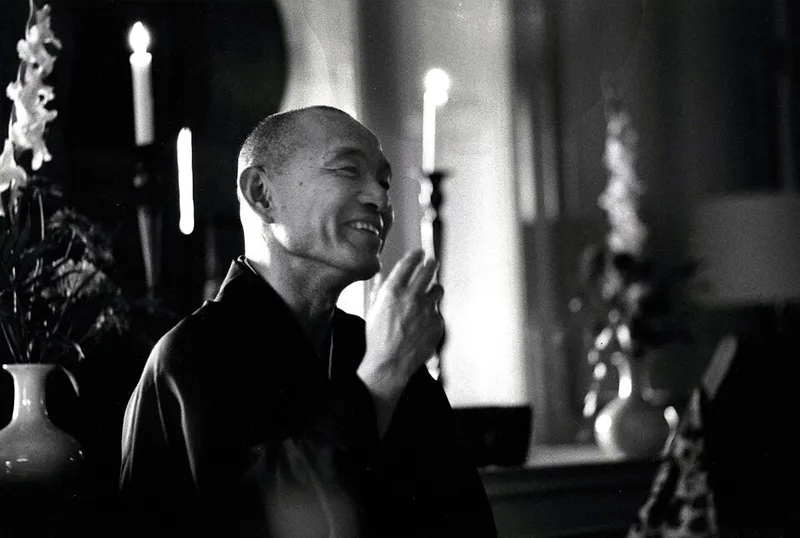
Taizan Maezumi
1931 – 1995
Hakuyū Taizan Maezumi was born February 24, 1931, in Ōtawara, Tochigi Prefecture, Japan, the son of Baian Hakujun Kuroda, abbot of Kirigayaji and a major figure of mid-twentieth-century Sōtō Zen. He was ordained a novice Sōtō monk at the age of eleven and went on to take degrees in Oriental literature and philosophy at Komazawa University, the Sōtō school's flagship institution, while completing formal monastic training at Sōji-ji[1][2]. In 1955 he received shihō (dharma transmission) from his father in the Sōtō lineage. What set Maezumi apart from almost every other Japanese teacher who came to the West was his determination to inherit several streams at once: he went on to receive inka shōmei from the Sanbō Kyōdan master Hakuun Yasutani in 1970, and a further inka in 1973 from the lay Rinzai master Kōryū Osaka, making him "one of very few teachers to receive Inka...in both the Inzan and Takuju Rinzai lineages, as well as Dharma Transmission in the Sōtō lineage."[2] These three transmissions are not equivalent in form or institutional standing: the 1955 act from Hakujun Kuroda is formal Sōtōshū-registered shihō; the Yasutani inka is a Sanbō Kyōdan certificate from a hybrid Sōtō-Rinzai modernist lineage that operates outside the Sōtōshū; and the Kōryū Osaka inka is from a Rinzai lay-koan-completion line. The triple lineage is the structural reason the White Plum Asanga is treated as a separate federation rather than a Sōtōshū sub-branch.
In 1956 Maezumi was sent to Los Angeles as a missionary priest of Zenshūji, the North American Sōtō headquarters, and in 1967 he founded the Zen Center of Los Angeles, which became one of the most influential American Zen training centers of the twentieth century[1][3]. He established the Kuroda Institute for the Study of Buddhism and Human Values in 1976 to support scholarly publication, and in 1979 he and his first heir Bernie Tetsugen Glassman conceived informally of the White Plum Asanga, named in honor of Baian Hakujun Dai-oshō; it was incorporated in 1995 after Maezumi's death and is today the umbrella for his entire lineage[2]. His curriculum integrated shikantaza, formal kōan study through the Harada-Yasutani curriculum, and the bodhisattva precepts, and his published writings include the foundational anthologies *On Zen Practice* (ZCLA, 1976) and *The Way of Everyday Life* (Center Publications, 1978), with the posthumous collections *Appreciate Your Life* (Shambhala, 2001) and *Teaching of the Great Mountain* (Tuttle, 2001) gathering decades of his Dharma talks[1].
Maezumi gave dharma transmission to twelve American successors — Tetsugen Bernard Glassman, Dennis Genpo Merzel, Charlotte Joko Beck, Jan Chozen Bays, John Daido Loori, Gerry Shishin Wick, John Tesshin Sanderson, Alfred Jitsudo Ancheta, Charles Tenshin Fletcher, Susan Myoyu Andersen, Nicolee Jikyo McMahon, and William Nyogen Yeo — and ordained 68 Zen priests and gave lay precepts to more than 500 students[1][2]. The breadth of that roster, which seeded ZCLA, Zen Peacemakers, Zen Mountain Monastery, the Ordinary Mind Zen School, Great Vow Monastery, and Kanzeon Sangha, is the principal reason the White Plum is now one of the largest Zen networks in the West. Maezumi died suddenly on May 15, 1995, in Tokyo, at the age of sixty-four[1][2].
Names
Teachers and lineage of Taizan Maezumi
Teacher / root master:
Formal Dharma transmission (shihō):
Teachings
- proverbAppreciate Your Life
Appreciate your life — this very life, with its fatigue, its mistakes, its small kindnesses. The Buddha did not promise a different life; only this one fully met.
- proverbThree Pillars of Practice
Sitting, study, and work — three pillars of one practice. Drop one and the roof leans; drop two and it falls; carry all three and the temple is strong even in storms.
- proverbOne Master, No Master
Take one master in this life and listen to him fully — and after listening, take no master at all. Without the first, the second is laziness; without the second, the first is idolatry.
- proverbBe Yourself
Be yourself, completely yourself. The Buddha had no other plan for you. The trying-to-be-someone-else is the only thing he ever asked us to give up.
- proverbImperfect Teacher
I am an imperfect teacher; I have stumbled in plain sight. Do not study my stumble — study the way I rose. The dharma is in the rising, even when the stumble was clearly mine.
Other masters in Sōtō
Master Record Sources
1931-1995
Taizan Maezumi
Soto
Yasutani Hakuun
1931-1995
Taizan Maezumi
Soto
Hakujun Kuroda