Robert Aitken
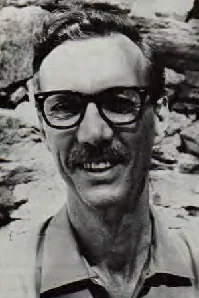
Robert Aitken
1917 – 2010
Robert Baker Aitken (19 June 1917 – 5 August 2010) was the dean of American Zen and, with his wife Anne Hopkins Aitken, the founder of the Honolulu Diamond Sangha — the first Western lay Zen community in the Sanbō Kyōdan stream. Born in Philadelphia and raised in Hawaii, he was working as a civilian construction worker on Guam when Japanese forces captured him in 1941; he spent the rest of the war in internment, and at a Kobe camp in 1944 a guard lent him R. H. Blyth's *Zen in English Literature and Oriental Classics*, which transformed him. He met Blyth in person in the same camp[1].
After the war Aitken trained successively with Nyogen Senzaki in Los Angeles in the late 1940s, with Nakagawa Soen in Japan from 1950, with Hakuun Yasutani from 1957, and finally — most decisively — with Yamada Kōun, who granted him teaching permission in 1974 and full dharma transmission in 1985[1]. In 1959 he and Anne began sitting with a small group at their Honolulu residence, the Koko-an Zendo, which grew into the Diamond Sangha and seeded affiliate centres across the United States, Australia, Argentina, and Europe[1]. In 1978 he co-founded the Buddhist Peace Fellowship, though his lifelong anarchist convictions meant he "didn't take any control due to distrusting all authority"[1].
Aitken's books gave English-speaking practitioners their first sustained vocabulary for Sanbō-style kōan work and engaged Buddhist ethics: *Taking the Path of Zen* (North Point Press, 1982), *The Mind of Clover: Essays in Zen Buddhist Ethics* (North Point Press, 1984), and *The Gateless Barrier: The Wu-men Kuan* (North Point Press, 1990), the last a full translation and commentary on the Mumonkan[1]. His acknowledged dharma successors — among them Nelson Foster, John Tarrant, Subhana Barzaghi, and Augusto Alcalde — extended the Diamond Sangha lineage internationally; Honolulu Diamond Sangha continues to describe itself as "a lay Zen Buddhist lineage grounded in the heritage of our Chinese and Japanese traditions" with Aitken among "Our Teachers, Past and Present"[2].
Names
Teachers and lineage of Robert Aitken
Teacher / root master:
Teachings
- proverbThe Precepts Are Alive
The precepts are not a set of rules imposed from outside. They are descriptions of how a person of true nature naturally behaves.
- proverbIntimate with All Things
Realization is not something you acquire. It is the intimate awareness that you were never separate from all things to begin with.
The bodhisattva does not practice in order to escape the world but in order to serve it. Zazen is not a retreat from suffering—it is the ground from which compassionate action arises. When you truly realize that self and other are not two, then the suffering of the world becomes your own suffering, and you cannot help but respond. This is the bodhisattva path: wisdom and compassion together, not one without the other. A Zen that ignores social justice is only half alive.
Each precept is a koan, a challenge to our understanding. 'Do not kill'—what does this really mean? It does not simply mean refraining from taking life. It means cherishing all life, nurturing all life, being life itself. When you take up a precept as a koan, you find that it opens endlessly, layer after layer. The precepts are not rules imposed from outside; they are the natural expression of an awakened life. To practice them deeply is to practice Zen itself.
- proverbMind of Clover
The bodhisattva's mind is the mind of clover — small leaves, intricate, modest, useful, growing in places no one chose. Be useful in the unchosen places.
- proverbPrecepts as Practice
The precepts are not laws to obey but practices to undertake. Each one is a koan in the body — solved by the way you live, not by the way you think about it.
- proverbEngaged Citizen
A Zen student is also a citizen. Sit in the morning; vote in the afternoon; protest in the evening if needed. The cushion does not absolve us from the polis.
Other masters in Sanbo-Zen
Master Record Sources
1917-2010
Robert Aitken
Sanbo-Zen
Yamada Koun