Chan
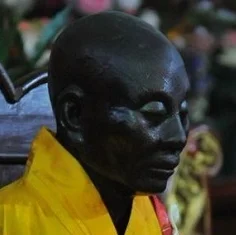
Chan
Chan
Top-level school branch
Chan (禪) is the Chinese Buddhist meditation tradition that emerged from the encounter between Indian Buddhism and Chinese culture, becoming the most influential school of East Asian Buddhism[1]. The word 'Chan' derives from the Sanskrit dhyana (meditation). Chan emphasizes direct experience of awakened mind over scriptural study, formalized by the motto attributed to Bodhidharma: 'A special transmission outside the scriptures; no dependence on words and letters; directly pointing to the human mind; seeing one's nature and becoming Buddha.'[2] During the Tang and Song dynasties, Chan developed its characteristic methods—encounter dialogues, koan practice, intensive sitting, and the teacher-student relationship as the vehicle of transmission[1]. The tradition crystallized into the Five Houses (Caodong, Linji, Yunmen, Guiyang, and Fayan), each with distinctive teaching styles[3]. Chan was transmitted to Korea (as Seon), Japan (as Zen), and Vietnam (as Thien), profoundly shaping the religious, artistic, and philosophical culture of East Asia[1].
Meditation practice
Chan encompasses a spectrum of meditation methods unified by the commitment to direct experiential realization over doctrinal study. The foundational practice is zuochan (sitting meditation), performed in lotus or half-lotus posture with regulated breathing and upright spine, complemented by distinctive methods within each school: silent illumination (mozhao) in Caodong, keyword investigation (huatou/kanhua) in Linji, and one-word barriers in Yunmen[3]. Encounter dialogue between teacher and student in the private interview (rushi/dokusan) serves as the primary vehicle for testing and deepening realization. Intensive group retreats (chanqi), typically lasting seven days with extended daily sitting, and the integration of manual labor (puqing) into practice, distinguish Chan's communal monastic training from other Buddhist traditions[4].
Prominent masters
Chan history is conventionally narrated through six Chinese patriarchs: Bodhidharma (the semi-legendary Indian founder)[2]; Dazu Huike, said to have severed his arm to demonstrate sincerity[5]; Jianzhi Sengcan, traditional author of the Xinxin Ming[6]; Dayi Daoxin, who established the East Mountain teaching at Mount Shuangfeng[7]; Daman Hongren, his successor at Mount Huangmei[8]; and Dajian Huineng, the illiterate Sixth Patriarch whose Platform Sutra became the charter of mature Chan[9]. From Huineng’s two great heirs, Qingyuan Xingsi and Nanyue Huairang, descend the Five Houses[3] — including the Caodong line of Dongshan Liangjie, the Linji line of Linji Yixuan, and the Yunmen, Fayan, and Guiyang houses[3].
Key texts
- Platform Sutra of the Sixth Patriarch
The only Chinese Buddhist text to be called a 'sutra.' Contains Huineng's autobiography, his poetry contest with Shenxiu, and the core teaching of sudden awakening. The foundational charter of mature Chan, treated by every later school as non-negotiable.
- Jingde-Era Record of the Transmission of the Lamp
The first and largest of the classical Chan 'lamp records' — thirty fascicles of biographies and encounter dialogues covering 1,700 masters from the seven Buddhas of antiquity down to the early Song. The primary source for nearly every Tang-dynasty Chan story still told today.
- Record of Linji
The sayings of Linji Yixuan — 'true person of no rank,' the four shouts, the famous 'If you meet the Buddha, kill the Buddha.' The single most influential Chan yulu (recorded sayings) and the beating heart of the Linji/Rinzai tradition.
- Blue Cliff Record
One hundred paradigmatic koans selected by Xuedou (Yunmen school) and unpacked by Yuanwu (Linji school) — each case framed by a pointer, main story, verse, and extensive commentary. The summit of Song-dynasty Chan literature.
- Gateless Barrier
Forty-eight kōans — including Zhaozhou's 'Mu,' 'The flag is moving,' and 'Nansen kills the cat' — each with a brief pointing verse. Lighter and more portable than the Blue Cliff Record; the standard entry point for koan practice in every subsequent Chan/Zen school.
Key concepts
- Zuochan
'Sitting Chan' — the foundational posture practice. Upright spine, regulated breath, eyes half-open; all Chan/Zen schools build their distinctive methods on top of zuochan rather than replacing it.
- Jianxing
'Seeing [one's] nature.' The second half of Bodhidharma's four-line motto and the explicit aim of Chan: a direct, non-conceptual apprehension that the awakened mind is one's own original face.
- Jiaowai biechuan
'A special transmission outside the scriptures.' The signature self-description of Chan — not a rejection of sutras but a claim that the awakening they describe is transmitted mind-to-mind in encounter, not by text alone.
- Gong'an
'Public case' (Japanese kōan, Korean kongan) — a recorded encounter or saying taken up as a live point of meditation. The characteristic Chan pedagogical instrument from the late Tang onward.
- Five Houses
Caodong, Linji, Yunmen, Fayan, and Guiyang — the five distinct teaching lineages that crystallized in late-Tang and early-Song Chan. Each has its own signature pedagogy; together they define the classical period.
- Puqing
'Universal invitation' — the Chan monastic labor system codified by Baizhang Huaihai. 'A day without work, a day without eating': manual work in the fields and kitchens is treated as no less awakening than seated meditation.
- Buddha-nature
'Foxing' (Jp. busshō) — the doctrine, drawn from the Tathāgatagarbha and Nirvāṇa sūtras, that all beings already possess the awakened nature of a buddha. The premise of every Chan claim that awakening is a recognition rather than an attainment.
- Emptiness
'Kōng' (Skt. śūnyatā, Jp. kū). The teaching, articulated by Nāgārjuna and inherited by Chan through the Prajñāpāramitā literature, that no thing has independent self-nature — everything arises in dependence on conditions. Not nihilism but the absence of fixity that makes liberation possible.
- Suchness
'Zhēnrú' (Skt. tathatā, Jp. shinnyo). Reality just as it is, prior to conceptual elaboration. The 'thus' of the Tathāgata — what shikantaza, kanhua, and silent illumination all point at, each in their own register.
- Original face
'Běnlái miànmù' (Jp. honrai no menmoku). 'What was your original face before your parents were born?' — the question Huineng poses in the Platform Sūtra, used in Chan and Zen ever since as a direct pointer to the mind that precedes name and form.
- Mondō
'Wèndá' (Jp. mondō). The recorded question-and-answer between master and student that became the dominant literary form of Chan from the Tang onward — and the raw material from which kōan collections were later assembled.
- Three Treasures
'Sānbǎo' (Jp. sanbō). The Buddha, the Dharma, and the Saṅgha — the three refuges every Chan practitioner takes formally at ordination and informally each day. Common ground with all Buddhist traditions.
Masters in this branch
No masters linked to this school yet.
Chan practice centres
United Kingdom
China
United States
Netherlands
- He Hua Temple
- Zen aan de Amstel (Maha Karuna Ch'an Amsterdam)
- Zen Rotterdam (Kloostertuin / Maha Karuna Ch'an)
- Zengroep Breda (Maha Karuna Ch'an)
- Zengroep Doetinchem (Maha Karuna Ch'an / Sint Willibrordsabdij)
- Zengroep Hengelo (Maha Karuna Ch'an)
- Zengroep Leudal (Maha Karuna Ch'an)
- Zengroep Terneuzen (Maha Karuna Ch'an)
Canada
Hong Kong
Taiwan
Sources in use
No supporting sources are attached to the linked masters yet.