Dongshan Liangjie
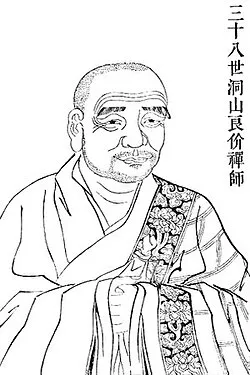
Dongshan Liangjie
807 – 869
Dongshan Liangjie was the founder of the Caodong school of Chinese Chan, the tradition that later became the Japanese Soto school through Dogen[1]. He was a student of Yunyan Tansheng and is famous above all for his awakening experience while crossing a stream: seeing his reflection in the water, he suddenly understood the teaching that Yunyan had been pointing to. His verse on this moment begins: "Earnestly avoid seeking without, lest it recede far from you."[2]
Dongshan developed the teaching of the Five Ranks (Wuwei), a sophisticated schema describing the relationship between the absolute (the dark, emptiness) and the relative (the bright, phenomena)[3]. The Five Ranks became the philosophical backbone of Caodong practice and have been studied and debated for twelve centuries. Unlike the Linji/Rinzai emphasis on sudden breakthrough through shock and paradox, Dongshan's approach was subtler and more gradualist, emphasizing the integration of emptiness and form in the stream of everyday activity[1]. He founded the Caodong school together with his student Caoshan Benji, and the school's name combines their two mountain names[3].
Names
Disciples of Dongshan Liangjie
Teachers and lineage of Dongshan Liangjie
Teacher / root master:
Works
Dongshan's dialectical schema of the relationship between the absolute (zhèng, "upright") and the relative (piān, "inclined"). The five positions — relative within the absolute, absolute within the relative, coming from the absolute, going within both, arriving in both — became the doctrinal backbone of Caodong/Sōtō and a major kōan-curriculum object in later Rinzai training.
- Baojing SanmeiSong of the Jewel Mirror Samādhi (Bǎojìng Sānmèi Gē)
Dongshan's verse compendium, transmitted from his teacher Yunyan, that compresses the entire Caodong account of practice into ninety-six lines. Chanted in Sōtō morning service worldwide alongside the Sandōkai. Notable for its treatment of the relationship between teacher and student as a single mirror reflecting itself.
Teachings
- proverbTruth Outside Yourself
If you look for the truth outside yourself, it gets farther and farther away.
In the third watch of the night before the moon appears, no wonder when we meet there is no recognition. Still cherished in my heart is the beauty of earlier days.
The Apparent within the Real: In the third watch of the night before the moon appears, no wonder when we meet there is no recognition. Still cherished in my heart is the beauty of earlier days. The Real within the Apparent: A sleepy-eyed grandma encounters herself in an old mirror. Clearly she sees a face, but it doesn't resemble hers at all. Too bad, with lowered head, she tries to recognize her reflection. Coming from within the Real: Within nothingness there is a path leading away from the dusts of the world. Even if you observe the taboo on the present emperor's name, you will surpass that eloquent one of yore who silenced every tongue. Arrival at Mutual Integration: When two blades cross points, there's no need to withdraw. The master swordsman is like the lotus blooming in the fire. Such a person has in and of themselves a heaven-soaring spirit.
- dialogueDongshan Crosses the Stream
Dongshan took leave of Yunyan and asked, "After you have passed away, if someone asks me to describe your teaching, what shall I say?" Yunyan was silent for a long time, then said, "Just this is it." Dongshan sank into thought. Yunyan said, "You must be very careful, since you are carrying this great matter." Dongshan was still doubtful. Later, as he was crossing a stream, he saw his own reflection in the water and was greatly awakened. He composed a verse: "Avoid seeking elsewhere, for that is far from the self. Now I travel alone, everywhere I meet it. It now is exactly me; I now am not it. One must understand in this way to merge with suchness."
- dialogueThe Seamless Monument
Dongshan was unwell. A monk asked, "Your Reverence is ill, but is there anyone who does not get ill?" Dongshan said, "There is." The monk asked, "Does the one who does not get ill look after Your Reverence?" Dongshan said, "This old monk is properly looking after that one." The monk asked, "How is it when you look after that one?" Dongshan said, "Then I do not see that there is any illness."
- proverbHost Within Host
When the host sees the guest, that is still a division. When the host sees the host, the whole household falls silent.
There is the apparent within the real; the real within the apparent; coming from within the real; arriving in mutual integration; arrival in unity. Five ranks, one lord — the names change, the lord does not.
- proverbWhere Cold Cannot Reach
A monk asked: when cold and heat come, how can we escape them? Why not go to a place where there is no cold and no heat? Where is such a place? Where the cold kills you, the heat kills you.
Crossing the stream I saw my own face in the water — and there it was at last, looking back. He is exactly me, but I am not him; the meeting is the meaning.
- proverbNot a Stranger
If you go to find this person, you will fail; the going makes him a stranger. Sit still where you are; soon he will sit down across from you, and you will not be able to tell which is the host.
Snow falls into a silver bowl: the white touches the white, and yet it is two. So with the meeting of the apparent and the real — they are not one, and not two, and not somewhere in between.
- proverbLast Sickness
Even a sickness can be the teaching. When my last sickness came, my students wept. I said: this body is not yours to mourn. Mourn the day you cannot tell whose body it is.
Featured in
- Jingde ChuandengluJust This Is It
Other masters in Qingyuan line
Master Record Sources
807-69
Dongshan Liangjie
Qingyuan line
- koan_refsChart of the Chan Ancestors
43 22,49,56 9,81 89,94,98 85
- nameZen Editorial Overlay - Originals Curation
Dongshan Liangjie
- teachersZen Editorial Overlay - Originals Curation
Yunyan Tansheng
807-869
Dongshan Liangjie
Caodong/Soto
807-869
Dongshan Liangjie
Caodong
807–869
Dongshan Liangjie
Caodong
- teachersWikipedia - Zen Lineage Charts
Yunyan Tansheng