Ananda
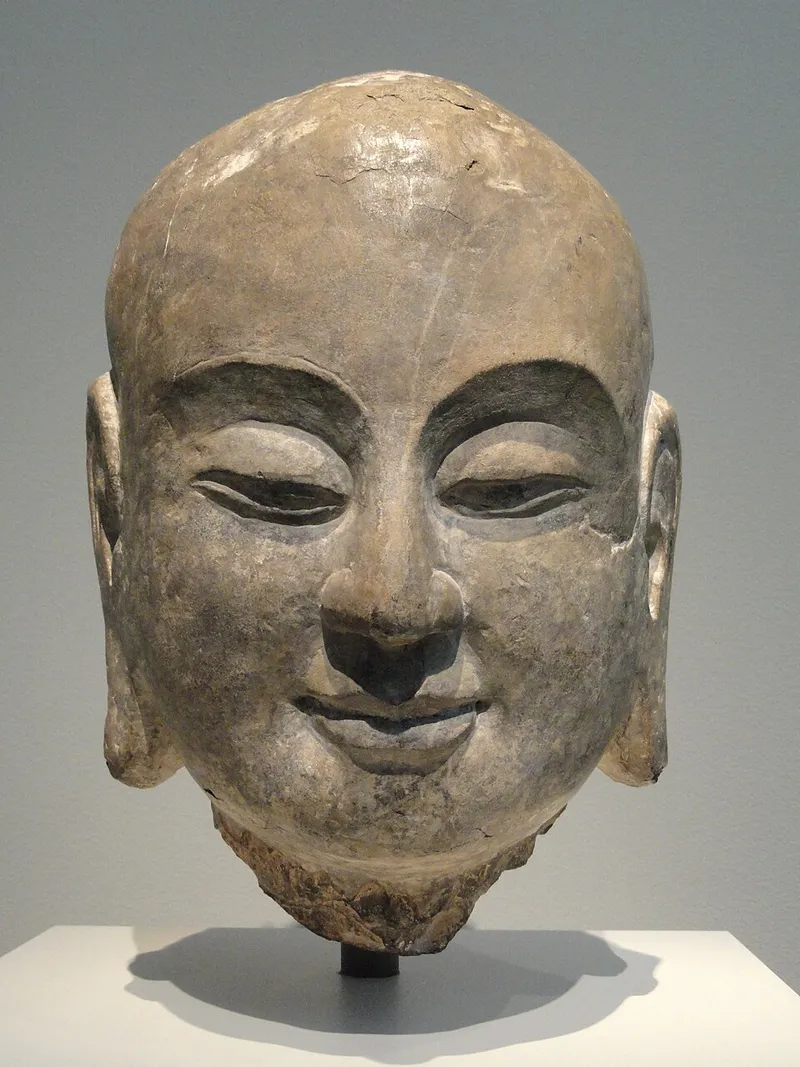
Ananda
5th c. BCE – Unknown
Ānanda was Śākyamuni Buddha's cousin, personal attendant, and the disciple foremost in *bahuśruta* (much-learning) and in service to others[1]. He is among the most extensively documented figures of the early canon: the Pāli Aṅguttara Nikāya credits him as the Buddha's attendant for the last twenty-five years of his life, and the introductory phrase that opens nearly every sūtra—*evaṃ me sutaṃ*, "thus have I heard"—is attributed to his recitation at the First Council[2].
Ānanda's most consequential intervention in the early canon is his role in the foundation of the *bhikkhunī saṅgha*. According to the *Cullavagga*, when Mahāprajāpatī Gautamī, the Buddha's foster-mother, three times petitioned the Buddha for ordination, the Buddha three times refused. Ānanda interceded, asking whether women were capable of attaining the four stages of awakening; when the Buddha affirmed that they were, Ānanda pressed the case until the Buddha consented, and the eight *gurudharmas* governing relations between the male and female sanghas were instituted on this occasion[3]. The episode is preserved as one of the earliest formal records of women's full ordination in any world religion.
Tradition holds that, although Ānanda had heard more of the Buddha's teaching than anyone else, he had not yet attained full *arhatship* during the Buddha's lifetime. On the night before the First Council—where Mahākāśyapa had reluctantly agreed to admit him only as a fully realized arhat—Ānanda is said to have meditated through the night and realized liberation just before dawn[4]. The next day he recited the entire corpus of discourses from memory; the council preserved this oral recension, which became the basis of the *Sūtra Piṭaka* of all early schools[5].
In the Chan lineage Ānanda is the second patriarch, the recipient of Mahākāśyapa's transmission and the teacher of Śāṇavāsa[6]. The most celebrated Chan story about him is "Kāśyapa's Flagpole," recorded as Case 22 of the *Wúménguān*: Ānanda asked Mahākāśyapa what the World-Honored One had transmitted besides the gold-embroidered robe; Mahākāśyapa called "Ānanda!" Ānanda answered "Yes!" Mahākāśyapa said: "Knock down the flagpole at the gate." The exchange is read in Chan as Mahākāśyapa's confirming gesture—what the Buddha transmitted to him, he transmits to Ānanda in the moment of being called and answered[7]. Ānanda is traditionally said to have lived to a great age and, at the moment of his *parinirvāṇa*, divided his relics by levitating to the middle of the Ganges, an etiological tale for two reliquary stūpas built on opposite banks by the kingdoms of Magadha and Vaiśālī[8].
Names
Disciples of Ananda
Teachers and lineage of Ananda
Teacher / root master:
Teachings
- sayingThus Have I Heard
Thus have I heard. These are the words with which every sutra begins, for it was Ananda—the Buddha's attendant for twenty-five years—who recited from memory the entirety of the Buddha's teachings at the First Council. Though Ananda had not yet attained full awakening during the Buddha's lifetime, his perfect memory preserved every word. On the night before the council, pressed by the urgency of the task, Ananda at last relinquished his striving and lay down to rest. In that moment of letting go, his mind opened completely, and he was fully awakened.
- proverbThus Have I Heard
Every sutra begins: thus have I heard. I was the one who heard. Memory is the first ferry; do not curse the ferryman.
- proverbWomen as Equals
I asked the World-Honored One whether women could awaken as men do. He said: yes. I asked again, in case he had not heard me. He said: yes again. The dharma did not need a third asking — but the world did.
- proverbKnock Down the Pole
Mahākāśyapa told me: knock down the pole at the gate. I did so, and only then was I admitted to the council. The robe and the memorizing were not enough; the gate too had to be released.
I was the World-Honored One's attendant for twenty-five years. The dharma I learned was not in the talks I overheard; it was in the way the bowl was washed after each meal.
- proverbLate Arahantship
I attained arahantship the night before the council, after years of being told I was not yet ready. Whoever has been told he is not ready: that telling itself is the door.
Other masters in Indian Patriarchs
Master Record Sources
- datesZen Editorial Overlay - Originals Curation
trad. 5th c. BCE
- nameZen Editorial Overlay - Originals Curation
Ananda
- schoolZen Editorial Overlay - Originals Curation
Indian Patriarchs
- teachersZen Editorial Overlay - Originals Curation
Mahakashyapa
- identityWikipedia - Zen Lineage Charts
Ānanda was the primary attendant of the Buddha and one of his ten principal disciples, renowned for his memory of the Buddha's discourses; in Chan lineage reckoning he is the second Indian patriarch.