Indian Patriarchs
Zen
Indian Patriarchs
Top-level school branch
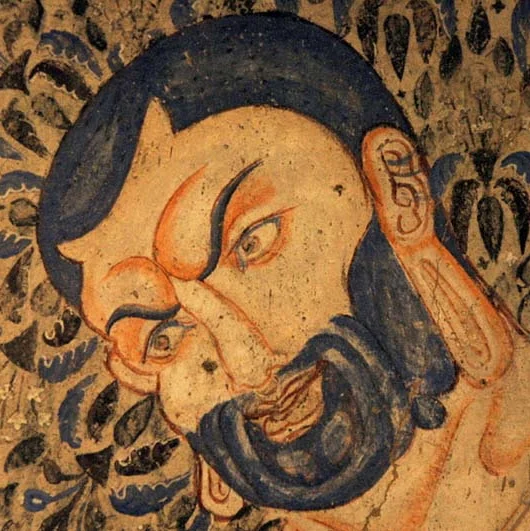
The twenty-eight Indian patriarchs form the traditional lineage from Shakyamuni Buddha to Bodhidharma, tracing the mind-to-mind transmission of awakening across roughly a thousand years of Indian Buddhism[1]. The lineage begins with the Flower Sermon: the Buddha held up a flower before the assembly on Vulture Peak, and only Mahakashyapa smiled in understanding[2]. This wordless exchange is regarded as the origin of the entire Chan/Zen transmission[2]. The chain passes through major figures in Indian Buddhist history—including Nagarjuna, Ashvaghosha, and Vasubandhu—before reaching Prajnatara, who recognized Bodhidharma and sent him east to China[1][3]. While modern historians question the historical accuracy of this lineage as a literal chain of teacher-student relationships, the tradition treats it as a sacred genealogy affirming that the awakening transmitted in Zen is identical to the Buddha's own realization[4].
Meditation practice
The Indian patriarchs transmitted dhyana—meditative absorption rooted in the Buddha’s own practice of seated contemplation and direct mind-to-mind transmission (yixin chuanxin). Their methods encompassed the full range of early Buddhist samatha-vipassana practice as well as Mahayana prajna contemplation, from Upagupta’s rigorous Sarvastivada meditation discipline to Nagarjuna’s Madhyamaka investigation of emptiness[3]. The lineage’s defining claim is that an awakening identical to the Buddha’s was passed wordlessly from teacher to student across twenty-eight generations, establishing the paradigm of direct transmission that became the hallmark of all Chan and Zen schools[1].
Prominent masters
The first patriarch, Mahākāśyapa, is venerated for receiving the Buddha’s wordless transmission at the Flower Sermon[2]. The lineage continues through Ānanda, the Buddha’s personal attendant who memorised the discourses; Śāṇavāsa; and the Mauryan-era master Upagupta, said to have ordained tens of thousands[5]. Among its most consequential figures are Nāgārjuna (c. 2nd c. CE), founder of the Madhyamaka school of emptiness[6]; Aśvaghoṣa, author of the Buddhacarita[7]; and Vasubandhu, the Yogācāra theorist[8]. The line closes with Prajñātāra, traditionally said to have recognised the young Bodhidharma and sent him east, where he is remembered as the 28th Indian and 1st Chinese patriarch[3].
Key texts
- Denkōroku (Transmission of the Light)
The Sōtō tradition's own narrative of the 53 ancestors — 28 Indian patriarchs from Śākyamuni through Bodhidharma, then 23 Chinese and 2 Japanese masters to Dōgen. The canonical source for stories of the Indian lineage as the Zen tradition remembers it.
- Flower Sermon
The Buddha holds up a flower before the assembly on Vulture Peak; only Mahākāśyapa smiles. Case 6 of the Mumonkan and the foundational scene of the entire Chan/Zen mind-to-mind transmission mythology.
- Mūlamadhyamakakārikā
'Root Verses on the Middle Way.' Nāgārjuna, the 14th Indian patriarch in the Zen lineage, systematized the Mahayana teaching of emptiness — the philosophical ground on which all later Chan and Zen thought rests.
Key concepts
- Twenty-Eight Patriarchs
The canonical genealogy from Mahākāśyapa to Bodhidharma, as recorded in the Jingde-era Transmission of the Lamp (1004) and earlier Chan texts. A sacred charter rather than strict history.
- Yixin chuanxin
'Transmitting mind with mind.' The characteristic description of how awakening passed between the Indian ancestors — not through scripture but through a direct, silent recognition between teacher and disciple.
- Dhyāna
The Sanskrit word from which 'Chan' and 'Zen' directly descend — meditative absorption, the sustained collected attention in which the awakening transmitted through the patriarchs is realized.
- Bodhicitta
'Mind of awakening.' The aspiration — central to the Mahāyāna inheritance Chan received from India — to realize buddhahood for the sake of all beings. The motivational ground beneath every later Chan vow.
- Bodhisattva
An 'awakening being' who postpones final nirvāṇa to liberate all sentient beings. The Mahāyāna ideal carried into China by the Indian patriarchs and embodied in figures like Avalokiteśvara (Guanyin) and Mañjuśrī.
- Prajñāpāramitā
'Perfection of wisdom.' The corpus of Mahāyāna sūtras — Heart, Diamond, and the longer Prajñāpāramitā texts — that grounds Chan's teaching of emptiness. Nāgārjuna's Madhyamaka is its philosophical articulation.
In the words of the masters
- Flower and Smile
On Vulture Peak the World-Honored One held up a flower; the assembly was silent; only Mahākāśyapa smiled. The flower has not stopped being held up; the smile has not stopped traveling.
- Why Mahākāśyapa Smiled
He smiled not because he understood, but because there was nothing left to misunderstand. To smile in that way once is to have transmission already.
- Three Robes and a Bowl
Three robes and a bowl are enough for a monk. If you cannot live within those four objects, no fifth object will save you.
- Ascetic Discipline
Some called my discipline severe. I never asked the body for more than the body could give; I asked it not to bargain. The bargaining is the only severe thing.
- First Council
After the World-Honored One died, we gathered to remember his words. Memory was the first sangha; the rules were a fence around the memory; the practice was the field inside the fence.
- Thus Have I Heard
Every sutra begins: thus have I heard. I was the one who heard. Memory is the first ferry; do not curse the ferryman.
Masters in this branch
Sources in use
- Zen Editorial Overlay - Originals Curation
- Tibetan Buddhist Encyclopedia - Zen Lineage Charts
- Wikipedia - Zen Lineage Charts