Upagupta
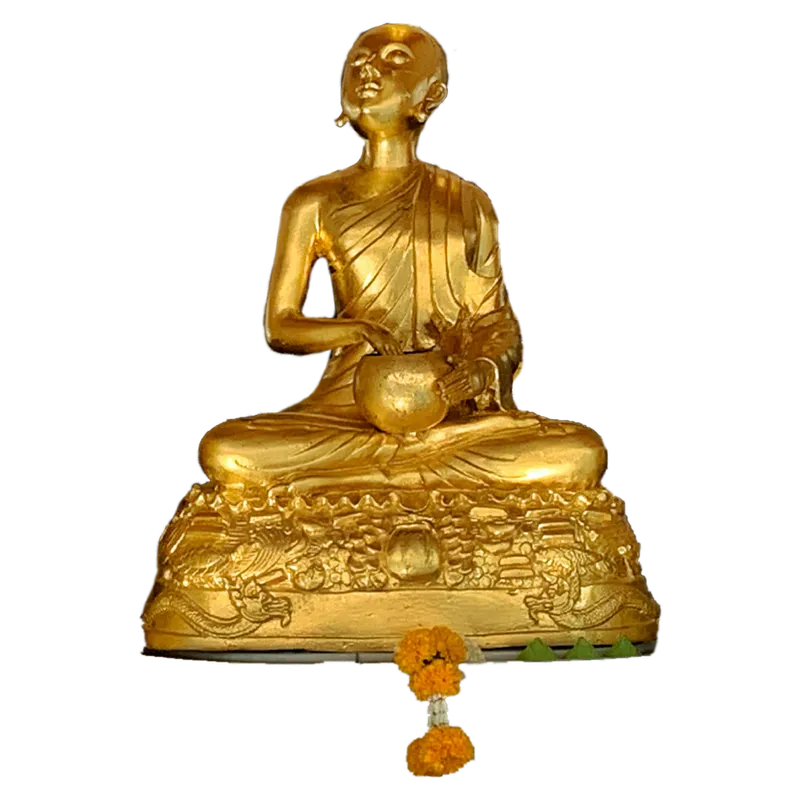
Upagupta
3rd c. BCE – Unknown
Upagupta is the fourth patriarch in the Chan list and one of the more substantively attested early figures, the subject of an extensive corpus of Sanskrit narrative literature centered in Mathurā[1]. The *Aśokāvadāna* presents him as the spiritual preceptor of the emperor Aśoka (r. c. 268–232 BCE), and John Strong's monograph *The Legend and Cult of Upagupta* documents a continuous regional cult that survives in modern Burma and Thailand, where he is invoked as *U Pakuṭ* and propitiated as a protector against monsoon storms[2].
Two narrative motifs dominate the Upagupta legend. The first is his subjugation of Māra: when Māra disrupted his preaching, Upagupta countered by binding three corpses—a dog, a snake, and a man—around Māra's neck as a perfumed garland that Māra could not remove until he humbled himself; afterwards Māra is said to have taken refuge in the Dharma[3]. The second is his role as imperial preceptor: he led Aśoka on a pilgrimage to the great sites of the Buddha's life, identifying each location and confirming the emperor's commitment to Buddhist patronage[4].
The Sarvāstivāda school of northwest India regarded Upagupta as their fifth patriarch, parallel to but distinct from the Chan reckoning. Dumoulin notes that the early Chan lineage drew on these northwestern materials but reorganized them around Mahāyāna concerns, producing the twenty-eight-name sequence that became canonical from the *Jǐngdé Chuándēng Lù* onward[5]. Upagupta is described in Chan sources as "the buddha without marks" (*alakṣaṇaka-buddha*)—accomplished in realization without possessing the thirty-two physical *lakṣaṇas* of a *cakravartin*[6].
Names
Disciples of Upagupta
Teachers and lineage of Upagupta
Teacher / root master:
Teachings
- dialogueThe Fragrance Without a Flower
When Śāṇavāsa was about to transmit the Dharma, he asked Upagupta: 'Can you hold the formless?' Upagupta held up his empty hand. Śāṇavāsa said: 'What is in your hand?' Upagupta said: 'Ask what is not in it.' Śāṇavāsa said: 'I transmit to you this flower without fragrance, this fragrance without a flower.' Keizan's verse: No root, no stem, no petal— / yet the whole garden fills with scent. / This is the flower transmitted / from mind to mind since ancient times.
- dialogueConverting Māra
Upagupta is said to have tamed Māra, the embodiment of delusion, through the power of samādhi. When Māra appeared in a radiant form to seduce practitioners, Upagupta placed the rotting corpses of a dog, a snake, and a human being around Māra's neck. Māra, unable to remove them, begged for release. Upagupta said: 'Bow to the Buddha.' Māra said: 'The Buddha is long gone.' Upagupta said: 'This form I put on you—is it gone?'
- proverbCounted Stones
I asked each new student to bring a small stone for every passion that arose. The cave filled with stones; the passions did not. Then we built a wall around the cave with the stones, and used it as a meditation hall.
- proverbLay Merchant Awakens
A wealthy merchant came to me wanting to leave the world. I told him: stay in the world and trade fairly; the dharma is in the weighing of the goods. He returned a year later and said: the scales have been my master.
Other masters in Indian Patriarchs
Master Record Sources
- datesZen Editorial Overlay - Originals Curation
trad. 3rd c. BCE
- nameZen Editorial Overlay - Originals Curation
Upagupta
- schoolZen Editorial Overlay - Originals Curation
Indian Patriarchs
- teachersZen Editorial Overlay - Originals Curation
Shanakavasa
- identityWikipedia - Zen Lineage Charts
Upagupta was a prominent Buddhist monk in the Mauryan period, associated with the reign of Ashoka; he is counted the fourth Indian patriarch in Chan reckoning and is particularly venerated in Southeast Asian Theravāda tradition.