Mahakashyapa
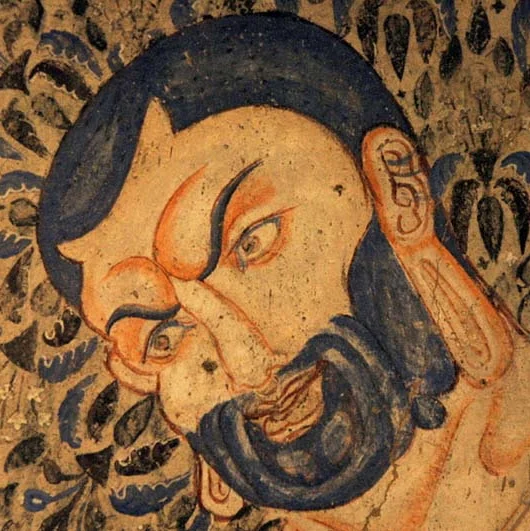
Mahakashyapa
5th c. BCE – Unknown
Mahākāśyapa (Pāli: Mahā-Kassapa) is one of the few figures of the Indian Chan lineage whose historical existence is firmly attested in the early canon. The Pāli Saṃyutta Nikāya devotes an entire chapter—the Kassapa Saṃyutta—to discourses associated with him, depicting an austere senior monk who maintained the *dhutaṅga* observances (rag robes, alms-food only, forest dwelling) into old age and who declined royal patronage[1]. Born Pippali into a wealthy brahmin family of Mahātittha in Magadha and married to the equally devout Bhaddā Kāpilānī, he is said to have renounced household life by mutual agreement with his wife, who herself ordained as a *bhikkhunī*[2]. The Buddha exchanged robes with him and praised him as foremost in ascetic discipline (*dhutaguṇa*).
Within the Chan tradition Mahākāśyapa is the first patriarch, the recipient of the wordless transmission given on Mount Gṛdhrakūṭa (Vulture Peak)[3]. The locus classicus of this episode is Case 6 of the *Wúménguān* (Mumonkan, 1228): when the Buddha "twirled a flower," only Mahākāśyapa smiled, and the Buddha said: "I have the eye of the true Dharma, the marvelous mind of nirvāṇa, the true mark of formlessness, the subtle Dharma gate that does not rest on words and letters and is transmitted outside the scriptures—this I entrust to Mahākāśyapa."[4] Modern scholarship traces the textual emergence of the Flower Sermon to the eleventh-century *Tiānshèng Guǎngdēng Lù* and the *Wúménguān*, and treats it as a Chan retrojection rather than an episode of the historical Buddha[5].
Following the Buddha's *parinirvāṇa*, Mahākāśyapa convened the First Council at Rājagṛha—an event recorded in the Pāli *Cullavagga* and the parallel Vinayas of all early schools. Five hundred *arhats* gathered; Ānanda recited the discourses (the *Sūtra Piṭaka*) and Upāli the monastic rules (the *Vinaya Piṭaka*), fixing the recension that would descend through oral transmission for several centuries before being committed to writing[6]. Tradition holds that Mahākāśyapa subsequently entered into deep meditative absorption on Mount Kukkuṭapāda ("Cock's Foot") to await the coming of Maitreya, the future Buddha, to whom he is to transmit the robe given him by Śākyamuni[7]. The Chinese pilgrim Xuanzang in the seventh century reported the mountain as a major pilgrimage site venerating his samādhi[8].
Names
Disciples of Mahakashyapa
Teachers and lineage of Mahakashyapa
Teacher / root master:
Teachings
Ananda asked Kashapa: "Buddha gave you the golden-woven robe of successorship. What else did he give you?" Kashapa said: "Ananda." Ananda answered: "Yes, brother." Said Kashapa: "Now you can take down my preaching sign and put up your own." Mumon’s comment: If one understands this, he will see the old brotherhood still gathering, but if not, even though he has studied the truth from ages before the Buddhas, he will not attain enlightenment. The point of the question is dull but the answer is intimate. How many persons hearing it will open their eyes? Elder brother calls and younger brother answers, This spring does not belong to the ordinary season.
- proverbFlower and Smile
On Vulture Peak the World-Honored One held up a flower; the assembly was silent; only Mahākāśyapa smiled. The flower has not stopped being held up; the smile has not stopped traveling.
- proverbWhy Mahākāśyapa Smiled
He smiled not because he understood, but because there was nothing left to misunderstand. To smile in that way once is to have transmission already.
- proverbThree Robes and a Bowl
Three robes and a bowl are enough for a monk. If you cannot live within those four objects, no fifth object will save you.
- proverbAscetic Discipline
Some called my discipline severe. I never asked the body for more than the body could give; I asked it not to bargain. The bargaining is the only severe thing.
- proverbFirst Council
After the World-Honored One died, we gathered to remember his words. Memory was the first sangha; the rules were a fence around the memory; the practice was the field inside the fence.
Other masters in Indian Patriarchs
Master Record Sources
- datesZen Editorial Overlay - Originals Curation
trad. 5th c. BCE
- nameZen Editorial Overlay - Originals Curation
Mahakashyapa
- schoolZen Editorial Overlay - Originals Curation
Indian Patriarchs
- teachersZen Editorial Overlay - Originals Curation
Shakyamuni Buddha
- identityWikipedia - Zen Lineage Charts
Mahakāśyapa was a principal disciple of the Buddha, presided over the First Buddhist Council, and is revered in Chan/Zen as the first patriarch who received the wordless mind-to-mind transmission symbolised by the Flower Sermon.