Hakuin Ekaku
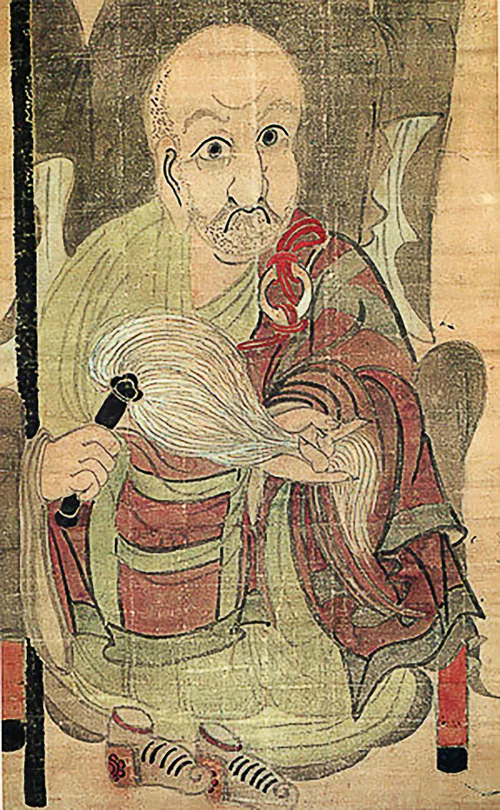
Hakuin Ekaku
1686 – 1769
Hakuin Ekaku, who lived from 1686 to 1769, is credited with single-handedly reviving and systematizing the Rinzai school of Zen after a period of significant decline[1]. Through his own intense and prolonged practice—marked by repeated experiences of kensho and equally repeated disillusionment when he recognized deeper layers of his own confusion—Hakuin developed a curriculum of koan practice that moved systematically through progressively deeper layers of inquiry. This curriculum became the standard structure for Rinzai training that continues to this day[2].
Hakuin's own biography is written in his awakening autobiography Orategama and Wild Ivy, extraordinary documents of the psychological and physical extremes of intensive practice[3]. He developed what he called "Zen sickness"—a dangerous energetic imbalance from excessive one-pointed effort—and was cured by the hermit Hakuyu, from whom he learned the practice of "soft butter" visualization for cultivating the body's energy[3]. Hakuin was also a prolific and unconventional visual artist, creating thousands of brushwork paintings and calligraphies that expressed Dharma teachings through visceral imagery[4]. His famous Circle of Emptiness paintings and his portraits of Bodhidharma are among the most iconic works of Japanese religious art. His restoration of Rinzai practice gave the Japanese Zen tradition a renewed vitality that has persisted to the modern period.
Names
Disciples of Hakuin Ekaku
Teachers and lineage of Hakuin Ekaku
Teacher / root master:
Works
- OrategamaOrategama (The Embossed Tea-Kettle)
A three-part collection of letters by Hakuin (1751) addressed to a daimyō, a nun, and a fellow Zen master. The Orategama lays out Hakuin's mature account of kōan introspection (kanna-zen), naijikan energy practice, and the necessity of post-satori cultivation — the framework that shapes modern Rinzai training to this day.
- Zazen WasanZazen Wasan (Song of Zazen)
Hakuin's short verse-hymn in the vernacular, chanted at the close of zazen sessions in Rinzai temples worldwide. "All beings by nature are Buddha, as ice by nature is water" — its forty-four lines compress Hakuin's teaching that practice and realization are not separate, intended to be memorised by lay practitioners.
Hakuin's most demanding kōan-commentary collection: dense, allusive verses and prose responses to traditional cases. The title — "poison-stamens" — flags Hakuin's view that genuine kōan study demands the ingestion of something dangerous to the conventional self. Selectively translated; remains a touchstone for Rinzai kōan curriculum.
Teachings
Not knowing how near the truth is, we seek it far away.
- proverbMeditation in Activity
Meditation in the midst of activity is a thousand times superior to meditation in stillness.
All beings by nature are Buddha, as ice by nature is water. Apart from water there is no ice; apart from beings, no Buddha. How sad that people ignore the near and search for truth afar: like someone in the midst of water crying out in thirst.
Imagine that a lump of soft butter, pure in color and fragrance, the size of a duck egg, is placed on the top of your head. As it begins to melt, it slowly flows downward, moistening and saturating your head, your shoulders, your arms, your chest, your lungs, your liver, your stomach, your back, your spine. All the ailments in these areas dissolve and flow downward like water. You can hear them trickling down. The melted butter continues flowing down through your legs to the soles of your feet, where it comes to rest. Then the whole process begins again. As you continue this meditation, the ailments of the body are healed, and the obstructions of the mind are cleared. This practice never fails.
You say that your practice has brought you to a state of exhaustion and illness. This is because you have been exerting yourself in the wrong way. True practice is not a matter of straining and forcing. When you sit, let the breath sink naturally to the ocean of ki below the navel. Let the strength gather in the legs and lower body while the upper body remains relaxed and open. Do not chase after enlightenment with a tense and agitated mind. The great matter is right here, in this breath, in this moment. When the mind is settled in the tanden and the breath flows naturally, the body heals itself and the Way opens of its own accord.
All beings are originally Buddha, as water and ice — apart from water no ice, apart from beings no Buddha. How sad that beings seek afar and do not know what is at hand.
- proverbSound of One Hand
What is the sound of one hand clapping? Listen until the listening becomes the only sound in the room.
- proverbGreat Doubt, Great Awakening
If your doubt is great, your awakening will be great. If your doubt is small, your awakening will be small. If you do not doubt at all, you will not awaken at all.
- proverbSoft-Butter Method
When the body grows ill from too-tight practice, place an imagined ball of soft butter on the crown of the head. Let it melt down through every joint and organ. The body returns; the practice continues without breaking the body it depends on.
- proverbIs That So?
When the village accused me of fathering the child, I said: is that so? When they brought the child for me to raise, I said: is that so? When they came years later to apologize, I said: is that so? The dharma was not different in any of the three rooms.
- proverbFrog of Hakuin
Sit with such concentration that even a frog is your teacher. The frog jumps when it must; you sit when you must; the koan is the same in both.
- proverbLaypeople Can Awaken Too
Some say only monks awaken. I have known farmers, weavers, and an old fishwife who saw their nature without ever entering a monastery. Whoever doubts greatly awakens greatly — robes are no shortcut.
- proverbAfter Satori, More Practice
After the great awakening, the practice does not stop. It continues for the rest of one's life — but now it is the practice of being grateful, not the practice of catching up.
- proverbHell Is Made of Self
Whoever has not seen self-nature has not yet escaped hell. Hell is not a place beneath the world; it is the room of self, and the door opens inward.
- proverbLetter to Young Monks
Sit in the burning house and do not run. The flames will become the wind that fans your practice. The student who runs out has only escaped a fire that was about to teach.
Other masters in Rinzai
Master Record Sources
- datesZen Editorial Overlay - Originals Curation
1686-1769
- nameZen Editorial Overlay - Originals Curation
Hakuin Ekaku
- schoolZen Editorial Overlay - Originals Curation
Rinzai
- teachersZen Editorial Overlay - Originals Curation
Shoju Rojin