Caodong
Chan
Caodong
曹洞宗
Branch of Qingyuan line
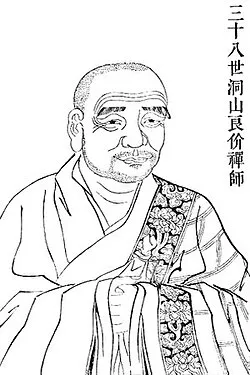
The Caodong school (曹洞宗) is one of the Five Houses of Chan, founded in the ninth century by Dongshan Liangjie and his student Caoshan Benji—the school's name combines the first characters of their mountain names[1]. Its central philosophical contribution is the Five Ranks (wuwei), a dialectical framework describing five modes of relationship between the absolute (emptiness) and the relative (form)[2]. Where the Linji school emphasized dramatic breakthrough through shouts and blows, the Caodong tradition developed a subtler approach centered on 'silent illumination' (mozhao chan)—objectless sitting in which awareness naturally illuminates itself without the pursuit of any particular experience[3]. Hongzhi Zhengjue, the Song dynasty master at Tiantong Monastery, was the school's greatest literary voice, composing the verses for the Book of Serenity and articulating silent illumination as a formal practice[4]. The Caodong school nearly went extinct during the Song dynasty before being revived through the extraordinary cross-lineage transmission from Dayang Jingxuan through the Linji master Fushan Fayuan to Touzi Yiqing[1]. Through Furong Daokai and subsequent masters, the revived Caodong tradition reached Tiantong Rujing, who transmitted it to Dogen and thus to all of Japanese Soto Zen[5].
Meditation practice
The Caodong school’s signature practice is silent illumination (mozhao chan), an objectless form of sitting meditation in which the practitioner rests in open, non-grasping awareness without chasing visions, insights, or altered states[3]. Hongzhi Zhengjue described this as a luminous field in which stillness and knowing are not two different things[4]. The school’s discipline is therefore less about forcing breakthrough than about stabilizing clear, upright presence until absolute and relative are experienced as mutually inclusive. Dongshan Liangjie’s Five Ranks complement seated practice by giving practitioners a framework for understanding how emptiness and phenomena, host and guest, silence and activity interpenetrate in lived realization[2].
Key texts
- Book of Serenity
The Caodong counterpart to the Blue Cliff Record — one hundred kōans with Hongzhi's verses and Wansong's commentary. The essential Song-dynasty literary monument of the silent-illumination tradition.
- Silent Illumination Inscription
'Mozhao Ming' — Hongzhi's programmatic poem on objectless sitting, answering Dahui Zonggao's polemic and articulating silent illumination as a formal meditative discipline rather than mere quietism.
- Song of the Jewel Mirror Samādhi
'Baojing Sanmei Ge' — Dongshan's founding poem on the interpenetration of absolute and relative, chanted daily in Caodong and Sōtō monasteries as a continuous meditation on the tradition's metaphysics.
- Sandokai (Harmony of Difference and Equality)
Shitou's 44-line verse on the non-duality of the one and the many — the philosophical headwater of the Caodong/Sōtō stream. Chanted daily alongside the Jewel Mirror Samādhi.
Key concepts
- Mozhao chan
'Silent illumination Chan' — Hongzhi Zhengjue's signature meditation: objectless sitting in which clarity and stillness are one undivided awareness. The doctrinal ancestor of Dōgen's shikantaza.
- Five Ranks
Dongshan Liangjie's dialectical framework describing five modes of relationship between the absolute (zheng, 'upright') and the relative (pian, 'bent'). Used across later Chan and Zen as a diagnostic of where a practitioner is standing in their realization.
- Host and Guest
A paired contemplative image in Caodong texts: host = absolute / essence, guest = relative / phenomenon. Training is to hold neither exclusively but to see their reciprocal dance in every moment.
In the words of the masters
- In Silence, In Clarity
In silence, words are forgotten. In clarity, things appear.
- Wine of Jade
There is a wine of jade in this house — invisible, scentless, intoxicating. The student who reaches for the cup misses it; the student who simply sits at the table is already drinking.
- Loyal Vassal
A loyal vassal speaks bluntly, even to the lord. So a real student answers his master plainly — the loyalty is in the bluntness, not in the bow.
- Painting the Five Positions
I drew circles for the five positions, partly black, partly white. A picture is only paint; the positions are in the way you stand up from the cushion.
- Blind Donkey
Beware of being a blind donkey, dragged by the lead. The lead is your own habit, dressed up as the dharma. Cut it, and the road is yours.
- After Death, a Water Buffalo
When this old monk dies, I will be reborn as a water buffalo at the foot of the mountain. The buffalo will have my name on its flank, and you will not be confused about who is teaching you.
Masters in this branch
- Caoshan Benji
- Yunju Daoying
- Changlu Qingliao
- Hongzhi Zhengjue
- Tiantong Rujing
- Dagui Muzhe
- Liangshan Yuanguan
- Tongan Guanzhi
- Guishan Lingyou
- Fushan Fayuan
- Jingzhao Mihu
- Guannan Daochang
- Wenshu Yingzhen
- Xingyang Qingrang
- Furong Daokai
- Yangshan Yong
- Kumu Daocheng
- Xuedou Zhijian
- Yangshan Huiji
- Nanta Guangyong
- Danxia Zichun
- Touzi Yiqing
- Cuiyan Lingcan
- Zhenxie Qingliao
- Moshan Liaoran
- Changsha Jingcen
- Bajiao Huiqing
- Shexian Guixing
- Tiantong Zongjue
- Changshui Zixuan
- Dayang Jingxuan
- Tongan Daopi
- Deshan Yuanmi
Sibling branches of Qingyuan line
Major works of this school
Sources in use
- Chart of the Chan Ancestors
- Zen Editorial Overlay - Originals Curation
- Terebess Asia Online - Zen Encyclopaedia
- Tibetan Buddhist Encyclopedia - Zen Lineage Charts
- Wikipedia - Zen Lineage Charts