Yunmen
Chan
Yunmen
雲門宗
Branch of Qingyuan line
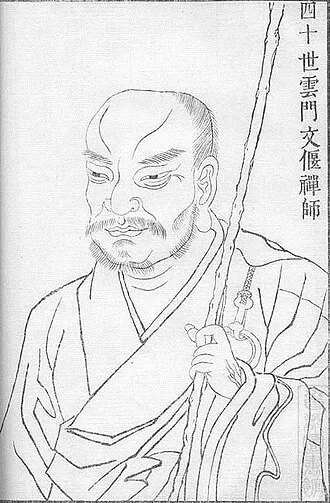
The Yunmen school (雲門宗) is one of the Five Houses of Chan, founded by Yunmen Wenyan (864–949), a student of Xuefeng Yicun[1]. It is renowned for the extraordinary economy and precision of its teaching language—Yunmen's responses were often a single word or phrase that functioned as a complete teaching, known as 'one-word barriers.'[1] His famous utterances include 'Every day is a good day,' 'A dried shit stick' (in response to 'What is Buddha?'), and 'The whole world is medicine—what is your self?'[1] The Yunmen school valued linguistic virtuosity not as literary display but as a form of direct pointing: each word chosen to cut through the student's conceptual mind with surgical precision. Xuedou Chongxian, the school's greatest literary figure, selected and composed verses on the hundred cases that became the basis for the Blue Cliff Record, arguably the supreme literary achievement of the Chan tradition[2]. Though the Yunmen school did not survive as an independent institution beyond the Song dynasty, its spirit permeated all subsequent Chan through the koan collections, and its emphasis on concise, powerful expression continues to shape Zen teaching style to this day.
Meditation practice
The Yunmen school’s practice centered on the ‘one-word barrier’ (yizi guan), in which the master’s single word or abrupt phrase functions both as a block to analysis and as a gate to realization[1]. Rather than encouraging long explanation, Yunmen training compresses the field of practice into an utterance so exact that it cuts off discursiveness on contact. Students contemplate phrases such as ‘Dried shit stick’ or ‘Every day is a good day’ until language stops behaving as commentary and starts acting as direct revelation. This style of practice trains immediacy, precision, and the ability to meet the whole situation without interpretive delay.
Prominent masters
Key texts
- Extensive Record of Yunmen
The complete sayings of the school's founder — the 'one-word barriers' ('Dried shit stick,' 'Every day is a good day'), the three statements, and encounter dialogues that set the template for Chan's compressed style.
- Blue Cliff Record
Xuedou — a Yunmen-school master — selected and versified the hundred cases that Yuanwu Keqin would later gloss into the Blue Cliff Record. The literary peak of Chan, and the main vehicle through which Yunmen's style survived after the school itself dissolved.
Key concepts
- One-word barrier
Yunmen's signature pedagogy: a single word or phrase that is simultaneously an obstruction to conceptual answer and a direct pointing to the mind. The most compressed form of koan in the Chan tradition.
- Three Statements of Yunmen
'Covering heaven and earth' (the absolute), 'cutting off all streams' (the function that stops conceptual mind), 'following the waves and pursuing the currents' (responsive activity). A compact diagnostic of any Chan teaching.
In the words of the masters
- Why Put on Your Robe?
The whole world is vast and wide. Why do you put on your robe at the sound of a bell?
- Dry Shit-Stick
What is Buddha? A dry shit-stick. The blunt phrase is the medicine for the polished mind.
- Every Day Is a Good Day
What about before the fifteenth of the month? I will not ask. After the fifteenth? Every day is a good day. The good is not in the calendar but in the willingness to meet whatever shows up.
- One-Word Barrier
What is the dharma? Suitable. What is the practice? Through. What is the highest matter? Look. One word, one barrier; pass it, and you walk.
- Three Statements of Yunmen
A statement that meets heaven and earth; a statement that follows the waves; a statement that cuts off all streams. Use them in turn — never as a formula, always as a fit.
- Bell and Robe
When the bell rings, why do you put on the seven-piece robe? The bell does not require the robe; the robe does not require the bell. Yet when the bell rings, the robe goes on. That is the practice.
Masters in this branch
Yunmen practice centres
China
Sibling branches of Qingyuan line
Sources in use
- Chart of the Chan Ancestors
- Zen Editorial Overlay - Originals Curation