Buddhanandi
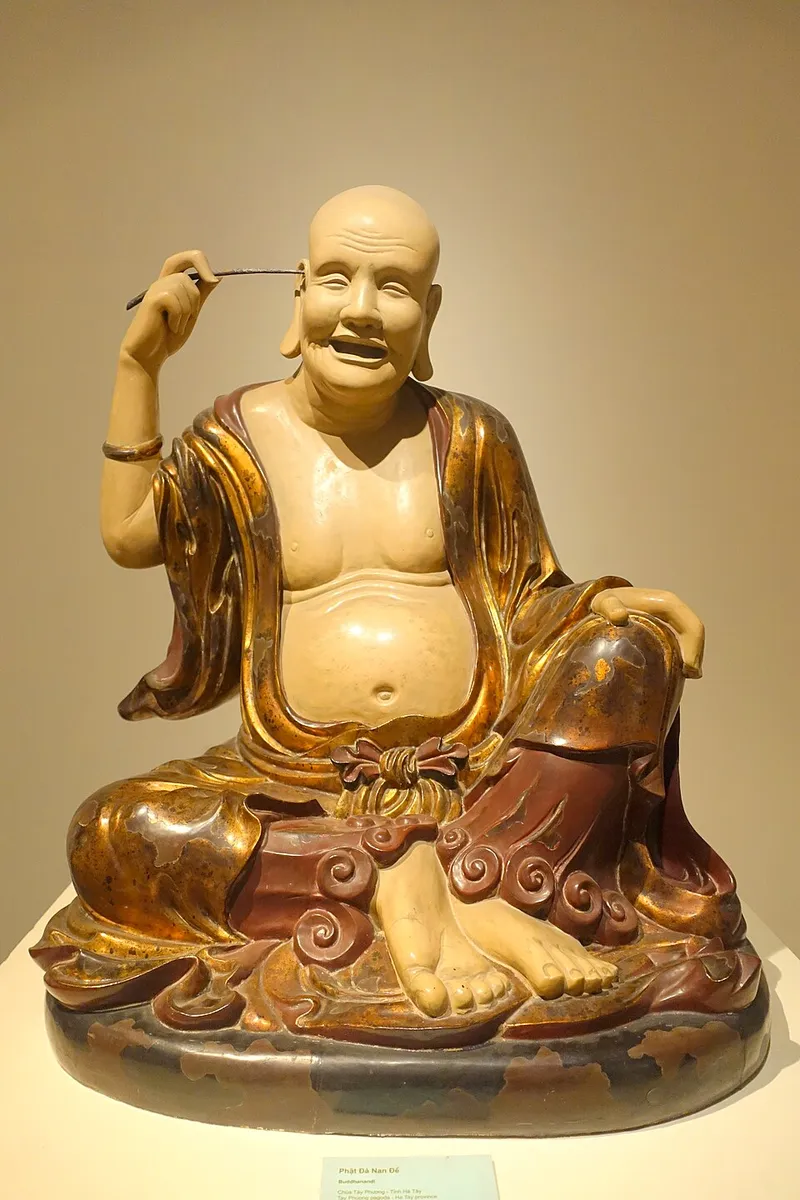
Buddhanandi
2nd c. BCE – Unknown
Buddhanandi ("Delight of the Buddha"), eighth patriarch in the Chan list, is named in the *Jǐngdé Chuándēng Lù* as the disciple of Vasumitra and teacher of Buddhamitra[1]. He belongs to the legendary middle stratum of the lineage and is not securely attested outside Chan transmission-of-the-lamp literature. The traditional account describes a young brahmin from Kāmarūpa (modern Assam) recognized by Vasumitra during a teaching tour and brought into the lineage after a brief exchange.
Dumoulin notes that the names in this section of the list often appear in pairs whose etymologies are suggestive (here Buddhanandi paired with Buddhamitra: "Joy of the Buddha" and "Friend of the Buddha"), reflecting the literary character of the construction[2].
Names
Disciples of Buddhanandi
Teachers and lineage of Buddhanandi
Teacher / root master:
Teachings
- dialogueThe Star That Does Not Move
When Vasumitra was about to transmit the Dharma, he asked Buddhanandi: 'A star shines in the north that does not move while all other stars revolve around it. What is this star?' Buddhanandi said: 'Every star is that star.' Vasumitra said: 'And what revolves around you?' Buddhanandi said: 'Nothing has ever moved.' Keizan's verse: The pole star holds its place / not through effort but through stillness. / Ten thousand thoughts arise and pass— / the one who watches does not stir.
A student asked Buddhanandi: 'When the bell is struck, where does the sound go?' Buddhanandi said: 'Ask where it came from.' The student was silent. Buddhanandi said: 'You hear the silence now. Has it gone anywhere?'
Other masters in Indian Patriarchs
Master Record Sources
- datesZen Editorial Overlay - Originals Curation
trad. 2nd c. BCE
- nameZen Editorial Overlay - Originals Curation
Buddhanandi
- schoolZen Editorial Overlay - Originals Curation
Indian Patriarchs
- teachersZen Editorial Overlay - Originals Curation
Vasumitra
Buddhanandī is counted the eighth Indian patriarch in Chan/Zen reckoning; the Tibetan Buddhist Encyclopedia preserves the traditional account of his transmission in the patriarchal lineage.