Jiyu-Kennett
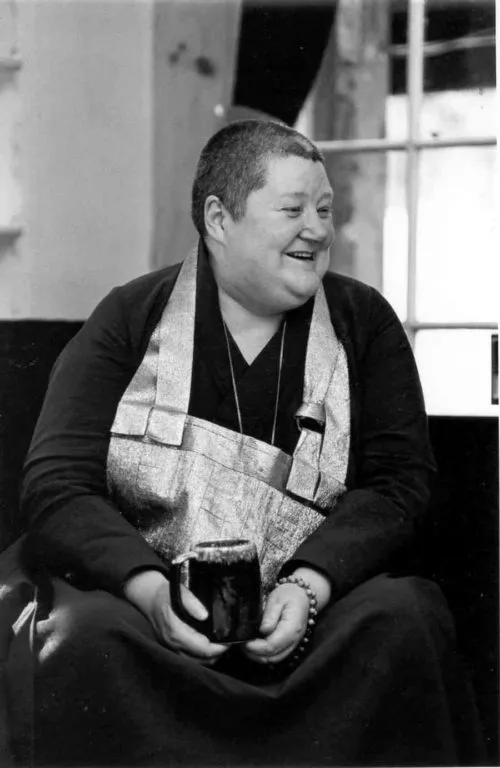
Jiyu-Kennett
1924 – 1996
Hōun Jiyu-Kennett (born Peggy Teresa Nancy Kennett, 1 January 1924, St Leonards-on-Sea, Sussex, England; died 6 November 1996, Mount Shasta, California) was the first Western woman to be sanctioned as a Sōtō Zen master in Japan and the founder of the Order of Buddhist Contemplatives (OBC). She studied medieval music at Durham University and held a scholarship at Trinity College of Music in London — a background that would later shape one of her most distinctive contributions, the use of plainchant for English-language Buddhist liturgy[1]. After initial ordination as a novice in 1962 by Venerable Seck Kim Seng in the Linji (Rinzai-line) Chinese Chan tradition in Malaysia — where she received the Buddhist name Jiyu — she travelled to Japan and trained from 1962 to 1963 at Sōji-ji, one of the two head temples of Sōtō Zen, under chief abbot Kōhō Keidō Chisan Zenji, with day-to-day instruction from Suigan Yogo Roshi. She received Dharma transmission on 28 May 1963 and was appointed Foreign Guest Hall Master at Sōji-ji[1].
Kennett returned to the West and in 1969 founded the Zen Mission Society in San Francisco; in 1970 she established Shasta Abbey at Mount Shasta in northern California — described as "the first Zen monastery in the United States to be established by a woman" — and in 1972 founded Throssel Hole Priory (now Throssel Hole Buddhist Abbey) in Northumberland, England. In 1978 she renamed the wider organisation the Order of Buddhist Contemplatives, formalising a Sōtō-rooted Western monastic order with celibate priests, distinctive black robes, and a vow-based community structure adapted to Anglophone life[1]. A central plank of her project was liturgical translation: she rendered the Sōtō service into English and set it to plainchant in the style of Gregorian chant — a deliberate inculturation that drew on her Durham musicology training so that Western practitioners could chant their own scriptures rather than transliterated Japanese[1].
Her published works are central to the lineage she founded. *Selling Water by the River: A Manual of Zen Training* appeared from Pantheon Books in 1972, later re-issued and expanded as *Zen is Eternal Life* (Tuttle Publishing, 1999); *The Wild, White Goose: The Diary of a Zen Trainee* was published by Shasta Abbey Press in 1978; and *How to Grow a Lotus Blossom, or How a Zen Buddhist Prepares for Death* — based on visions experienced during a serious illness — appeared from Shasta Abbey Press in 1993[1]. After her death the two-volume *Roar of the Tigress: The Oral Teachings of Rev. Master Jiyu-Kennett* was edited by her successor Daizui MacPhillamy and published by Shasta Abbey Press in 2000[2]. Her named Dharma heirs include Haryo Young (Head of the Order), Meian Elbert (Abbess of Shasta Abbey), Daishin Morgan (former Abbot of Throssel Hole) and Daizui MacPhillamy[1] — together carrying forward what the OBC calls the "Serene Reflection Meditation" (Sōtō Zen) tradition in English[3].
Names
Teachers and lineage of Jiyu-Kennett
Teacher / root master:
Works
- Dharma manualSelling Water by the River: A Manual of Zen Training
Kennett's first major book; the foundational manual of the Order of Buddhist Contemplatives' Sōtō training. Later reissued under the title *Zen is Eternal Life* (Shasta Abbey Press) after her break with the institutional Sōtōshū.
- Dharma-talks collectionRoar of the Tigress (Vols. I–II)
Two-volume posthumous collection of Kennett's dharma talks at Shasta Abbey, transcribed and edited by her OBC successors after her 1996 death.
- Spiritual autobiographyHow to Grow a Lotus Blossom: Or How a Zen Buddhist Prepares for Death
Kennett's account of the extended visionary experience she went through in 1976–77 during a serious illness, framed as preparation for death and a sustained meditation on Buddhist eschatology.
- Institutional siteShasta Abbey — shastaabbey.org
The Shasta Abbey monastic training centre in Mount Shasta, California, which Jiyu-Kennett founded in 1970 as the head temple of the Order of Buddhist Contemplatives; carries the abbey's training schedule and the Shasta Abbey Press catalogue.
Teachings
- proverbZen Is Eternal Life
There is no death in this practice — only the falling away of forms. The form falls; the practice continues in another form. Whoever has truly sat knows there has never been a death.
- proverbMonastery Rule for One
If you cannot live by the monastery rule, write a monastery rule for one — and live by it as if a hundred others were watching. They are not, but the dharma is.
- proverbFemale Master
I was the first Western woman to be transmitted in our line. They said I would not last. The dharma did not consult them, and I am still here.
Other masters in Sōtō
Master Record Sources
1924-1996
Jiyu-Kennett
Soto
Keido Chisan
1924-1996
Jiyu-Kennett
Soto
Keido Chisan