Tiantong Rujing
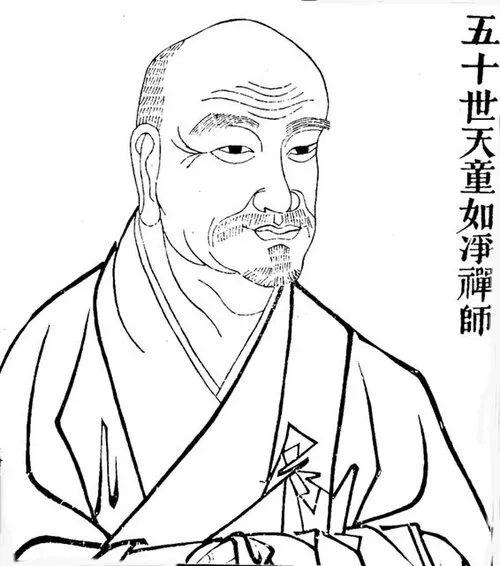
Tiantong Rujing
1163 – 1228
Tiantong Rujing (天童如淨, 1163–1228) was the Caodong master under whom Dōgen received Dharma transmission at the Tiantong-si monastery near Mingzhou between 1223 and 1227, and is thus the figure through whom the Caodong stream entered Japan as Sōtō Zen[1]. He was a Dharma heir of Xuedou Zhijian (also known as Zu'an Zhijian, 1105–1192), held the abbacy at Tiantong from 1224 until his death, and counted at least six "intimate Dharma heirs" — best-documented among them Dōgen himself, Jakuen (whose heir Giun would become the 5th abbot of Eihei-ji in 1314), and the Chinese monk Wuwai Yiyuan who much later (1242) sent Dōgen's collected *yulu* to Eihei-ji as the principal Chinese sanctioning document for the Japanese line[1][2].
Dōgen's *Hōkyō-ki* (寶慶記) records Rujing's instruction in extensive detail and is one of the principal early-Sōtō sources for the doctrine of *shēnxīn tuōluò* / *shinjin datsuraku* (身心脱落, "body-mind dropping away") that Dōgen would make central to his own teaching of *shikantaza*. Rujing's emphasis on *zazen* against the other Buddhist practices then in fashion — *nianfo*, vinaya formalism, incense-burning — and his distance from the Caodong silent-illumination polemics of the previous generation, shape the immediate background of Dōgen's mature thought[3].
Modern textual-critical scholarship (notably Steven Heine, *Did Dōgen Go to China?: What He Wrote and When He Wrote It*, OUP 2006) has problematised much of the canonical hagiography around the Rujing-Dōgen transmission while accepting the underlying historical event: the *Hōkyō-ki* survives only as an undated, posthumously-circulated text in three divergent recensions (Rinnō-ji 1598 / printed 1672 / Eihei-ji manuscript discovered 1937); Dōgen's distinctive term *shinjin-datsuraku* (身心脱落) is unattested in Rujing's own Chinese sources, where the comparable phrase is the homophonic *xīnchén tuōluò* (心塵脱落, "mind-dust dropping off") — a possible Dōgen mishearing or interpretive transformation has been a live scholarly possibility for two decades. The Eihei-ji transmission certificate (a Japanese National Treasure) is judged by Bodiford as "most certainly a medieval forgery"; the Kenzeiki (1452) and Menzan's 1752 glossed Sōtō biographical tradition introduce additional hagiographic episodes that are absent from contemporary Chinese sources, which terminate at Rujing's master Zhijian and contain no Song-era record naming Dōgen or any other heir of Rujing[4].
Names
Disciples of Tiantong Rujing
Teachers and lineage of Tiantong Rujing
Teacher / root master:
Teachings
- dialogueDrop Off Body and Mind!
During the early morning zazen, Rujing addressed the assembly: 'Studying Zen is the dropping off of body and mind.' Hearing these words, Dogen was suddenly and completely awakened. He went directly to the abbot's room and burned incense. Rujing asked, 'Why are you burning incense?' Dogen said, 'Body and mind have been dropped off.' Rujing said, 'Body and mind have been dropped off. The dropped-off body and mind.' Dogen said, 'This is only a temporary ability. Please do not give me your approval carelessly.' Rujing said, 'I am not giving you approval carelessly.' Dogen asked, 'What is this not giving approval carelessly?' Rujing said, 'Body and mind dropped off!'
Zazen is the Dharma gate of ease and bliss. Do not burn incense, make prostrations, practice nembutsu, perform penance, or read sutras. Just sit and get the business done. Zazen is not the practice of dhyana that is one of the six paramitas. It is not a method among methods. It is the Dharma gate of all the Buddhas. Do not exchange it for anything else.
- proverbBody and Mind Drop Away
Body and mind drop away — that is the practice. The student who tries to drop them on purpose finds them stuck more firmly. Sit until the body forgets itself; the rest is automatic.
- proverbDo Not Burn Incense for Show
Do not burn incense for show, do not bow for show, do not chant for show. The dharma does not need an audience; you need a few honest mornings.
Other masters in Caodong
Master Record Sources
1163-1228
Tiantong Rujing
Caodong
- datesZen Editorial Overlay - Originals Curation
1163-1228
- nameZen Editorial Overlay - Originals Curation
Tiantong Rujing
- teachersZen Editorial Overlay - Originals Curation
Xuedou Zhijian