Hongzhi Zhengjue
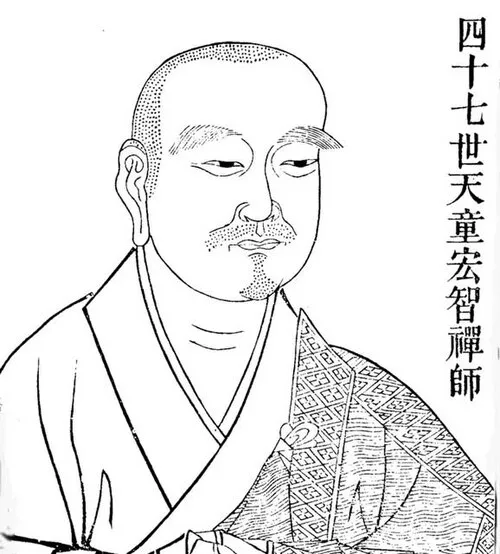
Hongzhi Zhengjue
1091 – 1157
Hongzhi Zhengjue (宏智正覺, 1091–1157) was the great Southern-Song Caodong master and the foremost articulator of *mòzhào chán* (默照禪, "silent illumination Chan"). He served as abbot of Tiantong-si (天童寺) near Mingzhou for thirty years and built it into the major Caodong centre of the twelfth century[1]. His prose poem *Mòzhào Míng* (默照銘, "Silent-Illumination Inscription") and his hundred verse-comments on koan cases — preserved in the *Hongzhi Songgu* and later assembled by Wansong Xingxiu into the *Cóngróng Lù* (從容錄, "Book of Serenity") — are the canonical statements of the silent-illumination practice and the Caodong literary-koan tradition that paralleled the Linji *Bìyán Lù* line[2].
Hongzhi's championing of silent illumination occasioned the famous polemic by his Linji-line contemporary Dahui Zonggao against *mòzhào* as a "dead-tree" quietism — though Dahui's earliest named targets were in fact Hongzhi's dharma-brother Zhenxie Qingliao (Changlu Qingliao) and the broader Caodong revival generation, not Hongzhi personally. Schlütter's *How Zen Became Zen* reads the controversy as institutional in stakes (competition for *shifang* public-monastery abbacies and gentry / literati patronage) at least as much as doctrinal[3]. The two men's relationship at the personal level was cordial: their monasteries were ~20 li apart, with mutual visits, Hongzhi sending food during shortages, and Hongzhi asking Dahui from his deathbed to officiate the funeral, which Dahui did. Hongzhi's doctrinal influence on the Japanese Sōtō understanding of *shikantaza* is direct and textual — Dōgen quotes him extensively — but the *lineage* line into Japan does not run through Hongzhi: it runs through his Danxia Zichun dharma-brother Zhenxie Qingliao → Tiantong Zongjue (who succeeded Hongzhi as abbot at Tiantong-si but received transmission from Qingliao, not Hongzhi) → Xuedou Zhijian → Tiantong Rujing → Dōgen. Wansong Xingxiu (1166–1246), compiler of the *Cóngróng Lù*, is the *textual* transmitter of Hongzhi's koan-comment corpus into the form Dōgen actually quoted, not a dharma-chain node on the way to Japan[4].
Names
Teachers and lineage of Hongzhi Zhengjue
Teacher / root master:
Works
- Book of SerenityBook of Serenity (Cóngróng Lù)
Hongzhi Zhengjue (1091–1157) selected and versed 100 kōans; a generation later Wansong Xingxiu added prose commentary, producing the Caodong/Sōtō counterpart to the Blue Cliff Record. The collection emphasises silent illumination (mòzhào) and the subtle dialectic of Caodong rather than dramatic encounter, and circulates today as the standard kōan curriculum on the Sōtō side of the lineage.
Teachings
- proverbIn Silence, In Clarity
In silence, words are forgotten. In clarity, things appear.
- sermonSilent Illumination
In silence and clarity, the mind is luminous and vast. In stillness and openness, awareness is bright and unobstructed. Silently and serenely, all words are forgotten. Clearly and vividly, it appears before you. When you turn the light around and shine it inward, you find there is nothing at all to know. Luminous and clear, you rest in quiet illumination. The clouds disperse, the waters are still. The autumn sky is brilliant. The empty vessel rides the light.
- proverbSilent Illumination
Sitting silently, the mind illumines without reaching. Illuminating without reaching, the world arises in the silence — not added on, not pushed away.
- proverbEmpty Field
Cultivate the empty field. Do not till it; do not seed it; do not weed it. Yet from the empty field, every grain of rice we eat at this monastery has come.
- proverbWide Pond, Single Reed
A wide pond and a single reed at its edge — that is the proper proportion of the meditation hall. Too many reeds and the pond is hidden; too wide a pond and the reed is forgotten.
- proverbDo Not Grasp Stillness
If you sit and grasp at stillness, the stillness becomes another form of activity. Sit and let stillness arrive; do not invite it; do not refuse it; serve it tea when it comes.
- proverbMoon and Pond
When the bright moon enters the pond, the pond is not deeper for it. When the moon leaves, the pond is not shallower. The pond's practice is to receive without recording.
Other masters in Caodong
Master Record Sources
1091-1157
Hongzhi Zhengjue
Caodong
- koan_refsChart of the Chan Ancestors
See Note 1
- datesZen Editorial Overlay - Originals Curation
1091-1157
- nameZen Editorial Overlay - Originals Curation
Hongzhi Zhengjue
- teachersZen Editorial Overlay - Originals Curation
Kumu Daocheng